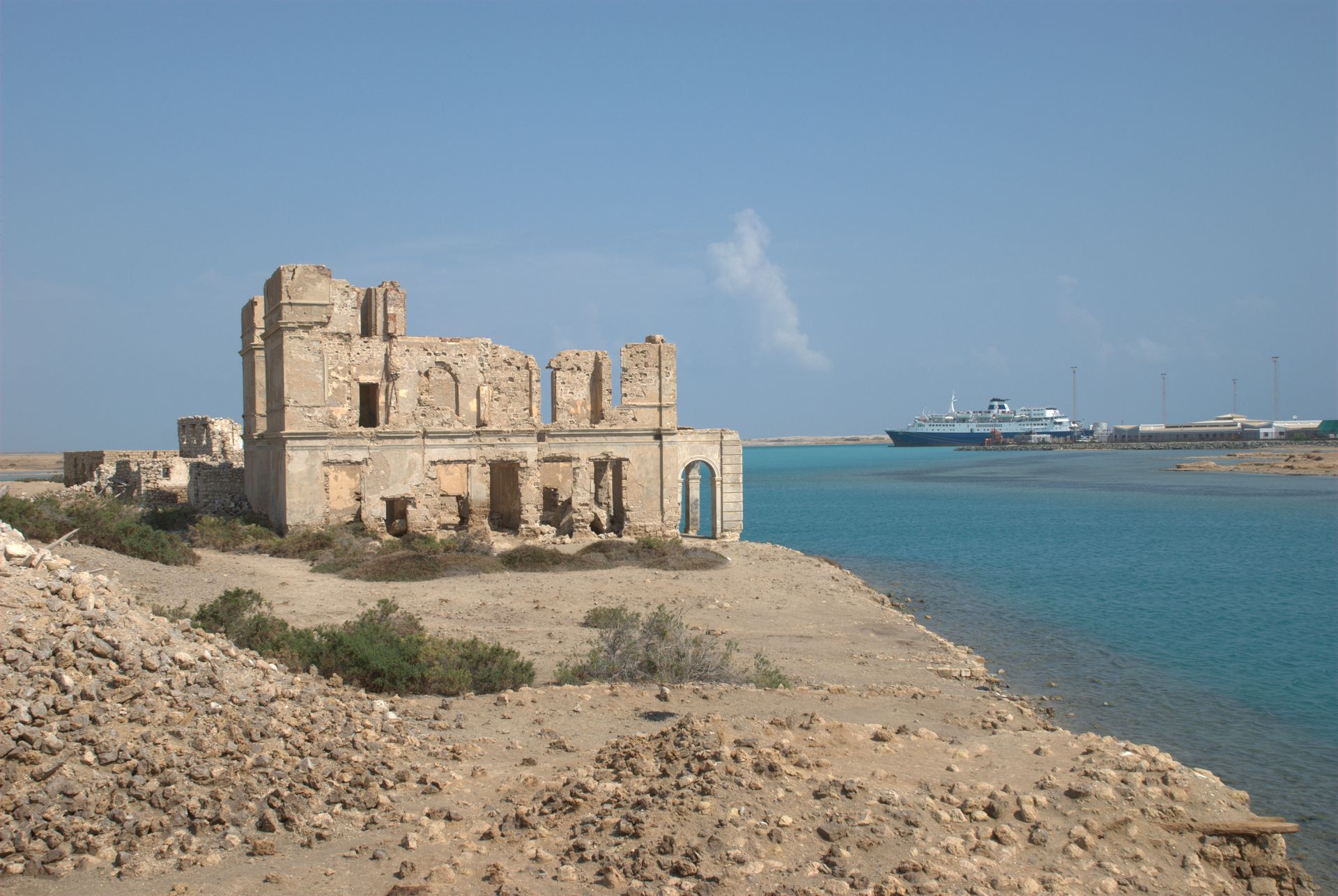
Suakin, Sudan, November 2008. Photograph by Bertramz. Location photograph, unmodified. Wikimedia Commons · CC BY 3.0.

A Swiss-held print, a restoration unit in Cairo, a distributor in Berlin and a Sudanese association in California all appear in the recent history of The Dislocation of Amber. The Roxie cinema’s September 2026 programme connects them. Hussein Shariffe’s film had reached another screen, half a century after it was made. Roxie programme
Made in 1975, The Dislocation of Amber takes the Red Sea port of Suakin as its setting. Shariffe’s own filmography credits the Sudanese Department of Culture Film Unit as producer, Abdel Moneim Aladawy as cinematographer and Allan Ballard as editor. It records a running time of 32 minutes and identifies Abdel-Aziz Dawoud’s singing as part of the soundtrack. These names matter together. The work preserved today carries the labour of a group of Sudanese and international collaborators. Shariffe’s filmography
The film also asks us to think about how a city is represented. Architectural historian Nancy Um, in her study of Suakin’s architectural imagery, draws attention to a particular quality of Shariffe’s work: its ruins are inhabited by people. Her observation offers a useful question for the film’s later audiences. Whose lives become visible when a place is remembered through images of its buildings? Nancy Um’s study
The film’s later survival depended on material held in several places. In his 2025 study of its damaged digital circulation, film scholar Laurence Kent identifies a 16mm print and a Betacam copy at Arsenal in Berlin, alongside a different 16mm print in the Cinémathèque suisse. He also describes digital versions with uncertain histories. The evidence leaves gaps in the itinerary of each copy. A custodian needs to establish which version is held, how it was made and its condition. Kent’s study
Family work helped reconnect the scattered materials. A September 2024 account from King’s College London records that Eiman Hussein began gathering her father’s films and documents after his death in 2005. Papers previously kept in family homes in Cairo and Khartoum travelled to London, and a research team brought his document archive to King’s in 2022 for cataloguing and digital copying. Eiman Hussein, Erica Carter, Sudan Film Factory, Cimatheque and Arsenal collaborated. These papers preserve a route into the film’s working relationships and production history. King’s account of the archive
The effort to find audiences was already under way before the new restoration. Arsenal’s December 2020 programme included The Dislocation of Amber and a discussion about Suakin, with collaborator Sondra Hale and anthropologist Ahmad Al-Shahi. King’s then announced a BFI Southbank study day for 7 January 2023, pairing Shariffe’s films with conversations among family, researchers and curators. These records show a sustained effort to bring the work back into discussion. They also place people who knew the filmmaker beside those encountering his cinema later. Arsenal’s 2020 programme · BFI study-day announcement
War disrupted the possibility of carrying this work back into Sudan. In May 2023, King’s reported that an international series of screenings and workshops had been intended to culminate in workshops in Khartoum that year. Following the outbreak of fighting, the partners shifted attention towards safeguarding collections and reaching Sudanese communities across borders. The geographical distance between an archive and its audiences had acquired a new urgency. A secure copy abroad could preserve the possibility of a future screening while the practical conditions for that screening at home remained uncertain. King’s May 2023 report
For The Dislocation of Amber, the restoration record becomes precise in 2025. Il Cinema Ritrovato credits Cimatheque–Alternative Film Centre with restoring the film from a 16mm positive print supplied by the Cinémathèque suisse. A positive print is a copy made for viewing, a different material from a camera negative. The credit identifies the actual source used for this restoration. Its earlier history and other production materials still need documentation. Bologna restoration record
The restoration also formed part of a training effort. Cimatheque and Sudan Film Factory’s Remastered programme advertised four months of on-site work in Cairo, from February to May 2025. Its curriculum combined film handling and digitisation with restoration ethics, image repair, colour grading and sound restoration. The programme targeted experienced post-production practitioners and planned practical work on two short films. This gives a sense of the skills that preservation requires, though a course announcement alone cannot establish what was done to every frame of a particular film. Cimatheque’s training programme
The restored film’s circulation also needs a careful chronology. It was announced for Forum Expanded at Berlinale 2026, but the festival’s own film page records its withdrawal by Cimatheque in consultation with the filmmakers’ families. The entry documents a planned appearance and its cancellation. Later records trace other routes to audiences: Il Cinema Ritrovato listed the restored film at Bologna’s Jolly cinema on 22 June 2026, in Arabic with English subtitles. Berlinale withdrawal notice · Bologna screening record
In September, Arsenal programmed the restoration with Eiman Hussein, Cimatheque’s Tamer El Said and Sudan Film Factory’s Talal Afifi as guests, the latter joining online. Across the Atlantic, the Roxie’s 26 September listing named SF IndieFest and the Sudanese Association for Northern California as co-presenters, and Arsenal as the supplier of the digital cinema package. A usable exhibition copy and people able to programme it brought these links together. Audience counts remain undocumented in these records. Arsenal screening record · Roxie screening record
This work sits within a larger effort to give endangered film archives a future. AFAC’s record for Rewind Forward identifies Cimatheque and Sudan Film Factory as partners in a 27-month project encompassing restoration, training and creative reuse. That programme provides a wider institutional setting for the archival work. The individual restoration and screening credits remain the evidence for what happened to The Dislocation of Amber. Rewind Forward project record
The remaining question is how the film reaches people who cannot attend those cinemas. For this draft, checked on 7 November 2026, a current authorized full-film stream of The Dislocation of Amber remains unverified. Kandaka’s Library links to a paid DAFilms stream of Sad Song of Touha, the Atteyat Al-Abnoudy film also restored by Cimatheque, while the platform’s streaming edition is unspecified. Such differences belong in the record. A programme listing, a working stream and an agreement permitting community screenings each provide a different kind of access. Kandaka Library · DAFilms listing
For Sudanese film preservation, this history suggests a practical place to begin: record surviving copies and their custodians, preserve production papers, train people to handle the materials, and plan how a restored work will be shown. Budgets need to cover those continuing relationships as well as the technical work. Family members and Sudanese cultural organisations should help shape decisions about description, translation and audiences. These are proposals drawn from the history, requiring agreements and resources appropriate to each collection.
The Dislocation of Amber has endured through the care of people and institutions able to connect its scattered traces. The Swiss print, the Cairo restoration and the later programmes are stages in that continuing work. Each new audience gives the film another opportunity to enter Sudanese cultural conversation. Sustaining that opportunity is part of what preservation asks of us.