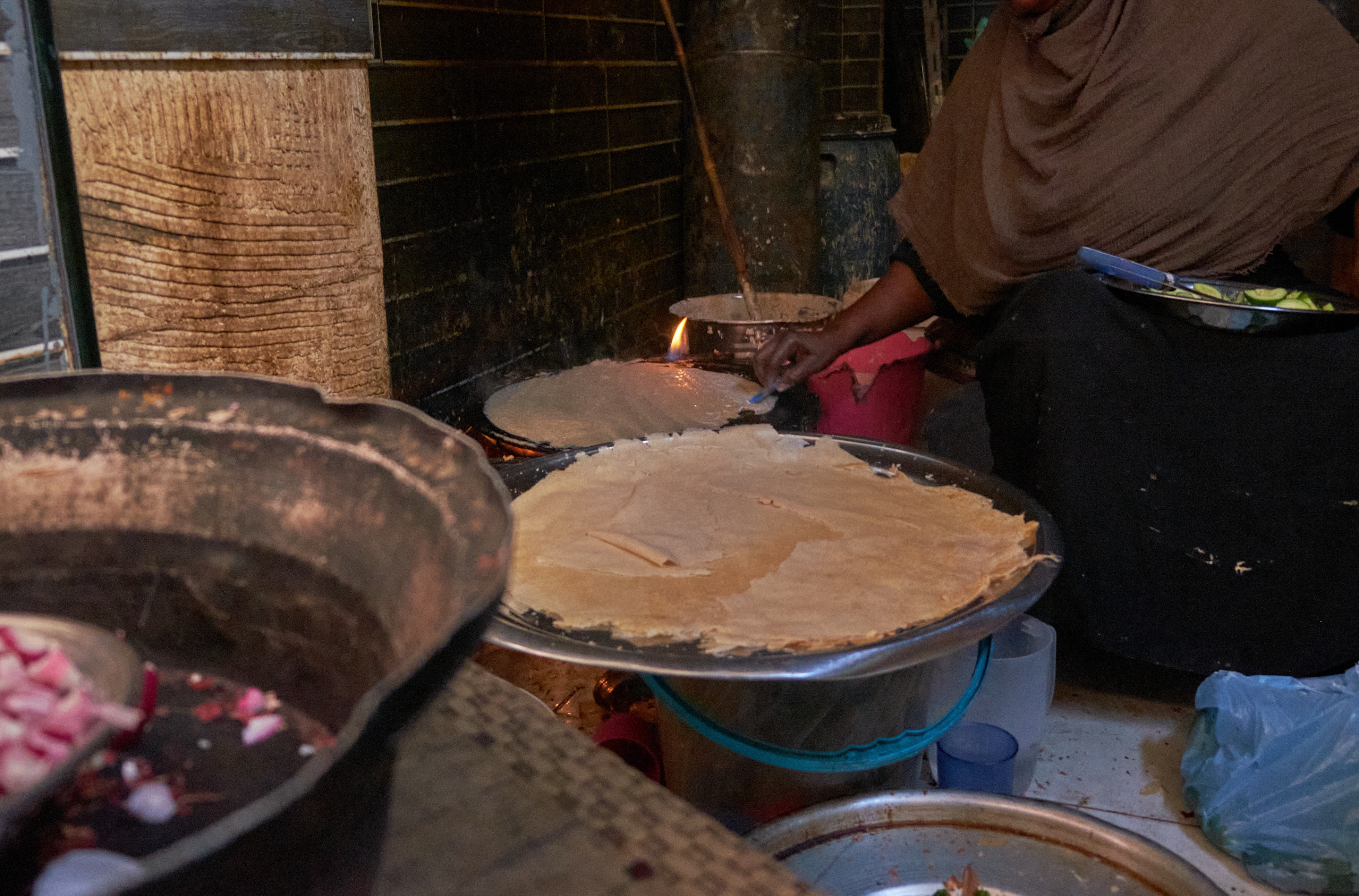
Photo: Evon2023, 11 June 2023. Sudanese kisra preparation; precise locality not supplied. Original photograph, CC BY-SA 4.0. Unmodified.

A photograph of kisra being made contains a small lesson in attention. The batter is spread across a hot surface; beside it, finished sheets lie folded over one another. What looks simple on the plate depends on a practiced movement at the stove. Flour and water alone do not explain the result. The cook matters.
Kisra and asida are a good place to begin a history of Sudanese food because they invite us to look closely at something familiar. They also resist the easy story in which every beloved dish must have been invented by a named ancient people and remained unchanged ever since. Their more interesting history concerns ingredients, technique, memory and variation.
A thin sheet, a different kind of bread
Kisra is not an oven loaf made smaller. FAO’s account of fermented cereals describes a thin sorghum bread made by fermenting a flour-and-water mixture, adjusting its consistency and cooking it on a hot surface. The fermentation contributes its characteristic sourness. This is a documented preparation method, not a rule that every household follows identically. FAO: fermented cereals
That distinction changes how we appreciate it. A loaf invites us to notice its rise and crumb. Kisra invites attention to thinness, flexibility and the balance between bread and the food eaten with it. It belongs in a food story as a finished pleasure, not merely as a useful way of consuming a crop.
Sorghum itself deserves recognition. FAO’s work on sorghum and millet places kisra within a wider family of fermented cereal foods, while distinguishing it from Ethiopian injera. Related ingredients or techniques do not make two foods interchangeable. Neither does a shared regional history make a Sudanese dish less worth knowing on its own terms. FAO: sorghum and millets in human nutrition
Asida changes the texture of the meal
Asida offers a different encounter with grain: a thick, cooked preparation rather than a thin sheet. The photograph here records a Sudanese serving with mulah tagalia. It shows one pairing, not the only correct version or a national recipe with fixed proportions.
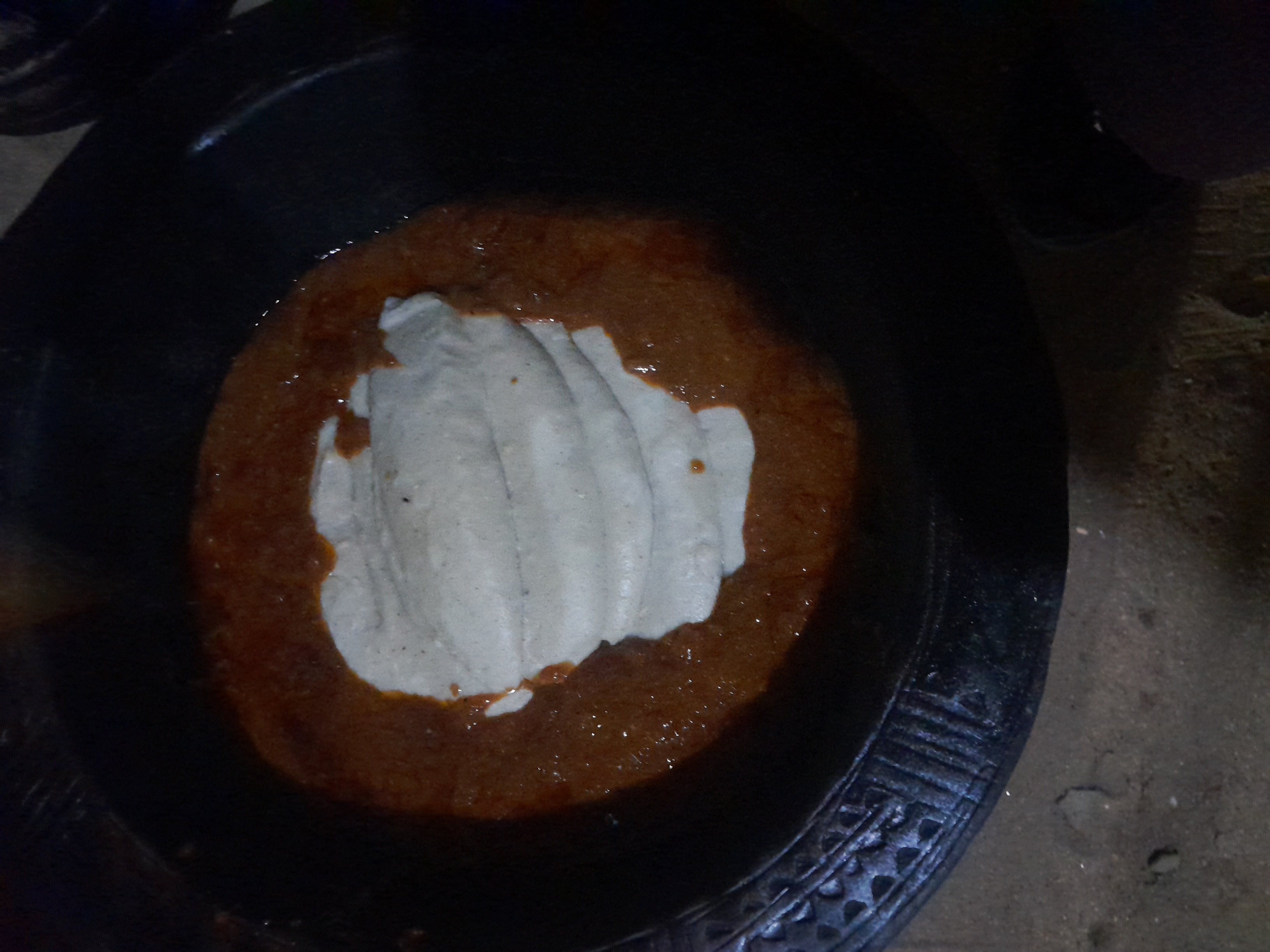
Photo: شيراز شوشو (Shiraz Shosho), 2025. The source identifies the dish as asida with mulah tagalia. Its written date and camera metadata differ, so no exact capture day is asserted. Original photograph, CC0. Unmodified.

The contrast between these two dishes is useful without becoming a competition. A thin bread and a substantial porridge-like dish can begin with related raw materials yet produce quite different meals. Texture is part of food history, as much as the names of ingredients. So are the utensils, the way a sauce is served and the skill needed to judge when something is ready.
Whose tradition are we describing?
Research on Ernetta Island in northern Sudan offers an important corrective to talk of a single timeless national kitchen. Published in 2022, the study records household demonstrations of kisra-making and memories of changing grains, milling and bread consumption. It also notes that savoury sorghum asida was more common elsewhere in Sudan than on the island. These are observations from a particular community, not a survey of the whole country. Ryan and colleagues: Ernetta food study
This is where a food feature becomes more interesting than a list of national favourites. Ask two cooks what they call a preparation, which flour they use, or what they learned from an older relative, and the differences are worth preserving rather than correcting into one standard version. A recipe can be authentic to a household without standing for every household.
How far back can the story go?
There is a difference between the history of a crop and the birthday of a dish. A study of impressions in pottery from eastern Sudan finds evidence relevant to sorghum domestication in the fourth millennium BCE. That is evidence about a plant and its cultivation—not proof that today’s kisra or asida existed in their present forms at that time. Winchell and colleagues, 2017
The distinction need not spoil the pleasure. It allows several histories to sit beside each other: the long story of grain, the more specific evidence for cooking methods, and the memories that people can actually relate about their own kitchens. We should not fill gaps between them with a confident ancient-origin tale simply because it makes an attractive headline.
Nor should we treat change as the loss of all authenticity. A different stove or mill does not automatically erase a cook’s knowledge. The interesting question is what changes in taste, texture, effort and everyday use—and what the cook chooses to keep.
A place at the table
Kandaka’s development focus does not require every plate to become an export strategy. There is value in learning how a food is made, giving its makers credit and enjoying the differences between one meal and another. Recording that knowledge carefully is worthwhile in itself.
For a future reader-submitted series, the most useful contribution would not be a claim to own the oldest recipe. It would be a named dish, a place, a cook willing to share the method, and a photograph with a clear credit. Kisra and asida give us an inviting starting point: two familiar foods that reward a closer look.
Sources and scope
- FAO’s two linked publications support preparation and cereal context, not exact origins or universal recipes.
- The Ernetta study is a local ethnographic account; its observations are not presented as Sudan-wide prevalence estimates.
- The sorghum-domestication paper is used only for the distinction between crop history and dish history; no recipe continuity is inferred.
- These are real photographs, not generated scenes. No interviews or recipe testing were conducted for this article.