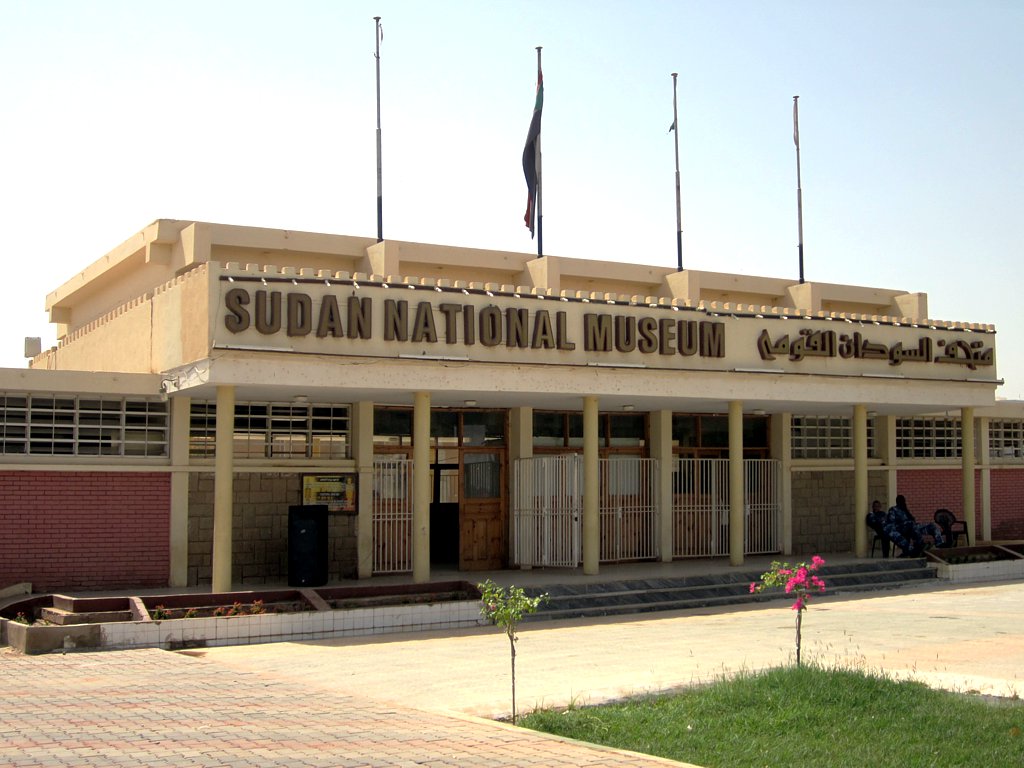
Sudan National Museum, Khartoum, 12 February 2013. Photograph: David Stanley, Wikimedia Commons, CC BY 2.0. Unmodified pre-war photograph; it does not establish the building’s present condition or visitor access.

More than a building full of objects
A museum object without its record may still be beautiful. But where was it found? Who made it? How did it enter the collection? What did it mean to the people who used it? Lose those connections and part of the evidence disappears, even if the object survives.
The same problem reaches beyond museums. A family photograph without a name, a recording without a language identified, or an archaeological site separated from local knowledge can become harder to understand with each passing generation. Protecting heritage is therefore also about protecting relationships between things, people and places.
In wartime, human safety comes first. That principle should shape heritage work, not erase it. Kandaka’s position is that supporting the people who care for collections and community memory belongs within recovery. It must never become an excuse to send civilians into danger or divert essential relief into prestige construction.
What the evidence says—and does not say
Habab Idriss Ahmed and Geoff Emberling’s 2025 Antiquity guest editorial records efforts by Sudan’s National Corporation for Antiquities and Museums, Sudanese professionals and international partners during 2023–2025. It is a valuable account from people connected to the work, not a comprehensive present-day inventory or independent evaluation of every intervention.1
Newer institutional records add an important qualification to a story told only through destruction. UNESCO reports conservation training at the Sudan National Museum in April 2026 and renewed rehabilitation commitments in July. The July account describes documentation and staff-workspace measures, while noting that wider rehabilitation depends on funding.23 Completion of a project phase is not proof that every collection is secure, that the whole building is restored or that visitors can safely return.
These sources also have different limits. Practitioners can explain decisions outsiders might miss, but a project’s own report is not an independent audit. Several announcements about the same initiative do not become several separate confirmations of its effectiveness. This article therefore avoids a supposedly definitive total of objects lost or recovered.
The first investment is in people
It is easier to photograph a restored room than the sustained work of a registrar or conservator. Yet a room cannot identify a displaced object, reconstruct a catalogue or decide how a fragile surface should be treated. Equipment without staff time and maintenance can quickly become another unused donation.
Kandaka proposes that heritage support begin with the conditions needed for people to work: safety assessment by qualified professionals, reliable compensation, suitable workspace, communications and access to specialist advice. None of this should imply that staff must remain at an unsafe site to prove commitment. Displacement does not cancel their expertise or their claim to participate in decisions.
Training should solve an identified need and leave a usable capacity. A short workshop can be valuable, but its attendance list is not evidence that a collection is protected. A better question is what staff can now document, store or monitor safely—and whether they have the resources to continue after the trainers leave.
Documentation should be useful, not merely digital
A photograph is a beginning, not a complete inventory. Records need consistent identifiers, descriptions, dates, sources and a clear distinction between observation and uncertainty. A report that an object is missing is not the same as confirmation that it was destroyed. A photograph shared online is not, on its own, proof of ownership, location or an illicit sale.
The Sudan Virtual Museum offers a concrete example. In an August 2026 project report, Ikhlas Abdllatief, Faïza Drici and Rennan Lemos describe digital access to museum galleries and the reconstructed tomb of Djehutyhotep, developed through collaboration with Sudan’s antiquities authority. This documents a particular initiative; it does not show that digitisation has secured every original object.4
A September 2026 King’s College London account of research by Laura Gibson, Sara El-Nager and Hannah Ishmael draws lessons from Sudan Memory: agree access and ownership with collection holders, support local skills, and retain oral histories and context alongside digital files. Its account of interviews with project contributors offers practical lessons, not an independent measure of national coverage or preservation success.5
Kandaka therefore proposes a distributed network linking museums, libraries, archives, universities and community custodians. Each participating collection would retain a clear say in access and interpretation, with compatible records and geographically separate backups. This is a proposed direction, not an existing nationwide service or a costed implementation plan. Digital copies should complement protection of original objects and places, never be treated as a replacement.
Digital systems should have maintained backups and named responsibilities. They should also work under realistic constraints: unstable connectivity, staff turnover and limited equipment. A database that only its foreign contractor can operate is a fragile form of assistance. Paper and offline working copies can remain important even when digital records improve access.
Not everything belongs on a public map. Detailed storage information, staff locations or vulnerable-site coordinates can create risks. Public transparency about spending and progress should coexist with controlled access to sensitive records. That is a governance decision, not a reason to hide all information.
Communities are not an audience added afterwards
Who decides which histories a rebuilt museum tells? A national institution should not reduce Sudan to one region, one religion or one celebrated era. Christian Nubia, Kushite history, Islamic traditions and the many other histories of Sudan belong within a plural account—not a contest in which recognising one requires erasing another.
Community involvement also needs substance. Neal Spencer’s account of the Amara West project describes both shortcomings in its original research design and a later shift towards local participation, including the community-owned Beit Abri lil-Turath. It is a useful practitioner reflection, not a template guaranteed to work everywhere.6
Mohamed Bashir’s September 2026 study draws on the Third and Fifth Cataract regions to argue that oral traditions and local place names can help researchers locate and interpret sites. It supports taking community knowledge seriously, while testing historical interpretations against material evidence. A remembered name or story does not, by itself, establish an ancient date or uninterrupted continuity.7
For Kandaka, a meaningful approach would give communities influence over interpretation and access, not simply invite them to an opening ceremony. Contributions should be credited; participation should be voluntary; sensitive memories should not be collected on the assumption that everything recorded must be published. Women, younger people, displaced residents and minority groups may have different priorities from the most visible local representatives.
Arabic access is essential for a national platform such as Kandaka, but bilingual Arabic–English publication is not the same as access in every Sudanese language. Projects should ask communities what formats and languages they need, rather than deciding for them.
Recovery is not an immediate tourism forecast
Heritage can support education, skilled employment and, where conditions permit, tourism. But a restored façade does not establish safe travel, operating services or a viable local business. Promising visitor income before those conditions exist can distort priorities and pressure communities to accept projects with uncertain benefits.
A phased plan would first ask what can be stabilised safely and what knowledge is at risk of being lost. It would then identify the staff, records and maintenance needed to sustain that work. Public access and commercial activities should follow realistic assessment, not serve as proof that recovery has already happened.
The same care applies to recovery of displaced objects. Responsible documentation and coordination with competent institutions are more useful than public accusations based on an image. This article does not offer legal determinations about particular objects or encourage readers to purchase suspected antiquities as a rescue strategy.
What success should look like
Success should be measured through conditions that can be checked: records that remain usable, staff able to work safely, conservation priorities explained, and communities able to influence decisions. Budgets should include continuing care, not only opening-day expenditure. An independently reviewed sample of work can be more informative than a large activity total.
There will be difficult choices. Not every structure can be restored immediately; not every memory can be recorded; not every international offer will fit local needs. Publicly explaining those choices is part of rebuilding trust.
Sudan’s memory is not a luxury to be considered once development is complete. Nor is it a collection of monuments that can substitute for living people. The task is to protect evidence and the people who give it meaning, so that recovery does not rebuild the country while narrowing the story it can tell about itself.
Habab Idriss Ahmed and Geoff Emberling, Archaeology and cultural heritage in wartime: Sudan 2023–2025, Antiquity, 2025. Guest editorial with a March–July 2025 update. ↩︎
UNESCO, Safeguarding Sudan’s Heritage in Times of Crisis, April 2026. Institutional activity report. ↩︎
UNESCO, Renewing Commitment to Sudan’s National Museum, 6 July 2026. Project reporting, not a present visitor-access advisory or independent assessment. ↩︎
Ikhlas Abdllatief, Faïza Drici and Rennan Lemos, Digitally preserving Sudan’s cultural heritage, Antiquity, 25 August 2026. Project Gallery; DOI: 10.15184/aqy.2026.10409. ↩︎
King’s College London, New report offers lessons for preserving cultural heritage in crisis zones, 7 September 2026. Institutional summary of Laura Gibson, Sara El-Nager and Hannah Ishmael’s Sudan Memory research; the claims here rely on that summary, not a full-report review. ↩︎
Neal Spencer, ResearchSpace? Genesis, ownership and access to archaeological data, 4 May 2021. First-person project reflection. The priorities proposed in this article are Kandaka’s analysis, not evaluated programme results. ↩︎
Mohamed Bashir, Pluriversal Pasts: Decolonising Archaeological Practice in Sudan through the Integration of Folklore and Community Epistemologies, Cambridge Archaeological Journal, 29 September 2026. Regional case studies and methodological argument, not a national impact evaluation. ↩︎