The work behind a portrait
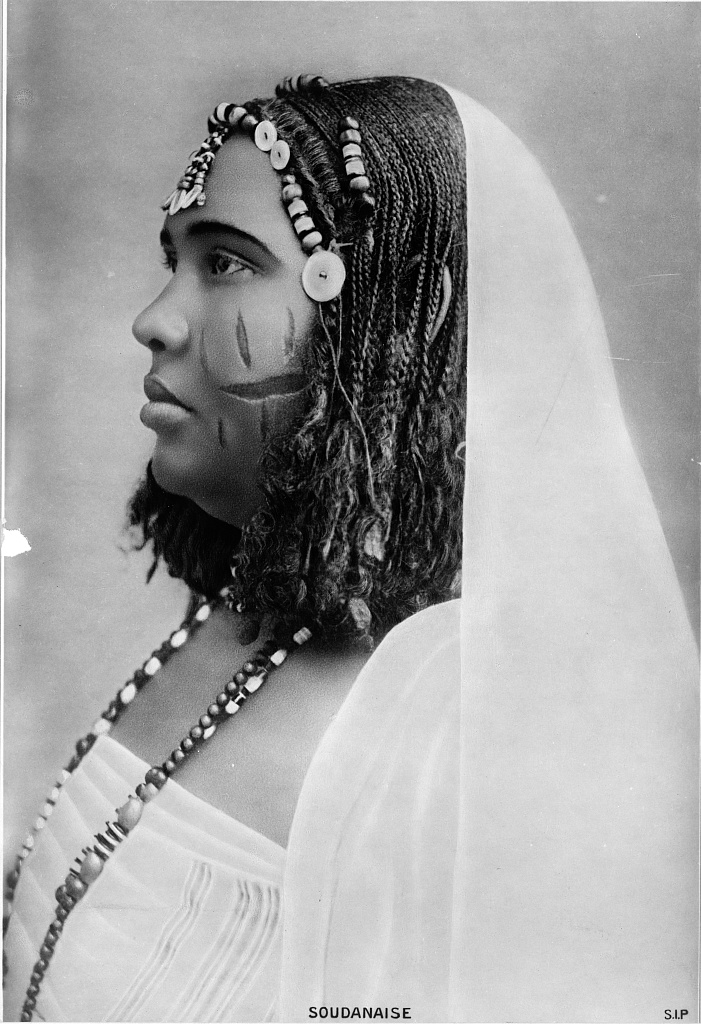
Look first at the hair. In a portrait catalogued by the Library of Congress as a Sudanese woman, dated somewhere between 1890 and 1923, fine braids run across the head and fall beside the face. Ornaments punctuate their lines. The photographer has left us an image, but not the name of the woman or the person who arranged her hair. Someone’s skilled work is visible even where the worker has disappeared from the record. Library of Congress — historical woman’s portrait
That is a useful beginning for a history of Sudanese hair. A hairstyle can be admired in an instant, while the knowledge required to make it takes much longer to acquire. The parting, the spacing, the handling of different lengths and the placement of decoration belong to a craft. The finished arrangement is also personal: it sits on a particular head, chosen or accepted by a particular person.
Women’s mushat and men’s grooming deserve to be considered together. Otherwise, beauty becomes a women-only subject and the male figures in old photographs become merely warriors, workers or officials. Men also made decisions about appearance. Their hair, beards, combs and head coverings belong in the history of taste.
This history is best read through specific examples. Sudan has never had a single hairstyle shared by every region or generation. Nor does a resemblance between two photographs, or between a living person and an ancient image, establish a line of inheritance across centuries.
An ancient object, a limited but valuable clue
At Penn Museum, a shell object from Buhen is catalogued as a hair ring, E10382. The museum dates it to the New Kingdom, 1539–1075 BCE. It is a small surviving clue to bodily adornment in ancient Nubia. It does not reveal an entire hairstyle, the identity of its wearer or the origin of modern mushat. Penn Museum — hair ring E10382
The distinction makes the object more interesting, not less. Instead of asking it to prove a grand claim, we can ask practical questions: how was it attached, what other objects accompanied it, and what did the excavators record? A comb, an ornament, preserved hair and a carved head offer different kinds of information. They should not be made interchangeable.
Ancient and medieval depictions require the same care. What appears to be hair may include a wig, a headdress or an artistic convention. A royal image is not a census of everyday grooming. A figure’s status and the purpose of the image matter as much as the shape around its face. These are reasons to build a history from dated examples rather than draw an uninterrupted line from Kush to a contemporary salon.
Medieval hair survives, but not every question has an answer
Hair itself survives from medieval Kulubnarti. A 2018 study by Walaa Basha and colleagues analysed hair from two cemeteries dated in the study to AD 550–800. Its purpose was to investigate diet through carbon isotopes, not to reconstruct hairstyles. The survival of hair and the identification of a fashion are different discoveries. This evidence brings actual people into the medieval story without supplying an imaginary catalogue of their cuts and braids. Basha et al. — Kulubnarti hair isotopes, 2018
Mushat and the woman who makes it
The word mushat brings the act of braiding and its cultural associations into the same conversation. The mushata, the woman who braids, deserves a place beside the finished style. A northern Sudanese survey published by Women’s Literacy in Sudan draws together accounts of braiders working within domestic and ceremonial life, including weddings. Its sources describe skill and social relationships as well as adornment. These are regionally situated accounts, not a rulebook for every Sudanese household. Hair Braiding in Northern Sudan, 2021
Consider what changes when the braider becomes the centre of the story. We begin to notice training, judgement, time and payment. We ask who taught her, which styles customers request, which tools she prefers and how she adapts a design. These questions recognise expertise instead of treating the finished braids as something that simply happens because a culture exists.
They also make room for disagreement. A style remembered fondly by one woman may have been inconvenient for another. An elaborate arrangement can be associated with pleasure, obligation, celebration or several of these at once. There is no need to choose between celebrating beauty and listening to the wearer.
Names matter, but they need their speakers. A catalogue of hairstyle names becomes much more useful when it records who uses each name, where and when. A family word should not automatically become a national classification. Nor should the meaning attached to a style in one community be imposed on another woman’s photograph.
A salon owner describes changing demand
In a report by Ikhlas Hussein for Al-Ra’i al-Aam, republished by Alnilin on 19 September 2013, salon owner Tahani al-Sayyid described turning her business towards braiding. The report recorded names including Sudan Gafal, Shabaka and Shatat. These names document a vocabulary in circulation at that moment; they are not proof that each style had one fixed national definition. Her account offers something valuable: a practitioner responding to customers, rather than a tradition frozen in a museum. Ikhlas Hussein — salon report, 2013
The distinction between a new name and a new technique matters. Names can travel quickly, while a technique may be adapted, combined with another or made fashionable again. A useful illustrated glossary would show the work alongside the name its maker uses. Without that pairing, readers may recognise the word but picture different arrangements.
Men’s hair and the khulal

Eastern Sudan offers a particularly useful route into men’s grooming. In its discussion of Griselda El Tayib’s work, Women’s Literacy in Sudan describes the khulal as a grooming implement with different forms, including single-pronged and multi-pronged examples. The same account relates it to carefully maintained Beja hairstyles. The account also describes a rounded form called tiffa and, for some men, plaits at the nape. Its illustrations and descriptions suggest a vocabulary of shape and grooming, not one universal Beja cut. These historical observations should not be presented as rules followed by every Beja man today. The Khulal — discussion of Griselda El Tayib
The tool changes how we see the hairstyle. Hair that an outsider describes as wild may be the result of deliberate maintenance. Volume, outline and the arrangement of strands can be choices. Calling a style untidy without understanding how it is made confuses an observer’s preference with the wearer’s intention.
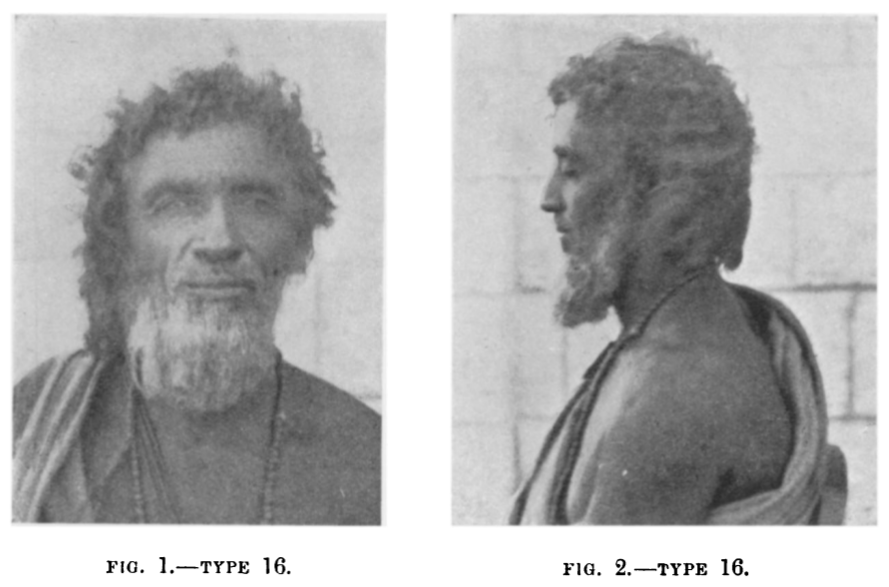
A paired portrait published in C. G. Seligman’s 1913 work shows a man identified in the source as Hadendowa, viewed from the front and side. His hair and beard are visible in both views. The original publication placed him within a racial classification; that framework is not a description Kandaka should adopt. The photograph can be considered as a historical image of a person without accepting the theory used to classify him. Its publication year is not a verified day of capture. Hadendowa portrait — publication 1913

There is another temptation to resist: making one historical portrait stand for all men of a community. A single sitter cannot establish the range of styles worn by younger and older men, town and rural residents, or people dressed for different occasions. The value of the image lies in its particularity.
A group at Wadi Halfa: variation within one photograph
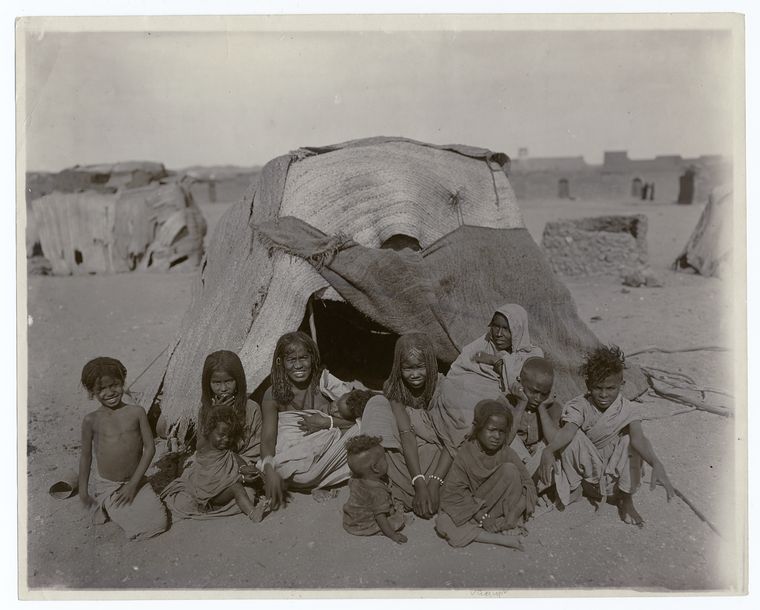

An archival photograph distributed by the New York Public Library identifies a Bisharin group outside a tent at Wadi Halfa. Its old title says Egypt; the accompanying catalogue note places Wadi Halfa in present-day Sudan. The record gives a broad 1860s–1920s range, not a precise sitting date. Several sitters have hanging plaits, while others show shorter hair or a covered head. NYPL photograph — Bisharin at Wadi Halfa, via Commons
It is worth looking at the whole group rather than isolating the most elaborate hairstyle. Even this single scene contains several arrangements. The picture does not tell us which differences reflect age, preference or occasion. It does show why a group’s name should not become a label for one standard head of hair.
Kau: a hairstyle with a named wearer
A German–Sudanese museum collaboration provides a more precise example from the Nuba Mountains. Its 2024 account identifies Dawud Kuku Londi in a 1975 photograph from Kau, following identification by the village headman. The caption associates his hairstyle and face paint with arm-wrestling fighters. That is a specific local and ceremonial context, not a description of all Nuba men. SPK — collaborative Nuba photograph research, 2024
Here the achievement is more than finding an arresting photograph. Restoring a person’s name changes how the image can be read. We can ask about an individual and an occasion, instead of treating an anonymous face as a specimen of an entire people. The copyrighted photograph remains linked at the museum source rather than reproduced here.
The barber belongs in this history too
The Sudan Archive at Durham lists photographs of a barber at work at Bakht er Ruda and a barber shaving a man at the roadside in Khartoum, both catalogued within 1950–1955. These are catalogue descriptions, rather than photographs reproduced here. They nevertheless identify specific records of grooming as everyday work. Durham, Corlass catalogue — SAD.337/2/43 and 147
This opens a different line of inquiry from the formal portrait. A barber’s work connects appearance with a service: a customer, a tool, a transaction and a place. It invites questions about apprenticeship, the cost of equipment and the choices customers bring to the chair.
For the customer, a haircut can be an ordinary pleasure. It does not have to carry a national political message to belong in history. Equally, the ordinary should not be confused with the insignificant. A history made entirely from ceremonies and famous people leaves out much of the work through which people prepare themselves for daily life.
The twentieth-century story should therefore include both older grooming practices and changing urban tastes. It should not assume a simple march from long hair to short hair, or from tradition to modernity. To describe a particular fashion as dominant in a particular decade, we need dated examples and testimony, not the memory of one celebrity photograph.
El Fasher: the salon as a workplace
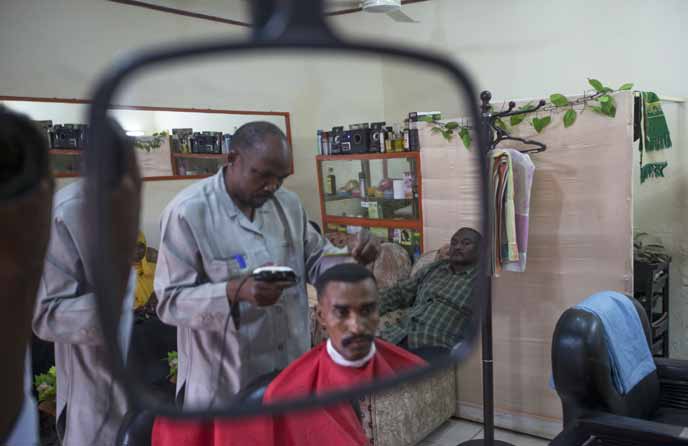
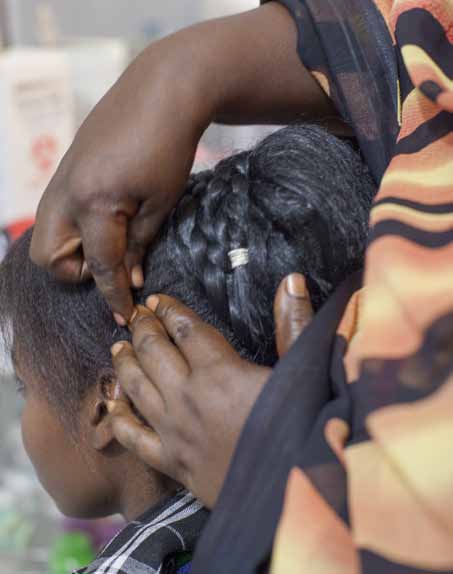
Darfur’s salon culture appears in a dated report by Emadeldin Rijal for UNAMID. Photographs taken on 29 April 2014 show Al-Mardi Nooreldin cutting a man’s hair in El Fasher and Mariam Sharafadeen styling a woman’s hair. The article describes a hairdressers’ union concerned with professional recognition, skills and hygiene. This is evidence about working practitioners in 2014, not a claim about present conditions. Emadeldin Rijal — Voices of Darfur, May 2014, pp.15–17
The photographs bring technique into view. In one, the barber works with clippers while the mirror frames the customer’s face. In the other, hands divide and gather sections of hair into an arrangement taking shape. Hairdressing becomes something we can watch being made, rather than a finished look detached from its maker.
A singer’s hairstyle reaches a boy in the north
In a reminiscence posted on SudaneseOnline on 19 October 2017, Ali Abdelwahab Osman recalled trying to copy singer Ibrahim Awad’s parted hairstyle. He associated the singer with radio listening in Burgeig and a photograph displayed at school. His father’s disapproval interrupted the experiment. This is one person’s retrospective account, not a national fashion survey, but it gives men’s grooming a recognisable human scale: admiration, imitation and a disagreement between generations. Ali Abdelwahab Osman — personal recollection, post 240, 2017
The anecdote suggests a question worth pursuing through family albums: how did a style move from a performer’s photograph to someone else’s head? A song could make a singer familiar while an image made his appearance imitable. The route between public performance and private experimentation deserves attention alongside formal portraits of political leaders.
It also gives the history a different rhythm. A hairstyle need not be ancient to matter. A young person’s attempt to look like a favourite musician is itself part of cultural life. Such memories can help build a history of taste, provided their dates and personal perspective remain visible.
A modern groom, without a costume label
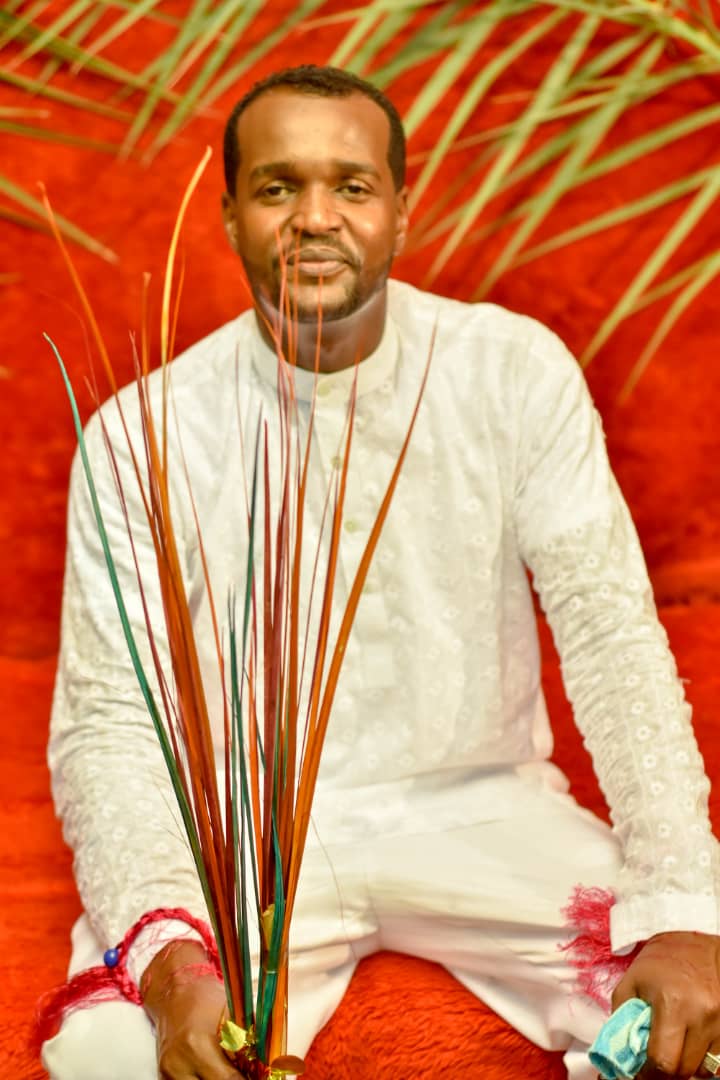

Rahma Abdalla’s photograph, dated 25 September 2019 and identified as taken in Sudan, shows a groom with short hair, a moustache and a short beard. The image supplies neither a named haircut nor a precise locality. It is nevertheless a useful contemporary counterpoint to the historical male portraits. Rahma Abdalla — Sudanese groom, 2019
Its place here is deliberate. If men enter a cultural feature only through unusual historical styles, ordinary contemporary grooming disappears. A short haircut belongs in this account too. This groom need not represent a whole generation, and his hair need not carry a special ceremonial meaning simply because he is photographed at a wedding.
Fashion can change without becoming less Sudanese

Marie Grace Brown’s research on clothing offers a helpful comparison. In a University of Kansas account of Khartoum at Night, she explains how Sudanese women used fashion names and choices to engage with public events and a wider world. Her study concerns dress and body politics; it should not be turned into a ready-made chronology of haircuts. Its broader insight is that changing taste can be part of local history rather than evidence of its disappearance. University of Kansas — Khartoum at Night
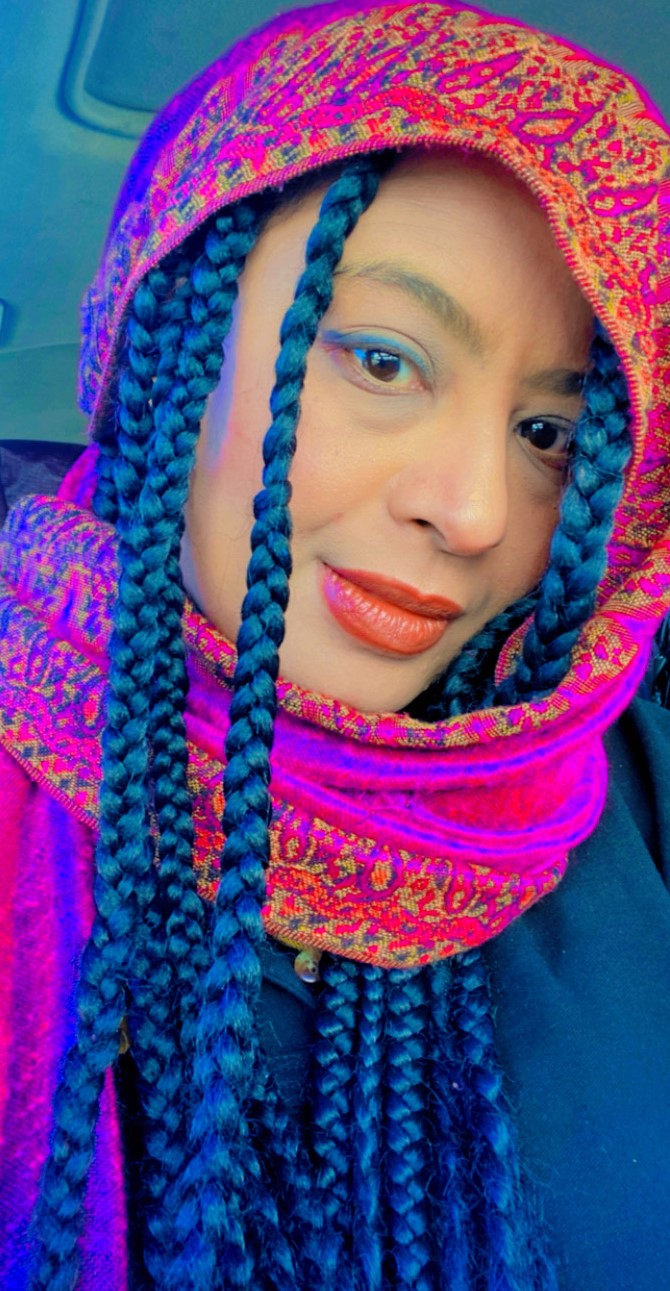
A modern photograph contributed by Najla777, dated 11 February 2023 and identified by its creator as taken in Sudan, shows long braids framed by a colourful head covering. The contributor connects the look with older northern Sudanese styles. We can reproduce that attribution while keeping the photograph firmly in 2023. It is not an old portrait, and its appearance alone cannot establish a style’s age. Najla777 — Sudan, 2023
Placed beside the earlier woman’s portrait, it invites comparison without forcing an answer. The scale of the braids, their visible arrangement and the relationship between hair and cloth differ. That difference is part of the attraction. Living traditions contain decisions, not only repetitions.
Documenting the makers
Hafsa Borai’s Braids of Identity is one contemporary Sudanese-led effort to take the craft seriously. The Safeguarding Sudan’s Living Heritage project describes the documentary as addressing the history and social and economic importance of braiding, including its role in livelihoods. That description places the practitioners and their knowledge at the centre of the subject. Hafsa Borai — Braids of Identity project
In a published interview with Monograf, Borai describes braiding as knowledge transmitted between generations and connected to women’s memories and relationships. Her account adds the filmmaker’s own explanation of the project, rather than leaving its purpose entirely to an institution’s summary. Hafsa Borai — Monograf interview
The profession also has a history of relationships. In a 2024 conference abstract, historian Elena Vezzadini highlighted scholarship on beauty specialists’ social ties, affective work and payment arrangements that did not always involve a fixed price. That is a reason to ask about the terms of work, not merely the finished appearance. It does not establish what all braiders charge today. Elena Vezzadini — conference abstract, 2024
Kandaka could contribute by building a small, carefully described visual record: the practitioner’s name, the name they give a style, the place and date, the tools used and an explanation in their own words. A sequence showing hands at work can explain something a finished portrait cannot. A barber’s account can be recorded with the same care as a braider’s.
Such a record would also help avoid an old imbalance. Archives often preserve the photographer’s name while leaving the sitter unnamed. Contemporary documentation offers an opportunity to credit the person who wears a style and the person who makes it, with their agreement about how the image will be used.
The ambition is not to select one hairstyle as the authentic Sudanese look. It is to make visible a field of skill and creativity: women and men arranging, cutting, covering, decorating and changing their hair. The strongest history of that work will leave room for both inheritance and invention—and for the people whose hands make each style possible.