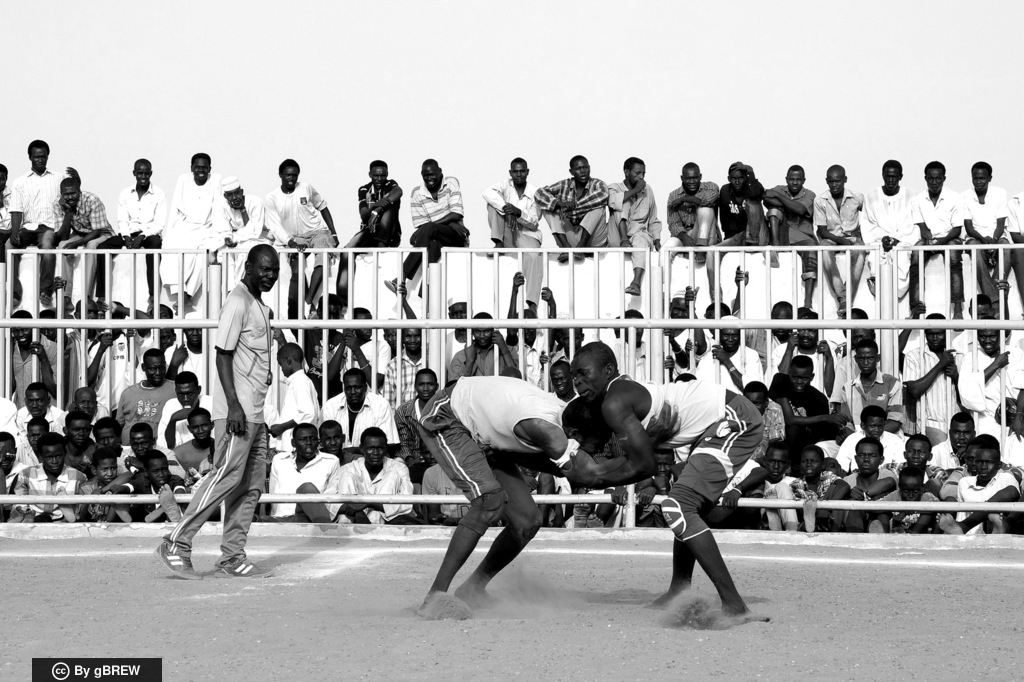
Cover: Nuba wrestling in Bahri, Sudan, 29 August 2014. Photograph by Joseph Bautista (Ginger Brew), via Wikimedia Commons, CC BY 2.0. No changes were made to the image.
Sudan has no need to manufacture a national sport. It already has one.
On wrestling grounds in Khartoum, athletes from different communities have competed before crowds drawn largely from the city’s working population. The sport they practice developed from wrestling traditions of the Nuba Mountains, but it no longer belongs only to one neighborhood or one ethnic group. Anthropologist Paul Hayes describes contemporary Sudanese wrestling as a practice adapted over the past three or four decades from diverse Nuba Mountains rituals. In the capital, he found, it brought together thousands of ethnically diverse athletes and spectators and allowed status to be earned through skill and conduct rather than ethnicity, religion, occupation, or political connections.
That makes wrestling more than entertainment. It is a living cultural institution, a possible bridge between communities, and an underdeveloped sporting asset. It is also a test of how Sudan treats the cultures of people whom the state has too often marginalized. Sudan can celebrate Nuba wrestling nationally, but only if it does not erase its origins, convert it into empty folklore, or take ownership away from the communities that sustained it.
The strongest national strategy has two connected tracks. The first should preserve and strengthen Nuba wrestling on its own terms: its local knowledge, ceremonies, competitions, histories, and community authority. The second should build a voluntary pathway for athletes who want to enter freestyle, Greco-Roman, women’s wrestling, and other recognized international disciplines. One track protects a culture. The other develops competitors. Neither should swallow the other.
What the ancient evidence proves—and what it does not
Wrestling has a deep documented history in the Nile Valley. Ancient Egyptian art depicts people identified as Nubians wrestling in several New Kingdom settings. Scott T. Carroll’s survey of the evidence discusses scenes in the tomb of Tyanen, conventionally dated to around 1410 BCE; scenes associated with Meryre II at Amarna in the fourteenth century BCE; another Amarna image of two Nubian wrestlers; and ceremonial contests represented at Medinet Habu during the reign of Ramesses III.
These images matter. They show that wrestling was practiced by, associated with, or represented through people whom Egyptians identified as Nubians more than three thousand years ago. They also show that African wrestling was visible in elite political and ceremonial settings—not a recent import into Sudan.
But the pictures are not neutral photographs. Some appear in scenes designed to glorify Egyptian power. A wrestling match between an Egyptian and a Nubian could function as imperial theatre: the foreign opponent is defeated so that Egypt’s dominance is made visible. Such an image tells us about wrestling, but also about the political message commissioned by the victorious court.
The evidence does not prove that modern Nuba wrestling is an unchanged continuation of those ancient contests. “Nubian” in the history of the Nile Valley and “Nuba” in the Nuba Mountains are not interchangeable labels. The Nuba Mountains contain many peoples and languages; “Nuba” is a collective designation, not the name of one homogeneous population. There are real and complex historical connections across Sudan, including linguistic relationships involving some communities, but resemblance, geography, or similar names cannot by themselves establish a single unbroken sporting genealogy.
Carroll proposed continuities between ancient images and modern practices, drawing on physical appearance, cattle culture, ornaments, and wrestling customs. Those comparisons are interesting questions for further research. They are not conclusive proof. Some of the paper’s language and racial classifications also belong to an older scholarly era and should not be repeated uncritically.
Kandaka therefore makes a precise claim: Sudan possesses both ancient evidence of wrestling among Nubians and a living group of wrestling traditions rooted in the Nuba Mountains. The relationship between them deserves careful archaeological, linguistic, oral-historical, and ethnographic study. It should not be settled by romantic assertion.
This distinction does not weaken the story. It makes it trustworthy.
A culture carried through marginalization and war
Modern Nuba wrestling cannot be understood only as a list of holds and rules. In different communities it has been associated with festivals, agricultural seasons, age groups, music, dance, prestige, discipline, courtship, and the public representation of strength. Local forms have differed. They have also changed over time, as all living traditions do.
Culture is not preserved by freezing it in the past. It survives because people practice it, reinterpret it, argue about it, and teach it to the next generation.
The Nuba Mountains have endured political marginalization, displacement, and repeated war. People carried wrestling with them when they moved. In Khartoum, the sport was reorganized in an urban setting and opened to a wider field of competitors and spectators. Hayes’s research treats this not simply as the survival of a rural custom, but as the creation of a modern, cross-ethnic Sudanese practice.
That expansion offers a hopeful form of national identity. Sudanese unity is often imagined as uniformity imposed from the center. Wrestling suggests another possibility: a national culture can grow when the country recognizes the contribution of a historically marginalized region and allows others to participate without disguising where the institution came from.
Recognition must carry obligations. Wrestlers, elders, organizers, musicians, women, and cultural researchers from the Nuba Mountains should help decide how traditions are documented and presented. Communities should share in funding and income generated through major events, broadcasting, sponsorship, tourism, archives, and merchandising. A national festival that uses Nuba culture while returning no authority or benefit to its custodians would repeat the extraction that national celebration is supposed to overcome.
There must also be room for internal disagreement. Some practitioners may welcome standardized rules and wider competition. Others may fear that federation control, commercial promotion, or Olympic ambitions will strip the sport of local meaning. Both concerns are legitimate. The answer is not to force every tradition into one national rulebook. It is to preserve local forms while creating clearly defined competition formats for athletes who choose them.
Sudan has already started—but has not built a system
The country is not beginning from zero. United World Wrestling recognizes a Sudan Wrestling Federation whose listed disciplines include men’s freestyle, Greco-Roman, women’s wrestling, beach wrestling, and African or traditional styles.
There have also been serious development attempts. United World Wrestling reports that a Level One coaching course was held in Sudan in 2016. In 2018, with Olympic Solidarity support, a Development of National Sports System program began with an assessment and talent-identification camp involving eight coaches and thirty athletes. The initiative included support for women’s wrestling.
In 2021, a Martial Arts Open School project in Khartoum taught Nuba wrestling to 150 young people and girls through local masters and the Sudan Wrestling Federation. These initiatives show that Sudan has organizers, coaches, young participants, and international partners. They also expose the weakness of the present approach: a course, camp, festival, or short project is not yet a durable pathway.
A real system would connect regular neighborhood practice to school clubs, trained coaches, referees, medical support, regional leagues, national selection, scholarships, and African competition. It would keep records. It would publish rules and selection criteria. It would provide safe training spaces and basic equipment. It would know how many athletes remain active one, two, or five years after a pilot program ends.
Sudan has not demonstrated that continuity. The war that began in 2023 has damaged sporting institutions and displaced athletes along with millions of other Sudanese. The International Olympic Committee reported emergency assistance to Sudan’s National Olympic Committee and scholarship support for athletes preparing for Paris 2024. Yet Sudan did not field a wrestler at those Games. This is not a judgment on the ability of Sudanese wrestlers. It is evidence of the distance between cultural strength and an international high-performance system.
The lesson is straightforward: talent cannot compensate indefinitely for missing institutions.
What Sudan can learn from Dagestan—without copying it
Dagestan and Chechnya are often invoked whenever wrestling and national development are discussed. The comparison has value, but only if used carefully.
The useful lesson is not that Sudan should copy the politics, patronage, or masculine culture of the North Caucasus. Nor is it that wrestling automatically prevents crime, extremism, or conflict. Sport can build discipline and social ties, but it is not a substitute for education, employment, justice, or peace.
The useful lesson is institutional density. Wrestling success in Dagestan is supported by a social world in which the sport carries prestige and by a network of local gyms, coaches, repeated competition, and routes into elite training. Research on wrestling halls in Makhachkala describes places where young people build social relationships and local standing, not merely athletic technique. Champions are the visible top of a much broader structure.
Sudan already possesses the cultural prestige. What it lacks is the dense and dependable structure beneath it.
That structure must also be more inclusive than the comparison. Sudan should develop girls’ and women’s participation from the beginning, with voluntary entry, women coaches and officials, safe facilities, safeguarding rules, family engagement, and freedom from harassment. It should make room for athletes outside Khartoum and for children whose families cannot pay. A national program that selects only boys with urban connections would reproduce the very inequalities it claims to overcome.
A two-track national strategy
Protect and strengthen the living tradition
Sudan should begin with a community-led cultural inventory. This does not mean creating a single official version of “Nuba wrestling.” Researchers and local custodians should document the names, rules, seasons, music, clothing, ceremonies, oral histories, and changes associated with wrestling in different communities. Documentation should be bilingual or multilingual where possible, and communities should control culturally sensitive material.
The state and cultural institutions should support locally governed festivals and competitions in the Nuba Mountains and among displaced communities. Funding agreements should state who owns recordings, who may license images, how performers and organizers are paid, and what share of commercial income returns locally.
A national wrestling archive could preserve photographs, film, interviews, rule variations, biographies, and archaeological evidence. It should distinguish verified fact, oral testimony, and interpretation. It should also confront the history of war and displacement without reducing Nuba people to victims or using wrestling as decorative folklore.
Build an international sporting pathway
Traditional Nuba wrestling is not itself an Olympic event. Athletes seeking an Olympic route must learn one of the recognized international styles. That requires cross-training, not cultural replacement.
The Sudan Wrestling Federation should publish a pathway showing how a traditional wrestler can enter freestyle or Greco-Roman competition and how girls and women can enter women’s freestyle. Coaches need instruction in the technical differences, scoring, weight management, injury prevention, safeguarding, and anti-doping rules. Athletes should be allowed to continue traditional competition where schedules and health permit.
Selection must be transparent. No athlete should need a political sponsor or personal connection to reach a trial. Regional qualifying events, published results, written selection criteria, and an appeal process would protect both athletes and the federation.
A realistic five-year program
Sudan cannot build an expensive elite complex in every state, especially during reconstruction. It can build a modest network that grows only when it demonstrates results.
Year one: map, protect, and pilot. The federation, community representatives, schools, and independent researchers should map active wrestling groups, coaches, women practitioners, competition grounds, and displaced-community networks. A governance and finance review should establish who makes decisions and how funds are reported. Pilot hubs should be selected in the Nuba Mountains or accessible neighboring areas, Greater Khartoum when security permits, and at least two other population centers hosting active communities. Each hub needs safe ground or mats, basic sanitation, first aid, a trained safeguarding contact, and a regular timetable.
Years two and three: build the base. School and community clubs should operate weekly rather than as one-off demonstrations. Coaches and referees should progress through published certification levels. Regional leagues should offer both agreed traditional formats and international styles, clearly separated. Nutrition support should use affordable local foods and target athletes facing food insecurity. Schools and clubs should monitor attendance and retention, not only enrollment. Girls’ programs should be developed with women participants and local families, never added as a publicity photograph after the men’s system is built.
Years four and five: connect the pathway. The strongest regional events should feed a transparent national championship. Promising athletes should receive scholarships covering education, training, nutrition, travel, and medical needs. Sudan should pursue regular camps and tournaments with African partners before measuring success only by Olympic qualification. Diaspora coaches and athletes can help, but each visit should transfer knowledge to Sudan-based staff rather than create dependence on visitors.
United World Wrestling, Olympic Solidarity, UNESCO-linked cultural programs, universities, and responsible private sponsors can contribute. External assistance should finance a Sudanese system with records, trained people, and local ownership—not a sequence of photogenic projects that disappears when a grant ends.
Measure the institution, not only the medals
Olympic participation is a worthy ambition, but medals are too narrow and too late to be the principal measure of progress. Kandaka proposes a public annual scorecard covering:
- active clubs and training hubs by state;
- weekly participants, one-year retention, and participation by girls and women;
- certified coaches, referees, women officials, and safeguarding officers;
- regional competitions held and results published;
- athlete injuries, medical coverage, and safeguarding cases handled;
- education completion and scholarships among supported athletes;
- representation from the Nuba Mountains, displaced communities, and states outside the capital;
- African championship entries, bouts, and results;
- federation income, spending, sponsors, and audited accounts; and
- cultural documentation completed with community consent and income returned to local custodians.
These measures make failure visible early. They also prevent one exceptional athlete from being used to conceal an empty system.
A national culture built by recognition, not appropriation
Sudan’s wrestling story is powerful even after the myths are removed.
Ancient images establish that wrestling had an important place in the Nile Valley and that Nubian wrestlers appeared in political and ceremonial art thousands of years ago. Modern Nuba communities preserved and developed their own wrestling traditions under very different historical conditions. In recent decades, wrestlers and organizers carried those practices into the capital, where they became part of a wider, cross-ethnic urban culture.
Those are three important truths. They do not need to be compressed into a single unproven line of descent.
The task now is not to declare wrestling Sudan’s national sport by decree. It is to behave as though the institution matters: respect its custodians, support its local life, open it to women and young people who choose to participate, build competent clubs and federations, and give talented athletes a fair route to African and international competition.
If Sudan does that, wrestling can offer more than medals. It can demonstrate a healthier idea of the nation—one in which a culture from a marginalized region is not hidden, appropriated, or made peripheral, but recognized as one of the forces capable of bringing Sudanese people together.
Sources
- Paul Hayes, The Wrestlers of Khartoum, Sudan: An Embodied Material Culture of Virility, Australian National University, 2022. The repository restricts the full thesis until February 2028; this article uses the public abstract and metadata.
- Scott T. Carroll, “Wrestling in Ancient Nubia”, Journal of Sport History 15, no. 2 (1988), pp. 121–137. Used critically for its catalog of ancient scenes, not as proof of direct continuity.
- United World Wrestling, Sudan Wrestling Federation and Sudan’s Development of the National Sports System program.
- UNESCO International Centre of Martial Arts, 2021 Martial Arts Open School in Sudan.
- International Olympic Committee, Olympic Solidarity and NOC Services Annual Report 2024.
- Sviatoslav Poliakov, “Wrestling Gym in Dagestan as a Space for Masculine Socialization”, Physical Culture and Sport: Studies and Research 96, no. 1 (2022), pp. 21–30.