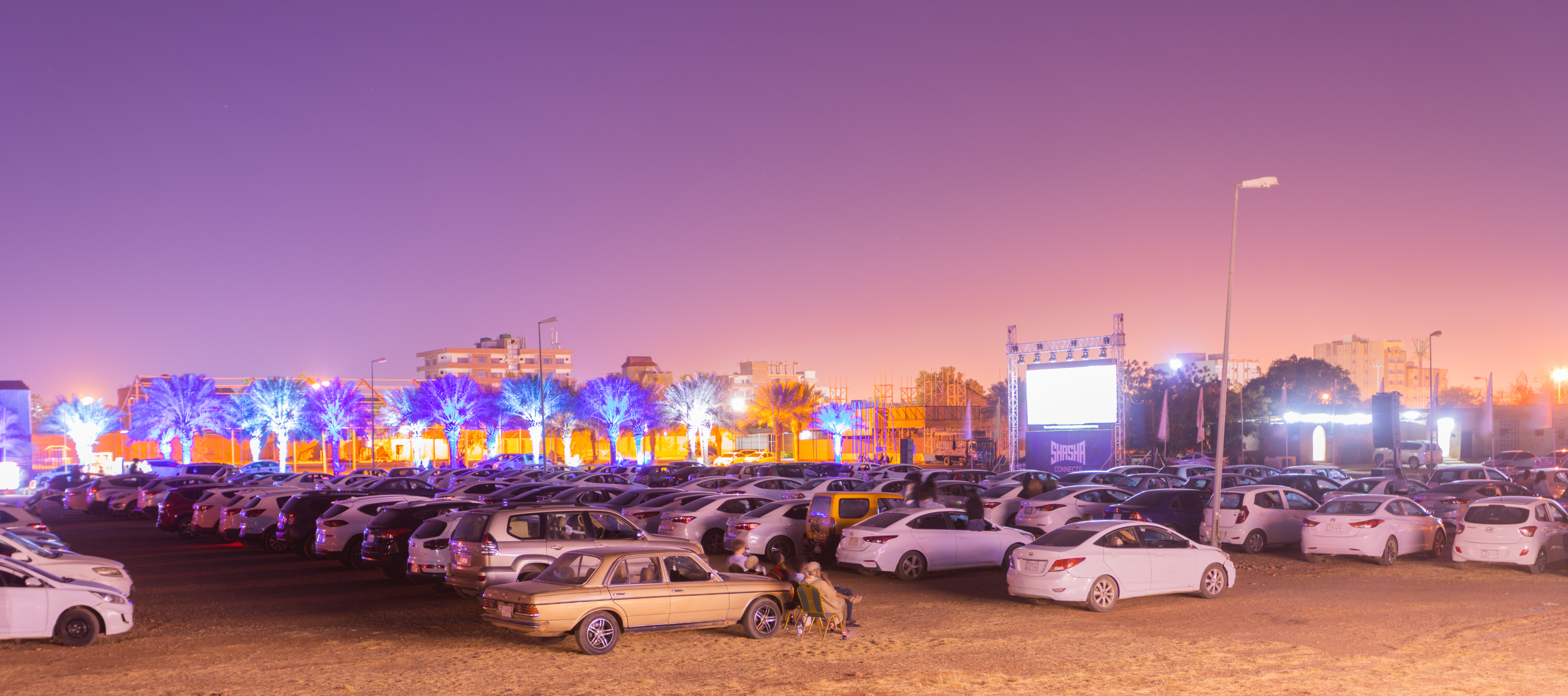
Drive-in screening at the Sudanese European Film Festival, 3 March 2021. Photograph: British Council Sudan, via Wikimedia Commons, CC BY-SA 4.0. Original photograph reproduced without alteration. This is a dated festival photograph, not evidence of current venue availability.

A programme for Sudan’s Independent Film Festival in January 2018 offers a useful starting point for a history usually told through famous directors and international prizes. Its screenings were spread across eight named venues in Khartoum, with free entry. This was a network of cultural spaces, not evidence of eight operating commercial cinemas. It nevertheless shows people organising places to encounter films before the international successes of 2019. British Council programme
An audience needs somewhere to gather. A finished film needs a route beyond its premiere. A filmmaker needs colleagues, equipment and another opportunity to work. An old reel needs a custodian before it can become a restoration. Sudanese cinema’s history becomes richer when these ordinary requirements sit beside the extraordinary films.
The history includes state institutions and independent groups, family studios and international collaborators, documentaries and fiction, experimental shorts and television. It also includes the experience of watching imported films. These activities overlap, but they are not interchangeable: a crowded screening does not establish a domestic production industry, and a Sudanese director’s film made abroad does not measure production capacity inside Sudan.
The central question is how this film culture has survived repeated interruptions—and how its achievements might become easier to sustain. The answer requires attention to who makes images, who keeps them and who gets to see them.
Images, institutions and their audiences
The starting point cannot simply be independence in 1956. Colonial film institutions preceded the independent state. A Sudanese historical study by Adel Daifallah and Othman Jamal al-Din places the Film Unit in 1949. Arsenal’s account identifies Gadalla Gubara’s earlier colonial training and his leadership of the Sudanese Film Unit after independence. These describe a colonial institutional inheritance and a later national role; they do not justify treating 1956 as the undisputed birth of all organised filmmaking. SUST study, Arsenal preservation history
That distinction changes the questions we ask. Who commissioned a film? What was the camera expected to demonstrate? What room remained for the people represented to speak or interpret? An institution can supply equipment and employment while also limiting the stories that receive support. Independence makes control over those choices newly important; it does not automatically settle them.
Cinema-going has its own history. Brendan Tuttle and Joseph Chol Duot’s study of southern Sudan between 1943 and 1965 follows mobile exhibition and Juba’s Picture House through archives and recollections. Audiences appear as interpreters and social participants, rather than merely recipients of official messages. The interview evidence, weighted towards educated men and civil servants, has limits. Juba belongs here to the period’s historical geography; it is now the capital of the separate Republic of South Sudan. Tuttle and Duot, 2023
Including this history avoids making Khartoum stand for every audience. It also avoids projecting today’s national borders backwards without explanation. A history of cinema across the former Sudan must be able to describe shared institutions and different experiences while respecting the political distinction between the two countries today.
Building films, keeping films
Early feature production is often presented as a race to identify a single first film or founding father. The surviving records demand more care. The 2018 SUST study’s table lists Hopes and Dreams in 1970, credits Ibrahim Mallasy as director and Rashid Mahdi as producer. Original screen credits were not inspected for this article. Those distinctions matter: production, direction and the work of a studio should not disappear into a convenient story about one pioneer. SUST study
Dates require similar discipline. MoMA catalogues Gadalla Gubara’s Tajouj as 1977; Arsenal’s preservation project lists 1979. Here it belongs to the late 1970s. The available records do not establish whether the discrepancy concerns completion, premiere or release, so no such explanation is assumed. MoMA programme, Arsenal project
These uncertainties should encourage better documentation, rather than diminish the achievement of making a feature. A national cinema cannot be understood only through its earliest surviving claim to a milestone. It also grows through the less visible labour that lets work continue: organising a production, caring for equipment and carrying knowledge between generations.
The Wedding of Zein raises another question about national boundaries. The Directors’ Fortnight archive records Khaled Siddik’s adaptation of Tayeb Salih in its 1977 selection, with performers including Ali Mahdi and Tahia Zarroug. A Sudanese literary story and a Kuwaiti filmmaker’s project meet in one production. It belongs in this cultural history without having to be counted automatically as domestic production, and its 1977 festival appearance does not by itself settle its production year. Directors’ Fortnight archive
Sara Gubara’s filmmaking and her work safeguarding her father’s holdings belong within that history. Arsenal’s 2013–2016 project records the involvement of the family and material arriving in Berlin for preservation. It also records damage that prevented some material from being digitised. Survival was uneven, and preservation depended on practical cooperation. Arsenal project
Recognising that labour changes how we describe an archive. A collection is the outcome of decisions and care, sometimes undertaken for years before a formal institution becomes involved. Giving a restored film a new audience should retain that history of custody and credit. Digitisation does not itself transfer ownership, settle exhibition rights or guarantee access for the people whose cinema is being preserved.
Hussein Shariffe’s The Dislocation of Amber, made around Suakin in 1975, offers another route into this history, through experimental filmmaking and the Red Sea. Its preservation and return to audiences are explored in Kandaka’s companion article. The broader lesson here is that preserving film history requires room for work beyond conventional feature drama. Arsenal film record, Kandaka’s restoration story
Shorts, training and the struggle for independence
The work of Ibrahim Shaddad, Suliman Elnour and Eltayeb Mahdi further widens the frame. Arsenal’s Sudanese Film Group collection includes Shaddad’s Hunting Party from 1964, made in East Germany, and Mahdi’s The Tomb from 1977, made in Egypt. Elnour’s It Still Rotates is listed as a 1978 Soviet production. Their careers connect Sudanese film history with training and production outside the country. Arsenal collection
A short film made abroad can belong meaningfully to a Sudanese filmmaker’s body of work without becoming evidence of domestic industrial output. Equally, a history restricted to locally produced fiction features would exclude much of the work through which filmmakers learned, experimented and developed professional relationships. The question of what counts must remain visible whenever someone announces a national film total.
Collective organisation was another achievement. Arsenal dates the founding of the Sudanese Film Group to April 1989, before the June coup, and records its re-registration in 2005 after repression of independent cultural activity. The chronology matters: filmmakers had articulated an independent organisational project before the political conditions for it deteriorated. Arsenal history
Yet “filmmaking stopped” is too absolute a description. Documentary and television production are part of the record examined by Daifallah and Jamal al-Din, whose study surveys 1950–2015. A closed institution, restricted public exhibition and the disappearance of regular feature production are different events. Each can seriously damage a film culture without proving that every person stopped working. SUST study
This is more than a correction to a familiar decline-and-rebirth narrative. If we describe every interruption as complete silence, we lose the work that connected one generation to the next. If we describe persistence as proof that institutions were unnecessary, we conceal how much effort people spent overcoming their absence or restrictions.
A wider cinema before the prizes
Training and exhibition provide concrete evidence of that connecting work. Goethe’s catalogue records six films emerging from a filmmaking workshop in 2010. That is a documented training output, not a measured employment outcome or a reason to collapse a workshop and an organisation’s later institutional history into one founding date. The 2018 festival programme supplies a separate example of organised exhibition. Goethe’s Made in Sudan record, British Council programme
The creative field also extends beyond the capital. Hajooj Kuka’s Beats of the Antonov (2014) concerns music and communities in Blue Nile and the Nuba Mountains. Its inclusion here helps resist a history in which regions enter the frame only as backgrounds to events elsewhere. This description follows the festival record; it is not a new review of the film. IDFA catalogue
Marwa Zein’s Khartoum Offside (2019), about women footballers, and Sara Suliman’s Heroic Bodies (2022), drawing on interviews and archival material about women’s histories and resistance, belong within the same developing chronology. Both women have production as well as directing credits. Their place in the story is that of makers with distinct projects and responsibilities. Khartoum Offside, Heroic Bodies
A useful history should leave space for different ambitions: recording an experience, investigating an institution, inventing a fictional world or experimenting with form. Asking every filmmaker to represent an entire country can flatten that range. It can also give international recognition disproportionate power to decide which work becomes visible at home.
Recognition, then another rupture
The achievements of 2019 deserve precise names. Suhaib Gasmelbari’s Talking About Trees received the Berlinale’s Glashütte Original Documentary Award. Amjad Abu Alala’s You Will Die at 20 received Venice’s Luigi De Laurentiis debut-film prize, the Lion of the Future. These were major distinctions; they were neither the Golden Bear nor the Golden Lion for best film. Berlinale awards, Venice awards
The titles also bring different forms of achievement into view. A documentary concerned with filmmakers trying to reopen a cinema and a fiction debut do not solve the same creative problem. A prize recognises a particular work. It does not establish how many domestic screenings followed, whether a production recovered its costs or whether its crew found sustained employment. BFI record for Talking About Trees
In May 2023, Cannes identified Mohamed Kordofani’s Goodbye Julia, presented in Un Certain Regard, as the first Sudanese film in its Official Selection. That is the scope of the milestone. It should not be expanded into a claim about every event associated with Cannes, or confused with winning the Palme d’Or. Cannes account
Recognition and catastrophe could coexist. Arsenal’s account records Shaddad and Elnour leaving for Egypt in June 2023. Their displacement belongs to a dated account of particular people, rather than evidence for a current census of all Sudanese filmmakers. Arsenal account
Later films demonstrate continuing work under changed conditions. Sundance’s 2025 Khartoum record credits Anas Saeed, Rawia Alhag, Ibrahim Snoopy, Timeea Ahmed and Phil Cox. It describes a project begun in 2022 that adapted after filmmakers and participants relocated to East Africa. The expired festival-player window is a historical screening record, not a present offer to stream the film. Sundance catalogue
Suzannah Mirghani’s fiction feature Cotton Queen appears in Venice Critics’ Week’s 2025 programme, with multinational production credits. It adds another contemporary filmmaking path to this account. International collaboration can help a project happen; the credits alone do not reveal financing terms, revenue or the durability of jobs inside Sudan. Critics’ Week film record
Continuation in exile is an achievement with costs, not a satisfactory substitute for the ability to work safely at home. Celebrating a completed film should leave room to ask who could not continue, who performed unpaid work and where the film’s next audience will be. Those questions require producer and crew testimony that festival catalogues cannot supply.
Rebuilding the connections
This history suggests a practical direction: support the connections between films, skills, rights and audiences. The proposals that follow are editorial recommendations, not a costed national programme or a claim that current operators have agreed to deliver them.
Preservation should begin with custodians and an inventory of what actually survives. Families, filmmakers and institutions need a way to record formats, condition, ownership and permissions without surrendering control of their material. Originals, preservation masters and public access copies serve different purposes. A backup arrangement must say who maintains it, who can retrieve it and what happens if an organisation closes. The AFAC-supported Rewind Forward project provides a documented example linking restoration, training and reuse; its programme description is not proof that every planned output has been completed. AFAC project record
Public access needs its own agreement. A restoration partner’s screening licence may not cover a school, a community festival or online viewing in Sudan. Each route needs clear terms, proper credits and a realistic payment arrangement. Catalogue descriptions should state what is available, in which territory, for how long and with which subtitles. A page about a film is not necessarily a way to watch it.
Training should connect to paid work. A workshop can be valuable, but its lasting contribution depends on opportunities to practise, maintain equipment and work on another production. Small commissioning rounds, mentored crew positions and shared equipment could be tested together. Selection and payment procedures should make it possible for women and applicants outside the capital to participate without assuming that everyone can travel freely or work unpaid. Success would need follow-up evidence, rather than a count of certificates issued.
Finance and distribution should be discussed before production ends. A grant can make a film possible without providing a plan for its circulation. Producers need to understand rights, delivery requirements, subtitle costs, payment restrictions and their share of future receipts. Transparent small grants and international co-productions can serve different projects, provided filmmakers can assess their terms. Neither a foreign partner nor a festival selection should be treated as an automatic loss of agency—or proof of commercial success.
Exhibition should begin with places that can operate safely and repeatedly. In suitable locations, a maintained hall, cultural centre or shared screening kit may be a better first investment than a new building. That choice requires local comparison: electricity, projection, sound, ventilation, toilets, accessibility, security, licences and the wages of the people running events. Equipment without maintenance and an audience plan is an expense awaiting a breakdown. A new cinema may eventually be justified, but its continuing costs deserve the same attention as its opening.
Community screenings also need curators and relationships. A regular programme with discussion, appropriate language access and reliable times can be more useful than an isolated ceremonial event. The audience should have a voice in programming. Children and adults may need different arrangements; regional communities should be partners in choosing films, rather than destinations for a programme designed elsewhere. These are propositions to test with local organisers, not assumptions about what every community wants.
Public support should protect independent choices. Transparent funding decisions, clear rights and the ability to exhibit lawful work without arbitrary interference would matter across this chain. No single institution needs to own every stage. The more useful objective is cooperation that can survive a change of personnel, a lost venue or a failed funding round.
The next account of Sudanese cinema should have more than another international prize to celebrate. It should be able to describe a film kept safely, a filmmaker paid, a crew working again and an audience able to return. That would give the achievements already made a stronger place in everyday cultural life.
Research note: This is a historical synthesis based on selected scholarly passages, archival accounts and official film and festival records. No full films were watched for this draft; it makes no original assessment of performances, scenes or visual style. Early dates and credits remain attributed where records conflict. Pre-war programmes do not establish today’s venue availability. No present national cinema count, audience total, box-office estimate or reconstruction budget is claimed. Arabic and English editions share these limits.