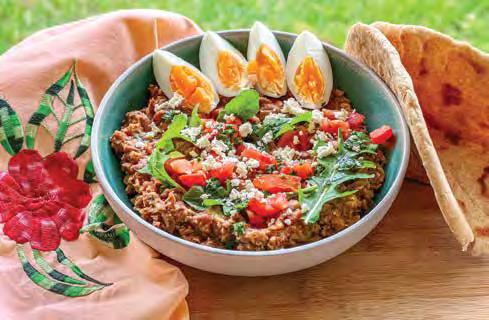
Ful with eggs and bread: a South Sudanese version featured in Healthy New Communities Cookbook, p. 44 (2025). Photography and food styling: Kym Perkins. © State of Queensland (Metro South Hospital and Health Service), CC BY 4.0. Photograph extracted unchanged from the cookbook; it illustrates a shared dish, not Monzir Hamdin’s recipe.
Warm bread, a generous plate of ful, a spoonful of lentils, something crisp and something sharp: there are many ways to build a satisfying Sudanese meal without meat. A peanut dressing can give aubergine richness; yoghurt can take it in another direction. A little shatta on the side lets everyone decide how much heat they want.
The pleasure is in the combination. Ful and tamiya deserve their familiar places, but they need not crowd out the vegetables, breads, dairy dishes and condiments around them. Following several cooks and family recipe collections reveals a table with room for different tastes—and different ways of making the same dish.
Ful and lentils: familiar food, personal touches
For Sudanese-born cook Monzir Hamdin, ful carries the memory of eating together. In an interview with SBS Food, he recalls his mother preparing a large shared plate for the family. He still enjoys it for breakfast or dinner. Monzir Hamdin’s account.
Habi Makes gives lentils another inviting treatment. Her cooked-lentil post combines onion, tomato and spices with lentils, oil and water. The result is thick enough to look at home beside bread. It is an everyday ingredient presented with care. The post is a commercial collaboration with Morouj, credited as such. Habi Makes’ original post.
Omer Al-Tijani’s adas offers a different texture: a smooth red-lentil soup finished with fried garlic, cumin and lime. These are two useful ways into lentils, one thicker and tomato-based, the other a soup with a fragrant finishing touch. The Sudanese Kitchen: adas.
Salads that deserve space on the table
The Arabic recipe archive Simsimaya’s Kitchen brings another home cook’s voice into the story. Her carrot salad starts with finely grated carrots briefly cooked with garlic and oil, then mixed with yoghurt, tahini and lemon. Sesame oil finishes the dish. It offers a creamy, colourful accompaniment; the yoghurt means this version contains dairy. Simsimaya’s carrot salad.
Beetroot brings another colour and a sharper note. Al-Tijani links his salatat banjar to meals in his childhood home in Bahri. His account reminds us how a dish can be familiar in one household without appearing equally often in another. Beetroot salad.
Eggplant with peanuts: salatat aswad bil-dakwa
Simsimaya’s salatat aswad combines fried aubergine with tomato, ground peanuts, garlic, spring onion and green pepper. Lemon brightens the mixture, and chilli is optional. The peanuts give the softened aubergine body and richness. Simsimaya’s peanut aubergine salad.
Asedo’s Kitchen documents another peanut version with onion, tomato and lemon, suggesting it as a side dish or a filling for bread and wraps. The two recipes offer practical variations rather than a single compulsory formula. Asedo’s Kitchen, first recipe.
Eggplant with yoghurt: salatat banzenjan bil-zabadi
The yoghurt preparation has its own appeal. Al-Tijani keeps browned aubergine slices beneath a dressing of yoghurt, garlic, lime and cumin. The slices remain visible, and the dressing brings a cool, tangy contrast. This particular recipe contains no peanut butter. The Sudanese Kitchen: yoghurt aubergine salad.
Separating these two versions helps readers picture what is on the plate, but household recipes can also combine ingredients. Sara Abdalla of Omdurman, contributing to Tasty Dishes for a Thriving Planet, uses peanuts, tahini and dairy-free yoghurt together. It is a specific plant-based version, showing how cooks adapt the dish to their preferences. Recipe, printed pages 68–69.
Bread, something creamy, a little heat
Bread gives these dishes company. Gurasa, a thick wheat bread, can take up a sauce or accompany a yoghurt mixture. Al-Tijani describes a yoghurt, garlic and onion pairing alongside his recipe. Kisra and asida bring further possibilities, with the character of the meal depending on the mullah or other accompaniment. Gurasa; Kandaka’s Kisra and Asida article.
Mish, in the version recorded by The Sudanese Kitchen, combines yoghurt, white cheese, chilli and nigella seeds. Shatta dakwa brings peanut richness and chilli heat to the side of the plate. A small serving lets each diner adjust the meal. Mish; shatta dakwa.
Dakwa also appears as a salad or dip. Tales of Jewish Sudan records a preparation with peanut butter, onion, lemon and spices. Here, too, naming the cook’s version is more useful than assuming every bowl of dakwa contains the same ingredients. Dakwa.
Kishri and a remembered Thursday table
Tales of Jewish Sudan describes kishri, rice and lentils with a cucumber-and-mint yoghurt accompaniment, and recalls meat-free Thursdays among many Jewish families in Sudan. Butter and yoghurt belong to this recorded version. The account gives the meal a place in community memory without turning that custom into a rule for the whole country. Kishri.
The same collection records bamia with lamb as an optional ingredient. Its meat-free option is another way to bring vegetables to the centre of a meal. Readers can follow the documented version rather than assume that every okra dish is automatically vegetarian. Bamia.
Tamiya: the pleasure of something crisp
Tamiya supplies a contrast to soft beans and creamy salads. Bakhita Emiliano’s recipe, published by SBS Food, uses soaked broad beans, onion, chilli, garlic and allspice, fried and optionally served in bread with salad. The recipe also describes the enjoyment of making the dish together. Bakhita Emiliano’s tamayya.
Al-Tijani records a chickpea version with dill and garlic. Putting the recipes side by side makes room for variation in the pulse itself, while keeping the attraction of a browned outside and a softer centre. Neither recipe needs to stand for every Sudanese family’s tamiya. The Sudanese Kitchen: ta’mia.
Recipes worth passing on
Simsimaya describes learning beside her mother, keeping her recipe notebooks and continuing to learn from other cooks. Habi Makes brings that sharing into the visual language of social media. A written method, a family recollection and a well-made cooking video each preserve something different: quantities, memories, texture, timing and the small gestures that make a recipe work. Simsimaya’s own account.
For readers, the invitation is simple: try a dish, follow a cook, ask a relative how they make it, or put several small plates together. Some versions here contain dairy; others use no animal products. Their variety is part of the pleasure.
For Kandaka, this is also a story of skill and cultural enterprise. Home cooks, recipe writers and food businesses can help more people discover Sudan through a meal they want to eat again. A table with ful, lentils, carrot salad, two different aubergine preparations and warm bread already offers plenty to talk about—and plenty to share.