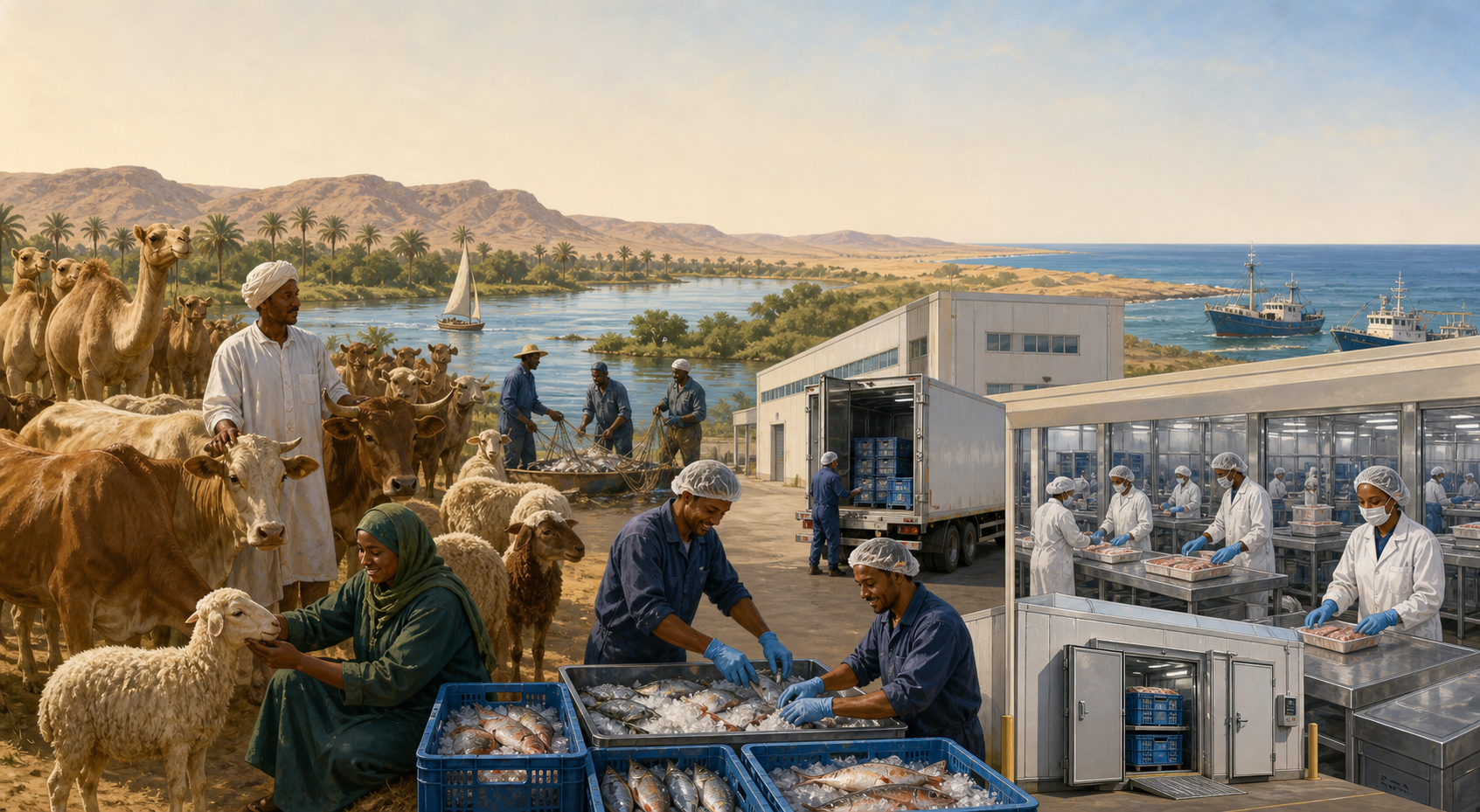
Cover: Original illustration commissioned by Kandaka, 2026.
Sudan already possesses one of Africa’s largest livestock populations. Yet having an enormous number of animals is not the same as having a powerful livestock industry.
The distinction can be seen in Sudan’s own trade figures. According to the Central Bank of Sudan, live animals earned approximately $287 million in the first half of 2026. Sheep accounted for most of that value, followed by camels. During the same six months, recorded meat exports were worth only about $0.55 million, while hides and skins earned about $1.78 million.
Those preliminary figures were collected during war and must be read cautiously. They do not capture informal trade, and they cannot tell us how many animals or productive assets have been lost. But they expose a long-standing structural problem: Sudan is still much better at exporting the animal than at building industries around it.
That should change.
Sudan should retain profitable live-animal exports where they make economic sense, especially established seasonal and regional markets. But it should also capture much more of the value created after an animal leaves the producer: meat, milk, cheese, leather, shoes, wool, animal feed, veterinary services, vaccines, breeding, cold storage, transport, rendering, fertilizer, gelatin, collagen, pet food and other products.
This is not simply an export strategy. It is a regional-development strategy, a food-security strategy and an industrial policy. Done well, it could create businesses and skilled work across some of Sudan’s most neglected regions. Done badly, it could dispossess pastoralists, exhaust rangelands, pollute water and transfer a national resource to a small group of politically connected processors.
The real question is therefore not whether Sudan has enough animals. It is whether Sudan can build a livestock economy in which the people who raise those animals become owners and beneficiaries of the industries built around them.
Start With Reality, Not the Headline Number
FAO currently estimates Sudan’s livestock population at about 115.4 million head: approximately 42.9 million sheep, 33.8 million goats, 33.5 million cattle and 5.1 million camels. It estimates that Darfur holds 31.8 percent of the national herd and Kordofan 27.7 percent.
These figures demonstrate scale, but they should not be mistaken for a precise post-war census. Much livestock production is mobile and difficult to count even in peacetime. Since April 2023, conflict has displaced communities, interrupted markets, reduced access to water and pasture, damaged veterinary infrastructure and caused herd losses. A credible reconstruction plan must therefore begin with a new livestock census and sample surveys designed with pastoralist organizations—not a database built only for taxation or surveillance.
Even the best census would not make herd size the main measure of success. A country can have more animals while producing too little milk per animal, losing hides through poor handling, suffering preventable disease, degrading pasture and receiving low prices at the farm gate. Productivity, animal health, producer income, domestic nutrition and value retained inside Sudan matter more than simply increasing the headcount.
Pastoral mobility must also be treated as an economic system rather than as backwardness. Moving animals in response to rainfall, pasture and water is a rational adaptation to Sudan’s ecology. Policies that block livestock routes, convert dry-season grazing land without agreement or force all production into fixed commercial ranches can reduce resilience and intensify conflict.
The objective should be to modernize the services around pastoralism—health, water, communications, markets, transport and finance—without destroying the mobility on which much of the system depends.
Live Exports Are Not the Enemy
It would be a mistake to prohibit live-animal exports in the hope that processors would automatically prosper. Live sheep and camel markets bring Sudan foreign exchange and give producers an important source of income. Some customers want live animals for religious, cultural or commercial reasons and will pay accordingly. If a live sheep earns more after all costs and risks are included, Sudan should sell it live.
The problem is dependence on a narrow range of products and buyers.
World Bank analysis found that between 2013 and 2019, live sheep generated 66 percent of the value of Sudan’s livestock exports and live camels another 16.7 percent. Meat represented only 5 percent. In 2018, 63 percent of live-animal exports went to Saudi Arabia and 34 percent to Egypt. This concentration exposes Sudan to import bans, disease scares, exchange-rate changes, border closures and the purchasing decisions of a small number of markets.
The answer is diversification, not prohibition.
Sudan should aim to sell the same animal into several possible markets: live when that is most profitable; chilled or frozen meat when processing creates a better return; and milk, hides, wool and by-products through separate value chains. Competition among buyers is also important. A processor should not receive protection that allows it to underpay pastoralists merely because it operates a local slaughterhouse.
Every proposed restriction on live exports should therefore pass a simple test: does it raise the producer’s net income, or does it merely transfer income from the herder to the processor?
The First Industry Is Animal Health
No country becomes a reliable livestock exporter without disease surveillance, vaccination, quarantine, laboratories, certification and traceability.
Sudan’s war has made this foundation more fragile. FAO reported that the destruction and looting of veterinary infrastructure interrupted domestic vaccine production and reduced vaccination coverage. A nationwide campaign completed in 2026 vaccinated about 9.1 million animals across all 18 states—an impressive emergency achievement, but still only part of a herd estimated above 115 million. Maintaining vaccines between 2°C and 8°C across long distances and conflict zones was itself one of the campaign’s greatest challenges.
Animal health should consequently be treated as productive infrastructure, like electricity or roads.
The first five-year investments should include:
- rebuilding Sudanese vaccine production where technically and financially viable;
- restoring national and state veterinary laboratories;
- training and equipping community animal-health workers, with professional supervision and referral systems;
- solar-powered vaccine refrigerators and mobile veterinary clinics along major livestock routes;
- continuous disease reporting that works through smartphones, basic phones, radio and local veterinary networks;
- quarantine facilities linked to specific export-market requirements;
- residue, feed, water and meat-safety testing; and
- a traceability system introduced gradually with producers and traders, rather than imposed without explanation.
Traceability cannot simply mean distributing ear tags. An IFAD review of a Sudan livestock programme found that some buyers interpreted tagged animals as animals rejected for export. The same review found that training targets could be met while actual commercial adoption remained poor, and that fattening schemes failed when they ignored local breeds, seasons, buyer contracts, veterinary services and the real availability of calves or lambs.
That is a valuable warning. Technology must solve a market problem that producers recognize. A simple, trusted record of origin, vaccination and movement can increase access to higher-value markets—but only if buyers reward it and pastoralists retain control over how their information is used.
Build a Ladder of Value
Sudan should not attempt every industry at once. The value chain should be built in stages, beginning with activities that save existing value from being lost.
Meat and cold chains
The immediate priorities are hygienic slaughter, reliable inspection, refrigerated transport, cold rooms, packaging and consistent electricity. Export-certified slaughterhouses matter, but domestic markets matter too. Cleaner local abattoirs and cold chains would improve public health and reduce spoilage even before Sudan wins new export contracts.
Large plants should be built only where there is dependable animal supply, water, power, transport, waste treatment and a committed market. Smaller modular facilities may be more appropriate in some regional centers. The objective is not to decorate every state with an identical slaughterhouse; it is to locate capacity where the economics work and where producers can reach it without losing their margin to transport and intermediaries.
Milk and dairy
Dairy may offer one of the strongest routes for women’s income and domestic import substitution. The World Bank notes that milk production and processing are already important activities for rural women, yet Sudan’s dairy system remains fragmented and productivity is low relative to the size of the herd.
Solar milk chillers, hygienic collection points, basic testing, reliable containers and contracts with processors can be more transformative than a single enormous dairy complex. Regional enterprises could produce pasteurized milk, yoghurt, cheese, butter, ghee and milk powder where the scale and energy costs justify it. Camel and goat milk deserve serious product and market research rather than being treated as curiosities.
Women who already milk animals or process dairy products should not be displaced when a formal dairy arrives. Their groups should be able to own collection centers, sell under transparent contracts, access working capital and, where commercially sound, take equity in processing businesses.
Hides, leather and finished goods
Hides and skins lose value quickly when animals are poorly slaughtered or the raw material is cut, contaminated, dried on the ground or stored incorrectly. The cheapest intervention is therefore not always a new tannery. It may be better knives, flaying training, salting or frame-drying, grading, collection and fast transport.
Sudan has been discussing the modernization of its leather industry for decades. Old UNIDO assessments already identified poor raw-material handling, maintenance problems, shortages of chemicals and spare parts, weak production control and irregular supply. Repeating the same capital investment without correcting those systems would repeat the same failure.
The goal should be to climb gradually from preserved hides to finished leather and then to higher-value goods: shoes, bags, belts, protective equipment, upholstery and selected industrial products. Tanneries require strict wastewater and chemical controls. A tannery that poisons a river or community is not development.
Wool and hair should be assessed with the same discipline. Collection, washing, grading and simple textile or felt products may support viable local enterprises in appropriate sheep- and camel-producing areas. But not every fibre will meet export-textile specifications, and washing can consume and pollute scarce water. Product trials and buyer tests should precede expensive mills.
Veterinary medicines are another possible industrial ladder. Sudan should first secure dependable procurement, storage and quality control for essential medicines and vaccines. Local packaging or formulation can follow where volumes, licensing and laboratory oversight support it; domestic manufacture should expand only when it can consistently meet potency and safety standards.
Feed, breeding and genetics
Feed can connect crop and livestock strategies. Sorghum, groundnut, sesame and other agricultural residues can be converted into tested feed, fodder blocks and supplements instead of being wasted. But feed must be monitored for contamination, especially aflatoxins, and its economics must reflect local grazing systems.
Breeding policy should focus on health, fertility, milk or meat performance, heat tolerance and drought resilience—not the indiscriminate import of exotic breeds. Sudan’s locally adapted cattle, sheep, goats and camels are genetic assets. Crossbreeding should be based on recorded performance and farmer choice, with conservation of indigenous breeds and access to artificial insemination only where the service can be maintained reliably.
The industries usually thrown away
Modern slaughter and processing can turn bones, blood, fat, offal and damaged material into products rather than pollution. Rendering can produce fats and protein meals under appropriate safety rules. Other streams can support organic fertilizer, gelatin, collagen, soap, pharmaceuticals or pet food.
But these are later-stage opportunities, not slogans. Each requires a feasibility study, sanitary controls, dependable volume and a buyer. Sudan should not build a collagen factory because collagen sounds sophisticated. It should build one only when the raw material, technology, environmental controls and market are proven.
Put the Industry Where the Animals Are
Sudan’s livestock economy should not be organized as a pipeline carrying animals and profits toward Khartoum.
Regional livestock hubs should be selected through evidence: herd composition, seasonal routes, water, feed, security, road or rail access, power, workforce and markets. Darfur and Kordofan are central because they contain most of the national herd. Blue Nile, White Nile, Sennar, Kassala, Gedaref, Red Sea and other states have different combinations of animals, crops, routes and market access.
Each hub should specialize instead of copying the others. One may focus on sheep aggregation, veterinary services and export quarantine. Another may combine cattle, dairy and feed. A Red Sea hub may connect slaughter, refrigerated logistics, fisheries and the port. A smaller locality may need only a market, water point, solar cold room, veterinary post and hides collection center.
Infrastructure should also follow the animals: protected livestock routes, water points governed with local users, rest areas, mobile coverage, veterinary stations and transparent markets. Restoring rail capacity for long-distance animal products and refrigerated cargo could eventually lower costs and reduce pressure on roads.
Pastoralists Must Be Owners, Not Raw-Material Suppliers
Producer ownership is not achieved by placing the word “cooperative” in a project document.
Pastoralists and local producer organizations should have several practical options:
- jointly owned aggregation, weighing, milk-cooling, hides-preservation or feed facilities;
- transparent contracts that specify grade, weight, price and payment time;
- profit-sharing or equity in larger processors where the expected return is credible;
- representation on the boards of facilities receiving public land, credit or guarantees;
- access to independent market-price information and dispute resolution; and
- the freedom to sell elsewhere if a local processor offers an unfair price.
Public support should be conditional. A slaughterhouse receiving subsidized credit or exclusive infrastructure access should publish its producer-payment record, local employment, environmental compliance and ownership. A cooperative should publish accounts to its members. Neither private investors nor cooperative leaders should be allowed to become a new layer of extraction.
Women, young people, ethnic and religious minorities, displaced people and communities historically excluded from state investment must be included through real economic roles. The opportunities will differ: women may already dominate parts of milk processing and small-ruminant care; young people can build businesses in animal health, refrigeration, repair, transport, digital market information and quality testing. Policy should begin from those realities, not assign people to activities that outsiders have selected for them.
Fisheries Need Their Own Realistic Strategy
Fisheries belong in this article because they share cold-chain, processing, feed, laboratory, logistics and food-security needs with livestock. They should not, however, be treated as a decorative appendix or assumed to match the scale of the herd.
Sudan has marine resources along the Red Sea and inland fisheries in the Nile system, Lake Nubia and major reservoirs. FAO has repeatedly found that the sector’s contribution is poorly captured in national statistics and that much production remains artisanal. That means the first requirement is not a fleet of industrial trawlers. It is a current stock assessment, landing data and enforceable management rules.
The quickest improvements are likely to be at landing sites: clean water, ice, solar cold rooms, insulated boxes, hygienic markets, safer boats, gear repair, simple processing and direct links between fisher cooperatives and buyers. Improved drying and smoking can remain valuable where refrigeration is unreliable.
Red Sea development must protect reefs, mangroves, spawning grounds and the rights of coastal communities. Industrial licences should not be issued on optimistic historic estimates of “potential.” Catch limits and permitted gear should follow current science, with community monitoring and public disclosure of licences and landings.
Aquaculture should proceed through measured pilots. Tilapia or catfish ponds may work in some irrigated areas; integrated use of reservoirs, canals or farm water may work elsewhere. But fish farming can fail through expensive imported feed, disease, water losses, poor seed stock or a market too distant to support refrigeration. Every project should publish its feed conversion, water use, mortality, energy cost and net return before the model is scaled.
A Five-Year Sequence
Sudan should judge the strategy by measurable capability, not by announcing factories.
Year one: measure and protect. Conduct a representative livestock census and fisheries baseline; map routes, markets and veterinary coverage; restore priority laboratories; expand vaccination and community animal-health services; identify existing abattoirs, tanneries, cold stores and vaccine facilities that can be repaired; and establish independent export-market and environmental audits.
Year two: stop preventable losses. Equip local slaughter points, hides collection, milk cooling, fish landing sites and vaccine cold chains. Introduce voluntary traceability pilots tied to a real buyer premium. Publish state-level disease, vaccination, price and market-access dashboards without exposing private household data.
Years three and four: build proven regional chains. Finance only facilities supported by supply contracts, feasibility studies and environmental plans. Expand accredited laboratories, export certification, refrigerated logistics, feed testing, dairy processing, leather finishing and selected fisheries or aquaculture pilots. Require public support to produce measurable local ownership, jobs, training and producer returns.
Year five: compete and correct. Measure value retained per animal, producer incomes, domestic nutrition, exports by product, women’s and youth ownership, disease incidence, rangeland condition, processing utilization and environmental compliance. Withdraw protection from failing firms, scale successful models and publish the failures as well as the successes.
The national scorecard should include at least:
- vaccination coverage by disease and state;
- mortality and major outbreak rates;
- producer prices as a share of final sale value;
- volume and value of live animals, meat, dairy, leather and other exports;
- domestic milk, meat and fish availability;
- percentage of hides receiving first-grade preservation;
- cold-chain loss rates;
- accredited facilities and rejection rates in export markets;
- local, women and youth ownership and employment;
- condition and legal protection of livestock routes and rangelands;
- fish stocks, landings and post-harvest losses; and
- water, waste and pollution compliance.
Targets should be set only after the first-year baseline. Inventing precise national production promises before Sudan knows the post-war condition of its herds, infrastructure and fish stocks would be planning theatre.
What Sudan Should Not Do
Sudan should not ban live exports simply to guarantee cheap animals to processors.
It should not build identical slaughterhouses in every state.
It should not replace mobile pastoralism with compulsory settlement.
It should not import breeds that cannot tolerate local heat, disease and feed conditions.
It should not call a training session an industry.
It should not measure women’s participation by attendance while men control the assets and revenue.
It should not industrialize fishing before measuring stocks.
And it should not subsidize politically connected firms indefinitely in the name of value addition.
From National Resource to National Capability
Sudan’s livestock wealth is already real. The industries around it are not.
The opportunity is larger than exporting more sheep or opening another slaughterhouse. It is to build a national system of animal health, regional processing, skilled work, producer ownership, food security and environmental stewardship.
If the strategy succeeds, a pastoralist should receive a healthier animal, better price information and a larger share of the final value. A woman processing milk should gain ownership and market access rather than lose her livelihood to formalization. A young veterinarian or refrigeration technician should be able to build a business in the state where they live. A fisher should lose less of the catch before it reaches the consumer. A Sudanese factory should turn materials now wasted or exported cheaply into products sold at home and abroad.
That is what becoming a livestock power should mean: not the largest herd on a statistical table, but the ability to convert animal wealth into healthy food, resilient landscapes, competitive industries and widely shared prosperity.
Principal sources for review
- Central Bank of Sudan, Foreign Trade Statistical Digest, January–June 2026 — preliminary current export values and quantities.
- FAO Sudan at a glance — current livestock estimate, regional distribution and conflict context.
- World Bank, Sudan Agriculture Value Chain Analysis — livestock export structure, meat/dairy constraints, standards, veterinary services and investment opportunities.
- FAO, 2026 cross-border vaccination campaign — vaccination reach, diseases, cold-chain requirements and conflict constraints.
- IFAD, Livestock Marketing and Resilience Programme mid-term review — implementation failures and lessons on fattening, traceability, animal health, gender targeting and buyer contracts.
- IFAD, Livestock Marketing and Resilience Programme — regional scope, pastoralist livelihoods, women and youth.
- FAO, support to Sudan’s fisheries and aquaculture sector — sector-review process, data limitations and investment planning.
- UNIDO, Assistance to the Leather Industry Sector in Sudan — historical tannery, raw-material, maintenance, marketing and finished-goods constraints.