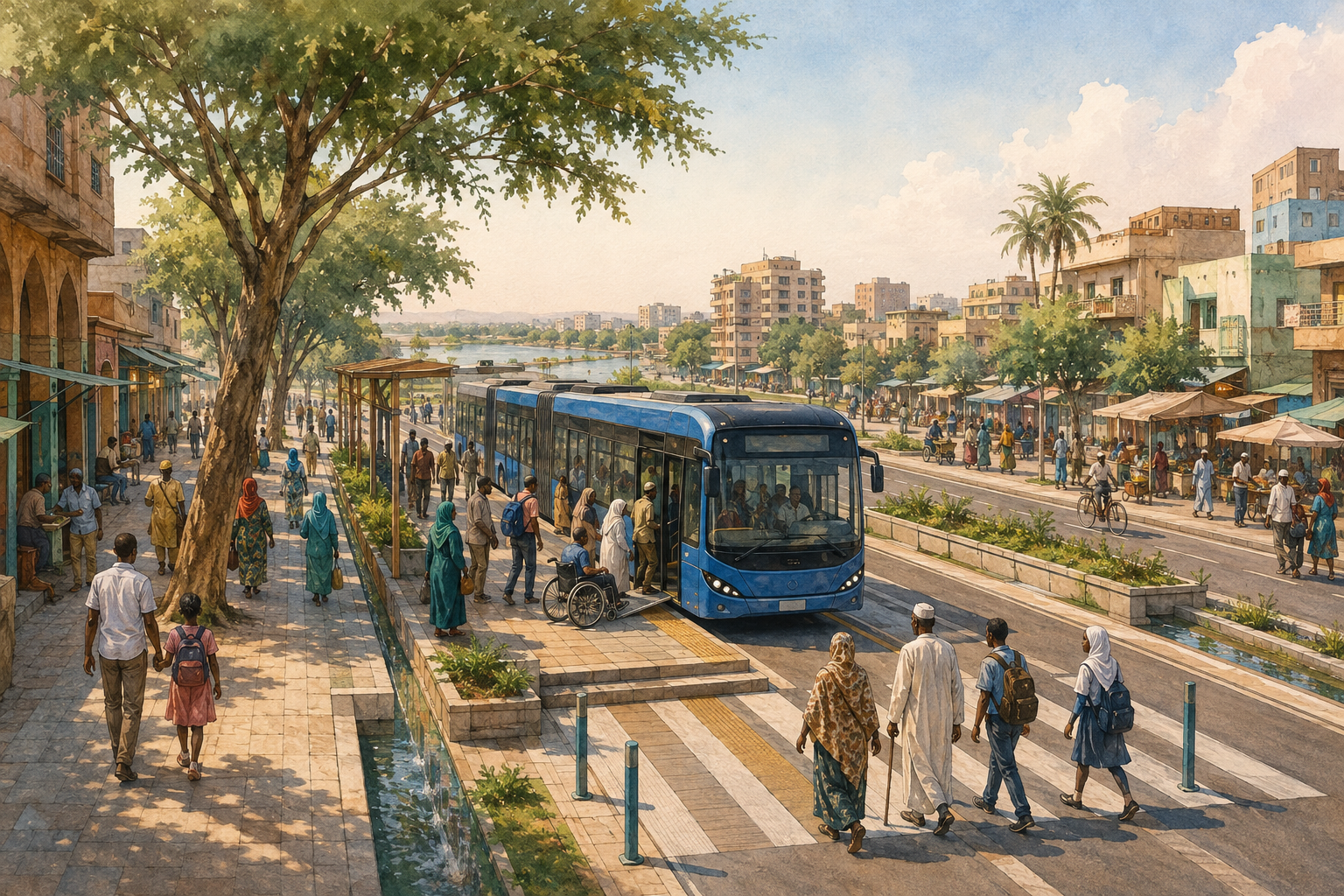
Cover: Original illustration commissioned by Kandaka, 2026.
BRT, Trambuses, Light Rail, Climate-Resilient Streets and a Sudanese Transit Industry
Sudan will not merely rebuild roads after the war. It will decide what its cities are for.
One choice produces wider highways, longer journeys, scattered services and growing dependence on imported cars and fuel. The other makes it possible for a child to reach school, an older person to reach a clinic, a worker to reach a job and a trader to reach a market safely and affordably without owning a car.
The second city is not created by buying a fashionable train. It is created by treating access as the purpose of transport.
Sudan should therefore rebuild its cities around the locally maintainable, climate-resilient and universally accessible public-transport system that delivers the most useful mobility per pound spent. In most corridors, that will begin with walking, feeders and buses given their own lanes. Some corridors may later justify trolleybuses, trambuses or light rail. A few might eventually justify elevated rail. An underground metro should be considered only where verified demand, engineering conditions and long-term finances make every less expensive option inadequate.
Technology should follow the problem. It should not become the plan.
This choice is no longer theoretical. In May 2026, the national committee preparing Khartoum for residents’ return reported work on water and electricity and planned tenders to rehabilitate major roads and the Halfaya, Al-Mak Nimir and Shambat bridges. Reopening what was damaged is essential. But every reconstruction contract also fixes the shape of the city for decades. Restoring a road exactly as it was—without reserving public-transport space, repairing drainage, providing shade or making crossings accessible—would rebuild vulnerability into the capital. Sudan Cabinet report on restoring Khartoum services, 24 May 2026.
Transport Is Access, Not Movement
A transport department can report that it built kilometres of road while people take longer to reach work. It can buy hundreds of buses while irregular service, unsafe crossings and unaffordable fares keep residents isolated. It can open a beautiful station that a wheelchair user cannot enter.
The correct question is not, “How fast can a vehicle travel?” It is, “How many people can reliably reach the things they need?”
That changes the measures of success. Sudanese cities should track:
- the share of residents who can reach frequent public transport through a safe, shaded and accessible journey of five to ten minutes;
- door-to-door travel time, including waiting and transfers;
- the fare as a share of low household incomes;
- service frequency, punctuality and vehicle availability;
- the proportion of vehicles, stops and crossings that are independently accessible;
- serious injuries and deaths, including those involving pedestrians;
- days of disruption caused by heat, dust, flooding or power failure;
- women’s safety and participation in transport employment;
- fuel and electricity use per passenger journey; and
- local content, maintenance time and the availability of spare parts.
This is a more demanding standard than counting flyovers, buses or rail kilometres. It is also much closer to daily life.
Sudanese Research Has Already Identified the Direction
Sudan does not need to import the basic diagnosis.
A 2008 Sudan University of Science and Technology study of central Khartoum examined traffic, land use and public transport and recommended high-capacity public transport on segregated corridors, including future tramways. A later SUST thesis on intelligent transport concluded that BRT was essential to improving Khartoum’s public transport. These studies differed in method and technology, but agreed on the decisive point: high-capacity public transport cannot work properly while trapped in ordinary traffic. SUST central-Khartoum study; SUST BRT thesis.
The 2025 study Evaluating Transit-Oriented Development in Khartoum used GIS and fourteen indicators to examine bus-terminal areas. It found strong spatial inequality: central nodes had the greatest potential, while 60 percent of the studied area scored below 15 on its index. The authors recommended better connectivity, mixed land use and priority investment in peripheral areas. The paper is especially useful because it treats transport and urban form as one problem, though its pre-war data and station mapping must be updated before investment decisions are made. Journal record and abstract.
A separate 2025 initiative, KhartouMap, began mapping Greater Khartoum’s semi-formal public-transport system. That effort points toward the first practical task after conflict: do not plan from an old diagram or an imagined city. Map where people now live, where routes actually operate, how fares and waiting times vary, and which connections war damage and displacement have changed. KhartouMap paper.
UN-Habitat’s work with Sudan’s Ministry of Physical Planning documented a city where transport was largely private, expensive and unavailable to many people on the metropolitan edge. It also placed transport inside a wider crisis of land, housing, services, poverty and local government capacity. That remains an important warning: a transport line cannot correct a city whose housing and services continually push poorer households farther away. Urban Sector Studies and Capacity Building for Khartoum State.
The evidence does not provide a ready-made network for 2026. It provides a direction and a duty to collect new evidence.
One Country Does Not Need One Technology
The national plan should define a common standard for access, safety, fares, data and procurement. Individual cities should then choose systems according to population, travel demand, street width, topography, climate, electricity and institutional capacity.
| Mode | Best role | Main condition | Main danger |
|---|---|---|---|
| Walking | Every journey; access to local services and stops | Continuous shade, drainage, crossings, smooth accessible paths and seating | Being treated as an afterthought despite carrying the poorest users |
| Cycling and e-bikes | Short trips, deliveries and some feeder journeys | Protected routes, secure parking and climate-appropriate timing | Copying temperate-climate plans where heat makes cycling unsafe or impractical |
| Feeder buses and minibuses | Neighborhood and lower-demand connections | Integrated routes, fares and service standards | Competition for passengers, unsafe driving and fragmented fares |
| Dedicated BRT | High-demand urban corridors | Physically protected lanes, station-quality stops and junction priority | Calling a bus in mixed traffic “BRT” |
| Trolleybus or trambus | Busy electric corridors where overhead supply is maintainable | Dedicated lanes, resilient power and standardized equipment | Vendor lock-in or fragile electrical maintenance |
| Surface light rail | Very strong, stable corridors | Reserved right-of-way, integrated feeders and proven operating finance | A prestige project that absorbs funds needed for the whole network |
| Elevated light metro | Exceptional corridors where crossings or land constraints defeat surface systems | Very high demand, strong maintenance and secure long-term funding | High capital cost and disconnected stations |
| Underground metro | The highest-demand corridors where no surface or elevated solution works | Exceptional ridership, geotechnical evidence, flood protection and deep institutional capacity | Consuming national resources for a small part of one city |
| Regional rail | Travel between cities and major economic corridors | Rehabilitated track, reliable operations and connections to urban networks | Confusing intercity rail with local urban access |
This hierarchy is not anti-rail. Rail can be the right answer where demand is high and sustained. It is anti-preselection.
Greater Khartoum’s long corridors and river crossings pose different questions from Port Sudan’s port economy and coastal heat. Wad Madani and Gedaref need links among neighborhoods, markets, hospitals, universities and agricultural logistics. Atbara’s railway heritage makes it a natural place for maintenance and rail skills. Kassala, El Obeid and Nyala have different street forms, displacement patterns and regional roles. Each needs an access map and travel survey before routes are promised.
National balance matters too. A capital-only megaproject would reinforce the centralization that has weakened Sudan. Secondary cities should receive early, visible improvements, not wait for an expensive Khartoum system to be completed.
Public Transport Must Escape the Traffic
The most important piece of BRT is not the bus. It is the right-of-way.
A large electric vehicle standing behind private cars is still standing in traffic. A tram sharing a congested lane is an expensive way to reproduce a bus problem. High-capacity corridors need physical separation, enforced access rules, safe stations, off-board or rapid fare collection, level boarding and priority at junctions.
The World Bank’s road-safety guidance notes that obstruction by ordinary vehicles negates the advantage of dedicated bus lanes and creates dangerous merging. Its urban-transport resources identify dedicated lanes, signal priority and rapid fare collection as characteristic BRT features. Road design and BRT guidance; urban passenger transport guidance.
Sudan should reserve transit space when reconstructing major arterials, even before full demand appears. A median can initially carry frequent buses and later be upgraded with stations or converted to another technology if evidence justifies it. Rebuilding the road without reserving that space would make every later solution harder and more expensive.
This will create political conflict. A transit lane may remove parking or a lane from cars. That is not road space being wasted. A full bus can carry many times the people carried by the cars occupying the same length of street. The allocation should be judged by people moved, access created and safety—not vehicle count.
Design for 45 Degrees, Dust and Floodwater
Plans borrowed from mild climates can become unusable in Sudan.
Walking five minutes without shade in extreme heat is not equivalent to walking five minutes under trees or an arcade. A metal shelter can become an oven. A battery bus that performs well in a temperate brochure may lose range when its air-conditioning works continuously. Fine dust can damage doors, electronics, filters and rail equipment. Floodwater can disable low electrical cabinets, depots, underpasses and poorly drained streets.
The World Bank’s 2025 heat guidance recommends heat-tolerant surfaces, durable cooling, ventilation, shaded stops, urban greenery and operational plans for overheated electric systems. It also warns that heat affects passengers and transport workers as well as assets. Preparing Resilient Transportation Systems for Heatwaves. These are not optional environmental additions for Sudan. They are basic service specifications.
Every corridor should therefore include:
- a continuous shaded path rather than isolated decorative trees;
- shelters oriented for airflow, with roofs and materials tested for radiant heat;
- drainage designed as part of the street, with safe overflow paths and raised vulnerable equipment;
- vehicle cooling and filtration tested under Sudanese heat and dust loads;
- backup power and manual operating procedures for critical systems;
- depots with water, shade and safe conditions for workers;
- sheltered transfers, seating and drinking water at major stations; and
- maintenance schedules that reflect dust, heat and seasonal flooding.
Climate resilience must appear in tenders and acceptance tests. A supplier should demonstrate performance under local conditions before a large fleet is ordered.
Design Around the Hardest Journey
A system is not accessible because one new vehicle has a wheelchair symbol.
The journey begins at the front door. It includes the footpath, crossing, stop, fare gate, platform, vehicle, transfer and destination. One broken link can make the whole system unusable.
Universal design should require low floors or genuinely level boarding; ramps or lifts where unavoidable; wheelchair spaces; tactile guidance; audible and visual information; safe crossing times; readable signs; accessible toilets at major terminals; and trained staff. Feeder and paratransit services are needed for people who cannot reach conventional routes independently.
The design test should include older people, disabled people, children, pregnant women, parents with prams, people carrying goods and people with temporary injuries or chronic illness. The World Bank’s work on age-ready cities emphasizes accessible public space, multiple transport options, clear information, suitable waiting areas and proximity to health and everyday services. Age-Ready Cities.
Designing for the person who finds the journey hardest usually improves it for everyone: fewer falls, faster boarding, clearer information and more dignified travel.
A Sudanese Five-to-Ten-Minute Neighborhood
Sudan should not mechanically copy the European “15-minute city.” It should adopt the useful principle—daily needs close to home—and redesign it for Sudanese climate, family life, commerce and public institutions.
Every urban neighborhood should aim to place a primary school, clinic or health post, groceries and markets, worship, a park or community space, basic government services and frequent public transport within a safe, shaded and accessible five-to-ten-minute journey for most residents. Hospitals, universities, major employment centres and regional terminals belong on the higher-capacity network; they do not need to be repeated in every neighborhood.
The five-to-ten-minute standard is not a circle drawn on a map. A short path severed by a highway, flood channel or unsafe crossing is not accessible. The time must be measured at the pace of an older person or wheelchair user, including heat exposure, gradients, crossings and the need to rest.
The 2025 Khartoum TOD study supports mixed uses and better peripheral connections. World Bank TOD guidance likewise connects compact mixed-use development, services and walking with strong public transport, while cautioning that the same treatment does not fit every station. The 3V approach to transit-oriented development.
Land policy is crucial. Improved transit can raise land values and invite speculation. Sudan should protect residents’ right of return, upgrade informal neighborhoods where possible, reserve affordable housing near stations and publish land transactions. Transit-oriented development must not become transit-oriented displacement.
Integrate the Operators Who Already Move the City
Informal buses and minibuses are often criticized for irregular routes, unsafe competition and unstable fares. But they also contain route knowledge, entrepreneurship, drivers, mechanics and a service that exists when the state does not.
Reform should not simply ban operators and hand the market to one foreign contractor. It should invite drivers and owners into route cooperatives or operating companies, provide retraining and financing, and contract service by scheduled kilometre and performance. Fare revenue should flow through an integrated system rather than encouraging vehicles to race for passengers.
The public authority should set routes, frequency, accessibility, safety, vehicle standards and fares. Operators can deliver service under transparent contracts. Small vehicles can become feeders instead of duplicating trunk routes. Existing mechanics can enter certified maintenance programmes.
The World Bank’s review of Bogotá warns that formalization should correct the harms of unregulated service without losing the responsiveness that makes informal transport viable. Sudan needs that balance. Bogotá bus-reform accessibility review.
Build a Transport Industry, Not Just a Fleet
Every imported vehicle creates a second obligation: Sudan must maintain it for years after the announcement and ribbon-cutting.
Procurement should require manuals, diagnostic access, software rights where necessary, technician training, spare-parts guarantees, open or interoperable standards and a credible route toward local work. The bid with the lowest purchase price may be the most expensive after ten years if parts are proprietary or unavailable.
Localization should proceed honestly.
Phase one can produce bus bodies, seats, windows, doors, handrails, shelters, steelwork, precast concrete, cables, electrical cabinets, signs, ticketing hardware, uniforms and maintenance consumables.
Phase two can add electric-bus assembly, battery packs, chargers, Sudan-adapted air-conditioning and filtration, vehicle electronics, wheels, axles and selected rail components.
Phase three can attempt traction equipment, bogies, control systems and local vehicle design only if the national and export market is large enough to support quality and continuous production.
This would stimulate steel, aluminium, glass, rubber and tyre production, electrical equipment, batteries, solar charging, cooling, software, payments, signalling, telecommunications, civil engineering and workshops. Atbara could contribute rail and workshop capability; other cities should compete for assembly and component clusters according to skills and logistics.
Other countries show how procurement can be tied to industry. Egypt contracted for locally made electric buses for Greater Cairo’s BRT. Morocco required industrial-compensation commitments in its 2025 train procurement, including local production of suburban trains and multi-year maintenance partnerships. Neither model can simply be copied, but both show that localization must be written into contracts, not requested after purchase. Egypt’s official announcement; Morocco ONCF procurement.
Addis Ababa: The Warning Sudan Should Study
Addis Ababa opened sub-Saharan Africa’s first modern light-rail system with immense symbolic value. It also demonstrates why the train itself is only part of a transport system.
A World Bank review reported ridership below forecasts, an electricity grid unable to support full operation, shortages of spare parts, debt problems and limited coverage of total city journeys. The lesson is not that African cities should avoid rail. It is that a railway without adequate power, maintenance, parts, feeder integration and operating finance can deliver far less than its construction price suggests. World Bank review of Addis Ababa LRT.
Sudan should require every major proposal to publish a thirty-year estimate covering construction, vehicles, power, staffing, renewal, spare parts and operating subsidy. It should compare alternatives on the same corridor and disclose the assumptions. A supplier’s ridership forecast is not sufficient.
A Five-Year Sequence
Sudan cannot wait for a complete master plan before improving mobility. It also cannot build responsibly without evidence. The answer is a sequence that delivers early benefits while protecting future choices.
Year one: map, repair and reserve
- Conduct household travel surveys and map formal and informal routes in each priority city.
- Map post-war population, schools, clinics, markets, jobs, disability access and flood/heat risk.
- Repair critical streets, crossings and drainage while reserving median or curb space for transit.
- Introduce bus-priority measures on selected corridors and publish route and fare information.
- Begin shade, sidewalk and accessible-stop programmes using local materials and labour.
- Establish national procurement, accessibility, data and safety standards.
Year two: prove a complete corridor
- Open one or more physically separated BRT demonstration corridors where demand is verified.
- Integrate feeder operators, fares, stations and passenger information.
- Test electric and other low-emission vehicles under real heat, dust, load and power conditions.
- Publish performance monthly, including failures and passenger complaints.
Years three and four: build a network and an industry
- Extend successful corridors and connect secondary cities to the national programme.
- Scale electric fleets only after trials prove total cost and reliability.
- Establish assembly, component, training and overhaul partnerships.
- Rezone appropriate station areas for mixed use while protecting affordable housing and tenure.
- Rehabilitate regional rail connections and connect them to urban terminals.
Year five: choose the next technology from evidence
- Evaluate whether the busiest corridors have outgrown BRT.
- Commission independent comparisons of upgraded BRT, trolleybus/trambus, light rail and elevated options.
- Approve rail only where ridership, land use, power, maintenance, finance and public benefit meet published thresholds.
- Expand what works and stop what does not.
This approach avoids two failures: endlessly studying without building, and building a monument before understanding the network.
Governance and Money
Each metropolitan area needs a public transport authority capable of planning routes across municipal boundaries, managing integrated fares, publishing data, enforcing contracts and coordinating streets with land use. A national body should set standards and support procurement, training and intercity connections without dictating every local route.
Funding will need a mix of fares, public budgets and carefully designed value capture around stations. Fares alone cannot finance an accessible network in a poor, recovering country. But subsidies must purchase measurable service, not disappear into an operator’s losses. Contracts should disclose cost per service-kilometre, punctuality, cancellations, safety and maintenance performance.
Social fares may be needed for students, older people, disabled passengers and very low-income households. Cash must remain usable during the transition; a phone-only fare system would exclude people without reliable devices, accounts or connectivity.
Public data is a form of accountability. Routes, timetables, fares, contracts, collisions, outages and accessibility audits should be published in usable formats. Independent passenger councils should include women, disabled people, informal-settlement residents, workers, students and operators.
What Sudan Should Refuse
Sudan should refuse:
- a rail project selected before corridor demand is measured;
- “BRT” that has no protected right-of-way;
- road widening presented as a congestion cure while land use keeps spreading journeys farther apart;
- electric vehicles purchased without testing batteries, cooling and charging in Sudanese conditions;
- inaccessible stations compensated by a few ramps at the entrance;
- imported fleets without diagnostic access, spares, training and technology transfer;
- transit-oriented construction that displaces the people the system was meant to serve;
- a Khartoum showcase that leaves other cities waiting; and
- a master plan that ignores the operators and passengers who understand the present system best.
The City Sudan Can Build
The most transformative transport project may not be a metro. It may be a child walking under shade to a nearby school without crossing six lanes of traffic. It may be an older woman reaching a clinic on a level path, boarding without being lifted, and paying one fare for the feeder and trunk route. It may be a locally assembled bus that arrives every ten minutes because the lane is protected and the maintenance depot has the correct parts.
Those outcomes are less spectacular than a rendering of an elevated train. Together, they create a productive city.
Sudan should preserve corridors now, begin with complete bus-based networks, design every street for heat and disability, connect transport to compact neighborhoods, integrate existing operators and use procurement to build Sudanese industry. It should keep rail as a serious option—not a political slogan—and demand evidence before choosing it.
The objective is not a city without cars. It is a city in which a car is a choice rather than the price of participation.
Sources
- Sudan Cabinet Secretariat, report on restoring services, roads and bridges for Khartoum’s return, 24 May 2026.
- Sudan University of Science and Technology, A Study of Traffic and Transport Characteristics in Central Khartoum and Their Effect on Congestion, 2008.
- Yousif Mohamed Abdel-Moniem Osman, A Study and Application of Intelligent Transportation System for Improving Traffic Management in Khartoum State, SUST, 2018.
- Mohammed M. Ali et al., Evaluating Transit-Oriented Development in Khartoum: A Spatial Analysis of Bus Terminals, 2025.
- Awad Abdelhalim, Ilham Ali and Abubakr Ziedan, KhartouMap: Mapping the Semi-formal Public Transit System of Khartoum, 2025.
- UN-Habitat and Sudan Ministry of Physical Planning and Public Utilities, Urban Sector Studies and Capacity Building for Khartoum State.
- World Bank, Preparing Resilient Transportation Systems for Heatwaves, 2025.
- World Bank, Transforming the Urban Space Through Transit-Oriented Development: The 3V Approach.
- World Bank, Age-Ready Cities.
- World Bank, review of Addis Ababa light rail.
- Egypt State Information Service, local electric buses for Greater Cairo BRT, 2022.
- Morocco National Railways Office, 2025 train procurement and industrial-compensation commitments.
Research was refreshed on 7 September 2026. No route shown or technology named here is a construction-ready proposal. Post-war settlement, demand, damage, accessibility and whole-life-cost evidence must be collected with residents and operators before a corridor is selected.