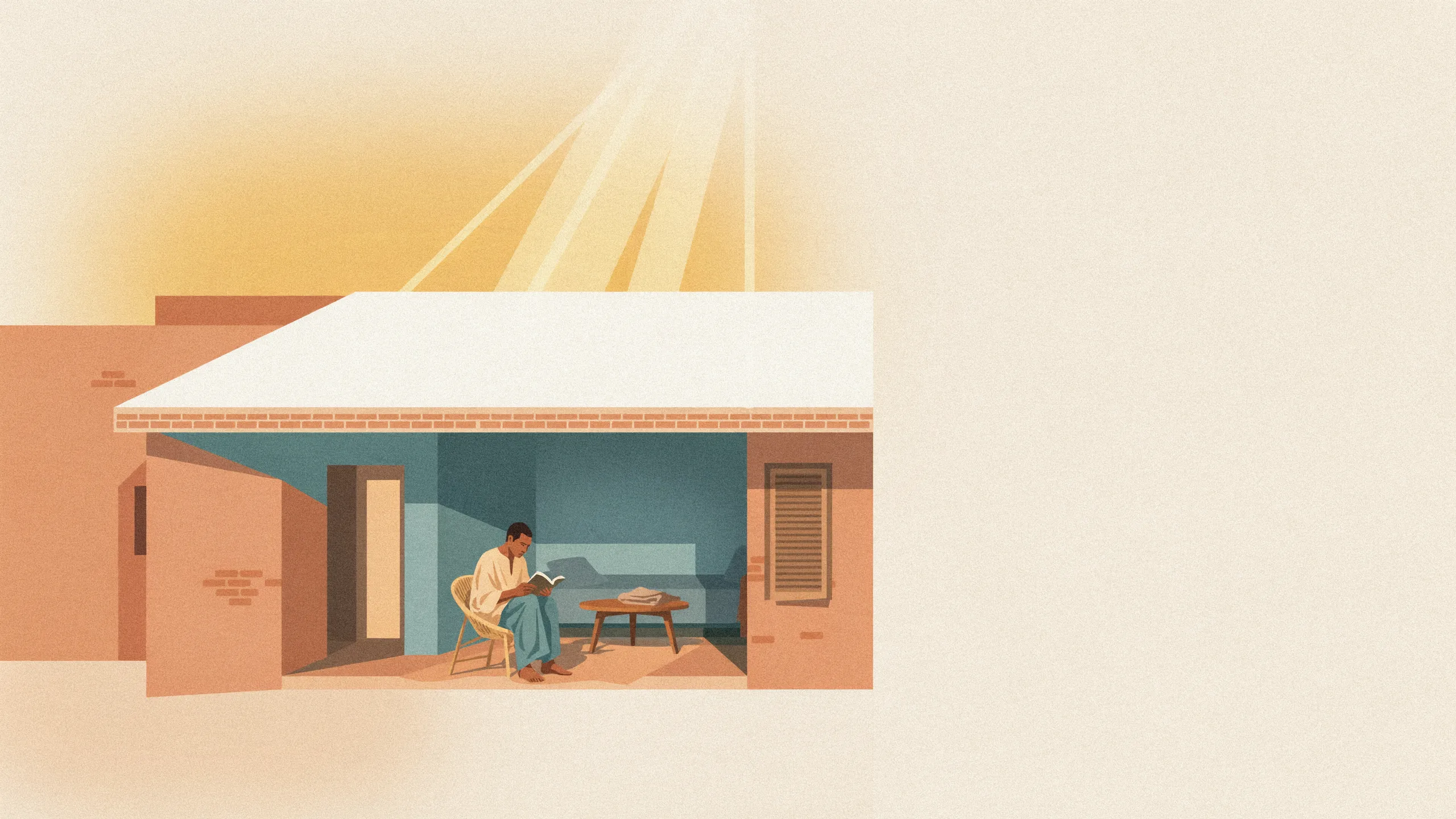
Cover: AI-generated conceptual illustration, Ideogram 4.5, 9 November 2026. It depicts an imagined home, not a completed Sudanese project or measured cooling result.
A roof is a large surface with a small audience. From the street, a fresh white coating may barely register. Inside the room below, its value would have to be felt in an ordinary afternoon: somewhere to sit, work or rest with less discomfort, or less expense keeping the room bearable.
That is the useful question for Sudan. Can a roof treatment improve life inside a home at a cost people can sustain? A convincing answer needs more than a photograph of a newly painted roof. It needs a comparison that follows the room and the people living in it.
What the roof can change
Reflective roofing reduces the sunlight a roof absorbs. Thermal emittance—the ability of a surface to release heat—also matters. But a cooler roof surface and cooler indoor air are different outcomes. Roof construction, insulation and the rest of the building affect what reaches the room. Dirt can reduce reflectance over time. These are practical considerations in Bryan Urban and Kurt Roth’s Guidelines for Selecting Cool Roofs, prepared for the US Department of Energy in July 2010; its American examples are not Sudanese performance estimates. Read the guide.
For a reader considering the idea, that distinction is essential. A dramatic surface-temperature photograph cannot tell us how a bedroom feels at bedtime. Nor can a coating label tell us whether a particular existing roof is ready to receive it.
Sudan already has a research history
In 1980, Y. A. Mukhtar published Roofs in Northern Sudan—Their Thermal Performance and Methods of Improvement. The publisher’s abstract describes ten differently roofed, half-size huts tested in Khartoum. It reports that more expensive roofs did not consistently perform better. Only the abstract was available for this article; the experiment cannot supply a present-day household cooling promise. It does establish that comparing roof performance in Sudan is an older local research question. Publisher record and abstract.
A useful new trial would build on that question with occupied homes, current materials and transparent costs. It should begin by identifying which roofs can safely and practically take part. A coating project cannot quietly become a substitute for necessary roof repair.
A caution from Delhi
EPIC-India’s project account, Cool Roofing Solutions for Reducing Heat Stress in Delhi Slums, describes a randomized trial of reflective paint. It reports near-zero reductions in indoor temperature. The researchers suggest that households may have reduced other cooling inputs, particularly water, after receiving the treatment. This is an institutional project summary, without the full statistical report reviewed here; that possible explanation should remain attributed. It is evidence against assuming that painting a roof automatically delivers cooler occupied rooms. EPIC-India project account.
The implication for a Sudanese pilot is practical. If a family uses less water or electricity while the room stays equally warm, that may still matter to its budget. It is a different result from reduced heat exposure. Both deserve to be recorded honestly, rather than combined into a single claim of success.
What a small Sudanese pilot should measure
The following is a proposed research brief, not a project already operating or a household installation guide.
Start with a limited group of comparable, suitable homes and a clearly defined treatment. Record roof material, condition, shading, room size and ventilation. Measure conditions before treatment and retain untreated comparison homes during the same weather. Random allocation, where feasible and acceptable to participants, would strengthen the comparison.
Put the main measurements where people live. Track indoor air temperature and humidity through the afternoon and night, alongside outdoor conditions. Record sensor placement and equipment checks. If resources allow, include a measure sensitive to radiant heat: discomfort can involve hot surrounding surfaces as well as air temperature. Report roof-surface readings separately.
Ask residents about comfort, sleep and use of rooms without presenting those accounts as clinical evidence. Track fan and cooler use, water consumption where measurable, electricity availability and expenditure. Changing cooling habits should be part of the findings, not an unexplained complication discovered afterwards.
Keep the comparison fair. If one group also receives repaired ceilings, better shading or ventilation changes, record those separately. Otherwise, the trial cannot tell readers which intervention produced the difference. Shade or insulation could be evaluated as distinct alternatives where local skills and roof suitability permit.
Price the roof after the opening day
“Low cost” needs an itemized local budget. Our proposed pilot would record the treated area, surface preparation, necessary repairs, materials, transport, labour and disruption to the household. It would distinguish installation from later inspection, cleaning and recoating. Imported price examples cannot settle those costs.
Follow-up should extend beyond the freshly finished surface. What happens after dust accumulates? Does the coating adhere? Are there leaks or other defects? Who can inspect the roof safely, and who pays for upkeep? Any cleaning requirement should account for labour and water, rather than treating them as free.
Publish the range of outcomes as well as the average. A treatment useful for one roof type may be disappointing for another. If gains fade, the maintenance record is part of the answer. If costs outweigh benefits, publishing that result can prevent a larger, less informative investment.
The strongest next step is a modest, well-documented test with residents involved in defining what improvement means. The roof is the intervention. The room, the household’s resources and the durability of the result are where its value must be judged.
Reporting note: This is an evidence-informed proposal. Kandaka has not conducted the pilot, measured homes, obtained Sudanese installation quotations or interviewed participating households. Research access limits are identified beside the relevant sources.