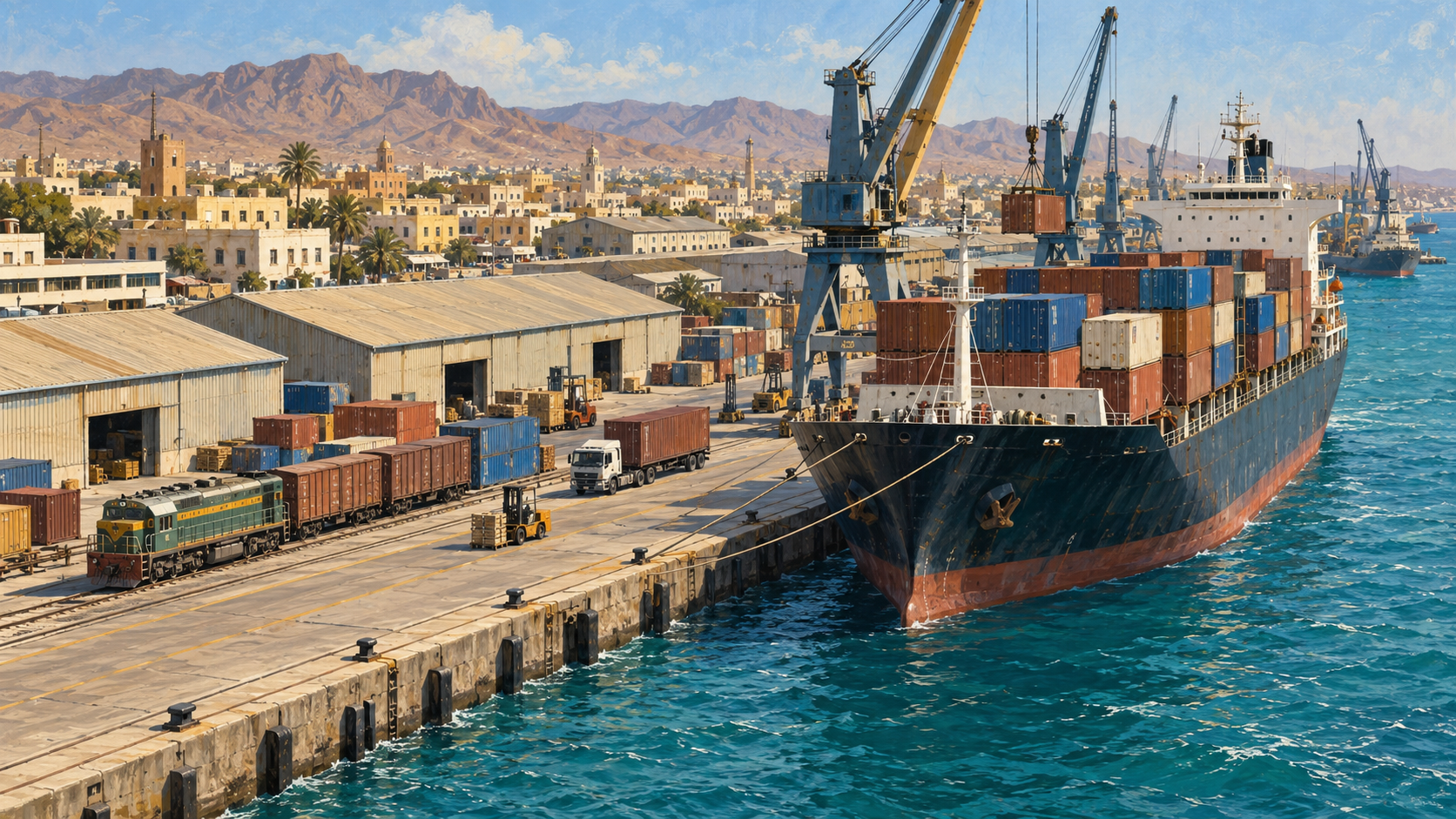
AI-generated editorial illustration created for Kandaka using OpenAI image generation. A fictional working harbour inspired by Port Sudan and its Red Sea setting—not a photograph, an exact view of the present port, an engineering design or an approved development project.
A coast is an opportunity, not a business model
Sudan’s Red Sea coast gives the country an opening to international trade. Turning that geography into prosperity, however, requires more than building deeper berths. The economic question is whether a port can connect Sudanese producers and consumers to useful services at competitive, dependable cost.
A deep-sea port can be part of that answer. It can also become an expensive facility whose traffic forecasts never arrive. Kandaka’s argument is that port development must be evaluated as a national production and logistics programme, with coastal communities as partners—not as a contest to announce the largest terminal.
Sudan already has a port system. The starting choice is therefore not simply between possessing a gateway and having none. It is between improving existing operations, expanding selected facilities and developing new capacity where evidence justifies it. Those alternatives should compete openly.
The Sea Ports Corporation describes specialized facilities for containers, general cargo, grain, liquids and livestock, including Port Sudan and Suakin. This confirms the importance of assessing an existing network. Its undated overview is not a current hydrographic survey or proof of available capacity, and this article does not reproduce its depth figures as navigation advice. Sea Ports Corporation, institutional overview.
What greater depth can offer
Sufficient navigable depth can allow vessels with greater draught to call, subject to channel conditions, berth design and safe operations. That may widen the range of services a port can handle and create opportunities for more efficient cargo movement. But depth alone does not persuade a shipping line to add a call.
Carriers need cargo volumes, reliable turnaround, suitable equipment and a commercially useful place in their network. Importers and exporters need predictable charges and inland delivery. A larger ship can lower some transport costs under the right conditions, yet those savings may be lost in waiting time, storage, fragmented procedures or inland disruption.
The appropriate performance measure is consequently the full journey. What does it cost to move a shipment from a Sudanese producer to its buyer—or an imported machine to the factory that needs it? How variable is that time and cost? A modern-looking terminal that leaves those answers unchanged has not delivered its central promise.
Five potential advantages worth testing
The first potential advantage is more dependable access to imported inputs. Machinery, medicines, packaging, spare parts and industrial materials all need predictable logistics. A port investment should demonstrate how it will reduce uncertainty for its users, not merely increase theoretical capacity.
Second, better logistics can support higher-value exports. Processed foods, refrigerated products and manufactured goods require different services from untreated bulk cargo. Inspection facilities, reliable cold storage and suitable transport may be as important as a new quay.
Third, a port can support domestic enterprises supplying repair, transport, warehousing, professional services and training. These benefits are not automatic. They depend on procurement practices, skills programmes and fair access for smaller firms.
Fourth, transit trade could connect Sudan’s coast with inland markets where commercial agreements, secure routes and competitive services make that attractive. This is a possibility to test country by country and corridor by corridor, not guaranteed revenue from drawing lines across a map.
Fifth, carefully designed additional capacity can improve resilience. Redundancy can matter when a facility or route is disrupted. But resilience is not the same as duplicating expensive assets that depend on the same vulnerable power supply, access road or institution.
These are Kandaka’s proposed channels of benefit. None is a forecast of jobs, revenue or cargo for an unnamed project.
The hinterland is part of the port
A port’s hinterland is the network of places that send and receive its goods. Reliable roads and railways, dry ports, warehouses, border procedures and communications determine how far the gateway’s advantages travel inland.
UNCTAD’s 2025 maritime review treats port performance and trade facilitation together. Its TrainForTrade contribution emphasizes transparency and communication among public and private participants. Kandaka draws a system-wide lesson: cargo-handling capacity is not a complete measure of success. UNCTAD, 2025 port-performance analysis.
For Sudan, Kandaka proposes testing the port programme against actual production chains. Can a processor obtain inputs and ship a finished product on time? Can a producer outside the capital reach the gateway without repeated avoidable delays? Can small exporters use shared services rather than finance their own parallel infrastructure?
The answers should shape investment sequencing. Sometimes the binding problem may be an inland connection, an unreliable inspection process or terminal management. If so, dredging first would solve the wrong constraint.
Coastal development must benefit the coast
Eastern Sudan should not be treated as empty space between ships and inland markets. A port programme must begin with the people living and working around its proposed footprint, including fishing communities and other users whose livelihoods may not be represented in formal land records.
Kandaka proposes early consultation, accessible information, fair compensation where relevant and an independent grievance process. Local benefit should be measurable through training, jobs, procurement and public services. Women and young people should have practical routes into those opportunities rather than appear only in consultation photographs.
Housing, water and transport pressures need assessment alongside commercial construction. A terminal may employ people while making daily life more difficult for nearby communities. That trade-off belongs in the public appraisal, not in an appendix nobody reads.
Environmental review must be specific to the site. Dredging, sediment disposal, habitat disturbance, pollution and changes in coastal activity should be assessed before commitments become difficult to reverse. Heritage and fisheries require attention in their own right. This article does not assume that an unidentified site is either environmentally acceptable or unacceptable.
A concession is not free money
Private participation can bring finance, expertise and operating capability. It can also transfer risks back to the state through guarantees, exclusivity, foreign-currency obligations or termination provisions. The label public-private partnership does not reveal who ultimately pays.
A defensible agreement should clearly distinguish construction, ownership, operation, regulation and security responsibilities. Tariff rules, service standards, public liabilities, beneficial ownership and arrangements at the end of the concession should be available for scrutiny to the extent compatible with legitimate confidentiality.
Competition matters on land as well as at sea. A terminal operator should not gain unchecked power over every service a user needs. Nor should unrelated land, mineral or agricultural concessions be bundled into a port transaction without separate public evaluation.
These are proposed governance standards, not allegations about a particular agreement. No current Sudanese concession is described here as signed, cancelled, financed or under construction without a verified source.
Red Sea exposure is a risk to price, not a reason to stop thinking
UNCTAD’s September 2025 assessment describes rerouting, volatile freight costs and fragile supply chains. That evidence strengthens the case for stress testing rather than assuming uninterrupted traffic. It is a dated global assessment, not a live shipping advisory for Sudan or a forecast for a specific terminal. UNCTAD, maritime trade under pressure.
A Sudanese port appraisal should test lower traffic, shipping-line changes, financing delays, disrupted inland access and higher operating costs. A strategic location can be valuable while still exposing a project to risks beyond its management’s control.
The commercial, diplomatic and security dimensions should be examined separately. Claims that a port automatically confers geopolitical power are not a substitute for an economic case. Any security arrangement would require its own lawful authority and public scrutiny.
Build a gateway that earns expansion
Kandaka proposes beginning with an independently checked baseline of existing facilities, demand, service performance and inland constraints. Compare rehabilitation, management reform, selective expansion and new construction on the same basis. Publish the assumptions and explain what evidence would change the decision.
Where an investment passes that test, structure it in useful stages. Each stage should deliver an operating service rather than depend on an entire speculative future city. Expansion should follow demonstrated demand and capability, with maintenance and environmental obligations funded from the outset.
Success would be visible in reliable delivery, competitive total costs, stronger local firms and opportunities shared with the coast and inland states. Those outcomes are more important than the maximum size of a vessel in a promotional rendering.
Sudan’s deep-sea ports could become gateways to a more productive economy. To do so, they must be planned from the factory, farm, workshop and coastal community outward—not from the photograph of a giant ship inward.