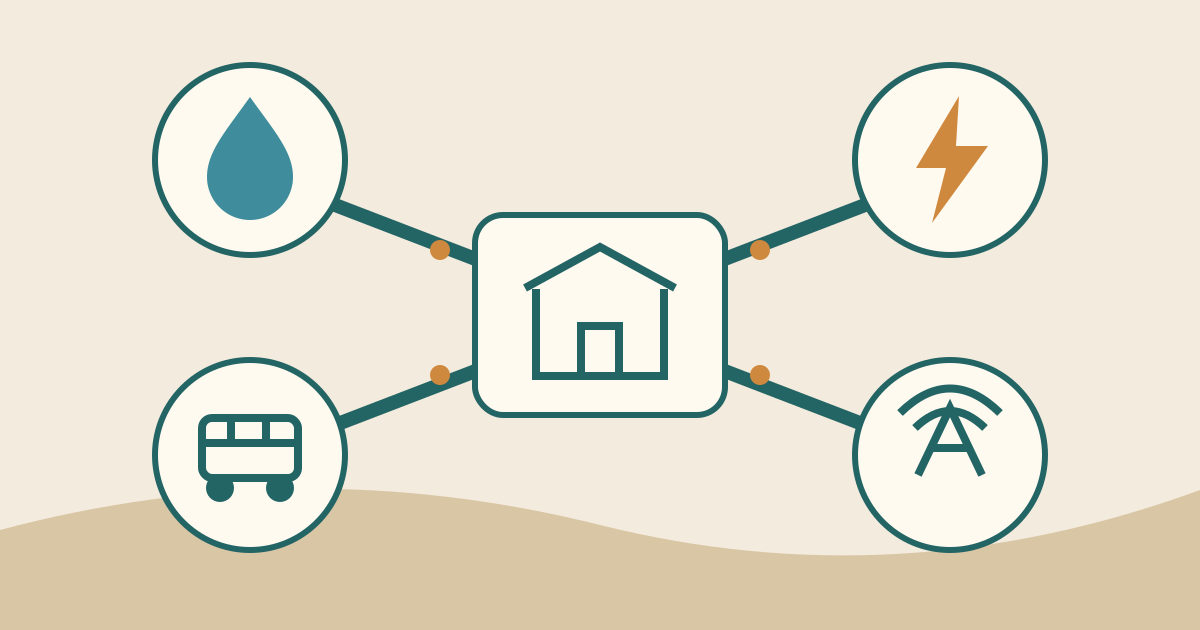
Original conceptual diagram by Kandaka. It is not a map or a depiction of completed projects.
The question behind the construction project
A road matters because someone can use it to reach a market, school or hospital. An electricity investment matters because power arrives when it is needed. A port matters because goods can move through it and onward, not simply because larger ships can approach its quay. Sudan’s reconstruction should begin with these outcomes.
This changes the central question from “What should we build?” to “Which broken connection most constrains daily life and productive activity?” The answers may still include major infrastructure. But they may also include maintenance, a missing feeder road, functioning communications, a repaired water system or an administrative reform that makes an existing asset useful.
Kandaka’s argument is that reconstruction should be judged as a connected service programme. Announced investment and completed structures are intermediate measures. Reliable access is the result that matters.
Reading the 2011 report responsibly
Ranganathan and Briceño-Garmendia’s report benchmarks transport, energy, water and communications through the Africa Infrastructure Country Diagnostic. It identifies uneven sector performance and substantial financing and efficiency challenges. It is valuable as a historical baseline, not a current reconstruction budget.
Its terminology requires care: “all parts of Sudan” denotes the pre-separation territory, while “Sudan” denotes the northern part and “South Sudan” the new country. Some underlying information was collected for the combined territory and allocated using imperfect proxies. Much technical evidence dates from 2006–07; financial data use earlier periods. Thus neither its boundaries nor its reference years can be assumed from the country name alone. World Bank, original report, especially the introductory methodological notes.
Those limitations are reasons to read the study carefully, not discard it. It supplies questions for a new assessment. It cannot supply today’s answers without fresh evidence.
Reconstruct a network, not a collection of announcements
Consider a proposed agricultural corridor. A trunk road might shorten part of the journey, but the economic result would still depend on access from producing areas, seasonal reliability, safe passage, storage, buyers and the practical ability to move goods onward. The right appraisal should examine the complete journey.
The same reasoning applies to a port. Additional maritime capacity should be assessed alongside inland transport, operating arrangements, customs processes and realistic cargo demand. A project cannot be justified solely by its engineering scale or its position on a map. This is a proposed appraisal principle, not a conclusion that any named Sudanese port project is viable or unviable.
For water and electricity, the network includes institutions as well as equipment. A repaired pump needs an operator, spare parts and a workable maintenance budget. A clinic needs a dependable service and the ability to report failures. An asset handed over without these arrangements carries an unresolved liability.
Kandaka proposes that each major project therefore publish a short service-chain assessment. It should identify the users, the other systems needed for success, the weakest links and the institution responsible for each. This would make hidden dependencies visible before construction begins.
Recovery changes the order of work
The World Bank’s May 2025 Sudan Economic Update documents the severe economic disruption associated with the war that began in April 2023. That context prevents a simple continuation of a pre-war investment agenda. A new programme needs current information on functionality, access and institutional capacity, not just an inventory of assets that once existed. World Bank, Sudan Economic Update, May 2025.
Our proposed first step is a service-functionality register. For each priority location, it would record what works, what fails, whom it serves, what repair is feasible and whether safe delivery is possible. It should distinguish verified observations from estimates and inaccessible areas from areas with no need.
The register should not become a reason to postpone urgent repairs. A rolling process could permit well-supported, safe interventions while more complex assessments continue. Decisions would be documented and revised as evidence improves. Uncertainty should change the confidence attached to a decision, not disappear from the record.
A sequence built around public needs
Kandaka proposes three overlapping stages rather than a rigid national timetable. The first is restoring essential services where conditions permit: water, health-related electricity, basic communications and critical access. The second is repairing connections that support livelihoods and regional exchange. The third is evaluating larger expansion projects against refreshed demand and public-finance assumptions.
This sequence is a policy proposal, not a funded programme or forecast. Different areas may occupy different stages simultaneously. A functioning region may be ready for an investment that would be premature elsewhere. National fairness does not require pretending that conditions are uniform.
Distributed systems deserve consideration where they can provide dependable service sooner, but should not automatically be treated as substitutes for future networks. Procurement should address compatibility, maintenance and eventual integration. The World Bank’s June 2025 ASCENT-Sudan announcement, focused on energy and digital connectivity in Gadaref, Kassala, Northern and River Nile states, provides a contemporary project example. Its announcement establishes intended activity, not completed results. World Bank project announcement.
Regional fairness must be explicit
An appraisal based only on existing commercial traffic can favour places already advantaged by earlier investment. An appraisal that ignores demand altogether risks expensive assets with little use. Sudan needs a transparent way to weigh both productive potential and equitable access.
One approach would publish separate scores for essential-service need, livelihood benefits, regional inclusion, readiness and recurring affordability. Readers could then see the trade-offs rather than being offered a single unexplained ranking. The weighting would require public deliberation, not merely a technical consultant’s preference.
Displaced people, pastoral communities and settlements with weak records must be considered directly. Their needs may not appear in conventional billing or traffic data. Consultation should seek evidence from intended users without assuming that the loudest local institution represents everyone.
Finance the service for its lifetime
For historical scale, the report estimated annual needs of roughly $4.2 billion, observed spending of $1.5 billion and inefficiencies of $580 million, chiefly in electricity. Water and transport dominated needs. These are dated estimates, not current costs or a measure of stolen money. 2011 report, synopsis.
Rail should face the same service test as roads: which feasible rehabilitation would move enough freight or passengers reliably to justify its full operating cost? A national rail vision is not a substitute for corridor-level assessment, nor is road expansion automatically preferable. Compare repair with replacement before selecting the technology. This complements Kandaka’s Five-Year Plan and public-transport analysis: productive capacity and accessibility require maintained connections. The same tests should inform a future megaproject scorecard rather than presuming that large projects always outrank smaller repairs.
A project budget should include more than the purchase price. Kandaka recommends a visible account of operation, maintenance, replacement and institutional costs, together with who is expected to pay. Financing that makes construction possible can still leave a service unaffordable to operate.
Affordability policy should distinguish users who cannot pay from avoidable losses and poorly managed expenditure. These are different problems and require different responses. Any proposed tariff or subsidy reform should explain service commitments and protections for vulnerable users; it should not simply assume that higher charges produce better services.
Public reporting should track functionality and reliability alongside expenditure. Useful measures might include service interruptions, repair times, access for previously underserved communities and whether maintenance funds are actually available. The selected measures should be independently checkable and should not expose sensitive information about vulnerable users.
Sudan does not need to choose between urgent recovery and a larger development vision. It needs a way to connect them. Restore essential services, repair the links that make production possible, and require major projects to demonstrate how they complete the network. The objective is not the greatest quantity of concrete. It is a country in which infrastructure enables people to live, work and move with greater reliability and dignity.