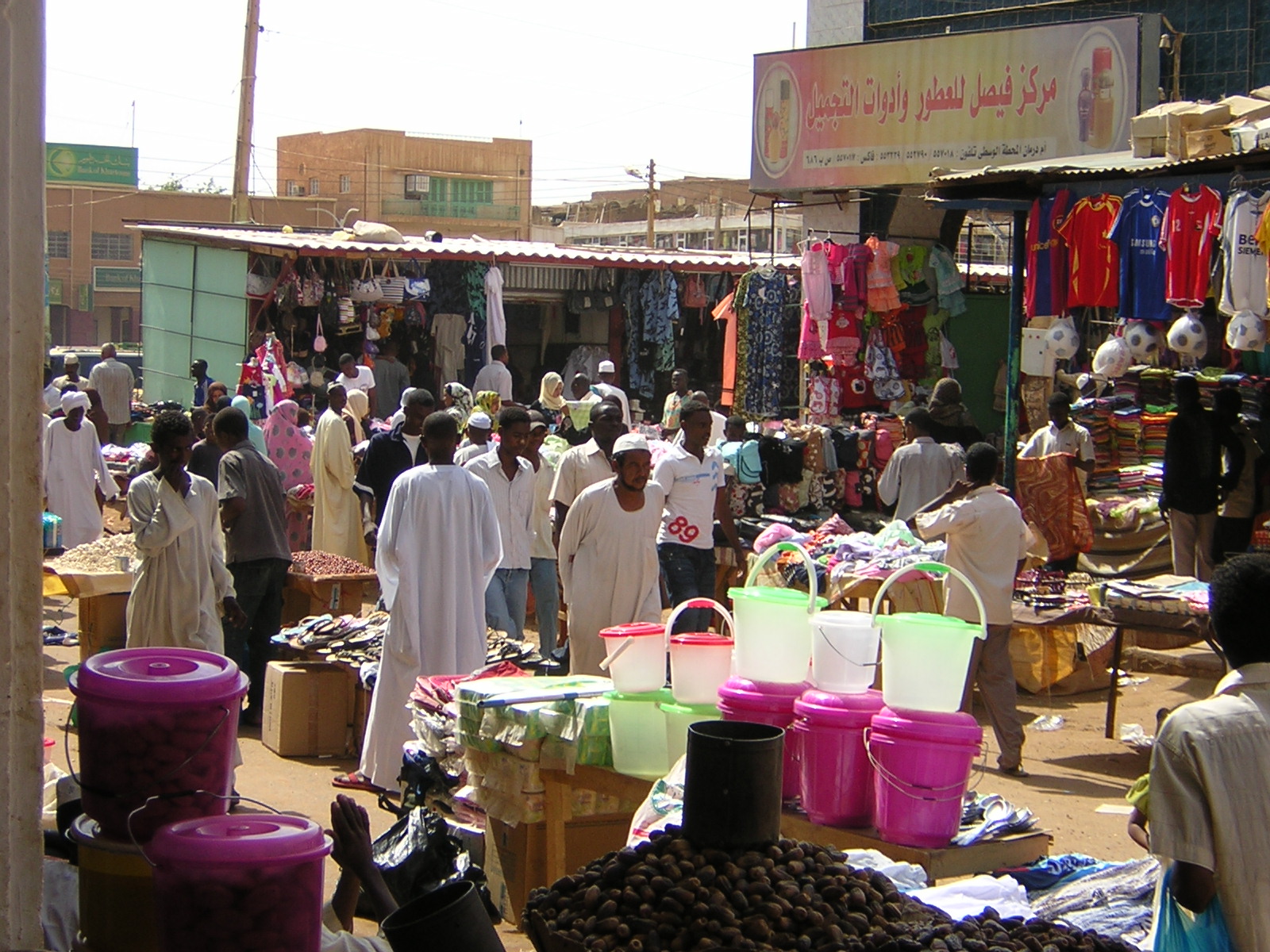
Omdurman market, 14 August 2009. Photograph: Petr Adam Dohnálek, Wikimedia Commons, CC BY-SA 3.0 CZ. Unmodified historical photograph, not a picture of present conditions; no income or employment status is inferred about the people shown.

Recovery has to reach the household
A salary can rise while the life it buys becomes smaller. A business can reopen without providing regular work. A household can receive money from a relative abroad and still be one illness away from having to sell an essential asset. These are different problems, and a recovery plan that puts them all under the heading of “jobs” will struggle to solve any of them well.
For Sudan, the practical question is not simply how to restore economic activity. It is how to make ordinary life less precarious: earnings that arrive when expected, markets people can reach safely, and basic services that do not swallow every additional pound.
This article’s argument is that household security should be a test of recovery, alongside production and investment. That is a policy position, not a result proved by a single survey.
A useful baseline, not a picture of today
ERF’s 2026 paper on income and wages uses the Sudan Labor Market Panel Survey of 2022. It reports disparities by gender and location and limited diversification of household income. But its monetary analysis relies on complete income records, available for only about 70% of surveyed households. It therefore offers a qualified pre-war baseline, not a current income distribution or a causal test of policy.1
Missing information matters because households that cannot or will not report an amount may differ from those that do. Without further investigation, we cannot confidently say how that affects the results. Nor should a national average be treated as the experience of every state, occupation or family.
The ILO’s April 2024 statement separately describes displacement and lost employment opportunities during the war. It establishes a dated account of disruption, not an updated wage survey.2 Reading it alongside the earlier baseline helps frame questions; it does not allow us to calculate today’s household earnings. Older pound amounts should not be relabelled as present purchasing power.
An income is not necessarily a wage
Consider a hypothetical household with a salaried worker, a small trading activity and occasional support from relatives. The salary, the trader’s earnings after expenses and the transfer are three distinct flows. Counting turnover as profit would exaggerate what is available to spend. Treating a transfer as a new job would misunderstand its role. Ignoring unpaid care would conceal the work that makes other employment possible.
Those distinctions have policy consequences. A worker owed wages needs payment and a way to challenge non-payment. A trader unable to replenish stock may need working capital or access to suppliers. A person unable to work may need income support. Sending all three to the same enterprise-training course would be administratively convenient and economically careless.
Diversification can help, but it is not magic. Two earners whose customers depend on the same closed market may share the same risk. A second activity can also mean longer hours and less time for rest or care, rather than genuine resilience. The question is whether another income source improves security after its costs are counted.
Measure what a pay packet can buy
Nominal pay is the number written on the payment. Real pay describes its purchasing power. Imagine, purely for illustration, that earnings increase by one quarter while a household’s essential costs rise by one half. The household has more money in pounds but less room to live. Announcing the pay rise alone would tell the wrong story.
The ILO’s wage work explicitly addresses real wages, pay-setting institutions and gender pay gaps.3 For Kandaka, the practical implication is to ask several questions together: Was the worker paid? Was payment timely? How many hours were required? What did food, transport and housing cost locally? Were there deductions or costs that the headline figure concealed?
A useful public dashboard could track those measures in accessible local markets, state its geographic gaps and protect respondents’ identities. It should not turn a few reachable towns into a supposedly precise national picture. Better incomplete evidence, honestly labelled, than a confident number whose coverage is invisible.
Women’s earnings require more than an average gap
A difference between women’s and men’s earnings is an invitation to investigate, not a complete explanation. Hours, occupations, interrupted careers, hiring practices, access to transport and unpaid care can all matter. A comparison of household heads is also not the same as a comparison of all women and men.
Kandaka proposes testing recovery programmes against the barriers people actually face. Are working hours compatible with care responsibilities? Can applicants participate safely? Is selection tied to property or documents that displaced people may not possess? Can workers raise concerns without losing their position? These questions should include women with disabilities, rural workers and people outside salaried employment.
The answer should not be a separate “women’s component” added at the end of an otherwise unchanged programme. Recruitment, payment and evaluation need to be designed with those obstacles in mind. A programme can achieve numerical participation and still leave the most difficult barriers intact.
Support work without making debt the answer to everything
Recovery assistance should begin with a diagnosis. A temporarily interrupted but viable activity differs from one whose customers have disappeared. A grant may be appropriate for replacing essential tools; repayable finance may suit a predictable order; an income transfer may protect someone who cannot safely work. These are options to assess, not a blanket prescription for every place.
Public employment programmes, where safe and feasible, should pay for useful work rather than reward attendance at unnecessary projects. Rehabilitation tasks need technical supervision and clear protections. Participation must never require civilians to handle explosive hazards or enter unsafe structures. People unable to participate should not lose access to essential support.
Public-sector pay also deserves attention: reliable services require people to deliver them. But a credible plan must identify financing and priorities, not merely announce higher entitlements. Delayed promises are not household income. Equally, demanding immediate cost recovery from every damaged service can shift the burden onto families least able to pay.
Ask who is better off after the project ends
A recovery programme should publish more than the number of loans, trainees or temporary positions. It should ask whether participants retained earnings after expenses, whether payment became more predictable, and whether gains lasted. Where comparisons are possible, evaluators should account for differences in starting conditions and wider market changes.
Workers, small employers and community representatives should help decide what success means. That does not remove trade-offs: scarce money cannot meet every demand. It makes those trade-offs visible and gives people a way to challenge an impressive headline that does not match their experience.
Sudan needs productive businesses and functioning infrastructure. It also needs a simple discipline in judging them: does recovery give people a more secure way to live? The answer belongs in household budgets and everyday choices, not only in national totals.
May Gadallah, Nesma Mamdouh Amer, Sara Ragab and Dalia Hany, ERF Working Paper 1824, March 2026. Methods and income definitions, printed pp. 6–8; conclusions, pp. 36–38. No microdata reanalysis was undertaken. ↩︎
ILO, statement on decent work amid conflict in Sudan, 16 April 2024. Institutional statement, not a new household survey. ↩︎
ILO, Wages. General wage-policy framework; not a Sudan-specific estimate. The programme proposals above are Kandaka’s analysis. ↩︎