Updated
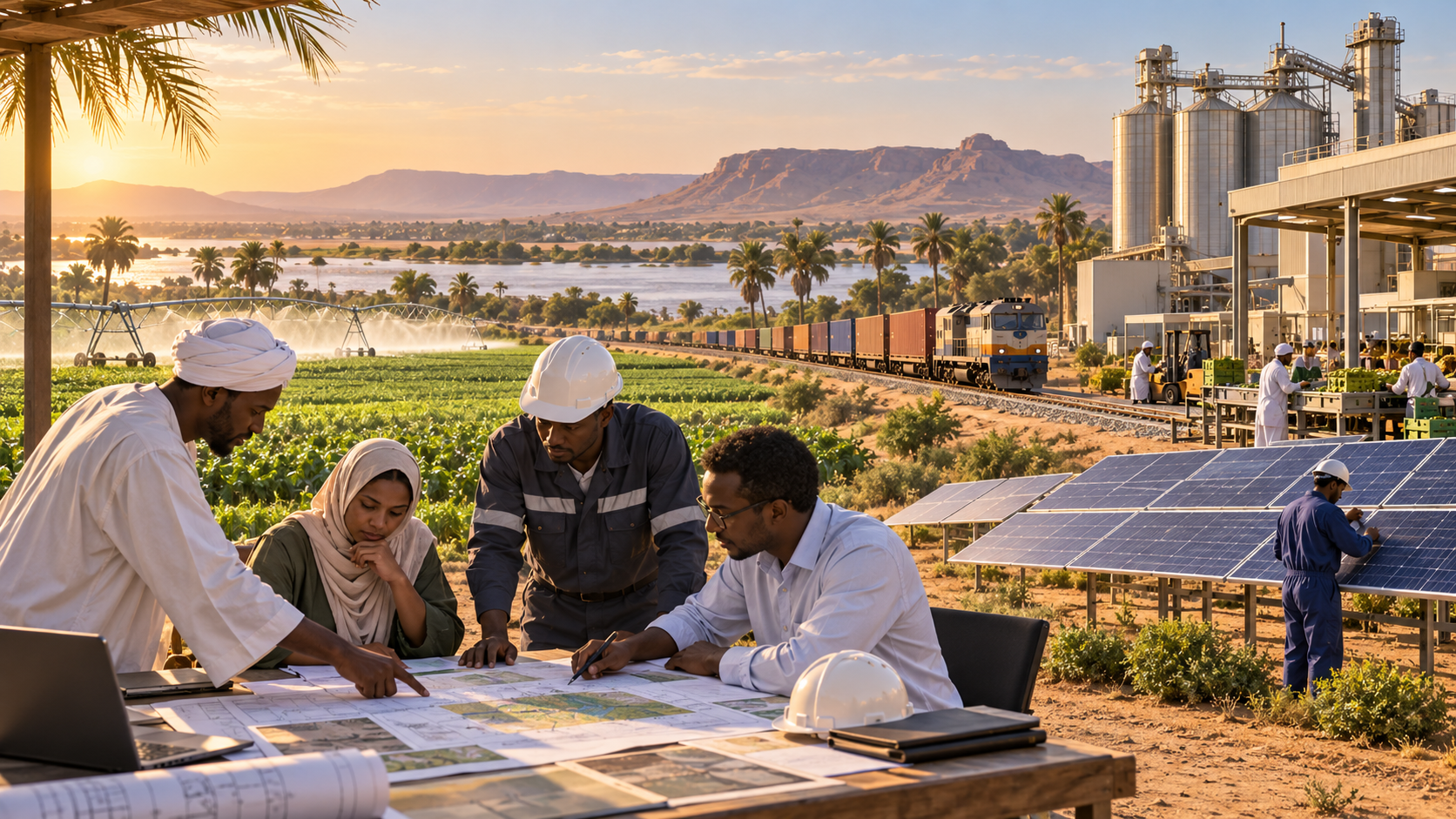
An accountable production plan must connect farms, power, processing, skills and transport. Original illustration commissioned for Kandaka.
Sudan does not need another document that promises everything to everyone. It needs a plan that makes choices, names who must deliver them, and allows citizens to see—year by year—whether anything changed.
That distinction matters because Sudan is not merely discussing a future plan. The government has been preparing a national 2026–2030 Five-Year Strategic Plan. In April 2026, the Cabinet Secretariat described reconstruction, peace, productive projects, youth employment, agriculture, livestock and mining as central themes. A later workshop called for a shift from planning by activities to planning by results and impact, and for infrastructure to be linked directly to production. By May, federal ministries were submitting their own five-year plans for consolidation. (Cabinet workshop, 8 April; planning guidelines, 24 April; ministerial coordination, 20 May)
Those are sensible intentions. But Sudan has had sensible intentions before. Its 1977/78–1982/83 Six-Year Plan also promised to relieve transport bottlenecks, expand exports, improve foreign exchange, and increase domestic production of sugar, wheat and textiles. (World Bank assessment) The recurring problem has not been a shortage of plans. It has been the distance between a plan and a functioning system of delivery.
The question, then, is not whether Sudan should have a five-year plan. It is:
What would make the 2026–2030 plan different from the plans that came before it?
Sudan’s Ten-Year Plan of 1960/61–1969/70 and Five-Year Plan of 1970/71–1974/75 preceded those ambitions. The Six-Year Plan’s 7.5% annual real-growth goal was a target, not an achieved rate. A later investment program emphasized completing and rehabilitating existing projects; H. A. Mahran’s 1994 retrospective found that 54.3% of planned allocations were utilized in the first three-year public investment program. That measures one historical program’s implementation, not all Sudanese investment since independence. (Mahran, 1994)
Begin with the constraint Sudan cannot print away
The first discipline is foreign exchange. Sudan can issue local currency, but it cannot print the dollars, euros, dirhams or riyals needed to buy fuel, wheat, medicines, machinery and spare parts. A production plan that ignores the import bill is not a production plan.
The Central Bank of Sudan’s preliminary figures show the scale of the problem. In January–June 2026, recorded merchandise imports reached $4.517 billion, up from $3.073 billion in the same period of 2025. Recorded exports were only $1.816 billion, leaving a six-month merchandise trade deficit of about $2.701 billion. (CBOS Foreign Trade Statistical Digest, January–June 2026)
These tables measure trade recorded through customs stations and should not be read as a complete account of informal or otherwise unrecorded cross-border flows.
The import bill was not one undifferentiated burden:
| Import group, January–June 2026 | Preliminary value |
|---|---|
| Petroleum products | $1.495 billion |
| Food | $992.1 million |
| Machinery and equipment | $517.3 million |
| Medicines | $241.6 million |
| Textiles | $203.6 million |
| Transport equipment | $293.9 million |
The wrong response would be to announce that Sudan will simply reduce imports. Machinery imports rose from $357.6 million to $517.3 million. Tractor imports rose from about $21.9 million to $67.6 million. Railway-wagon imports rose from about $0.4 million to $9.1 million. Those purchases may increase the import bill today while rebuilding the capacity to produce tomorrow.
The plan should therefore divide imports into three baskets.
- Replaceable consumption imports: goods Sudan can competitively produce or process within five years—parts of the sugar, edible-oil, flour, garment, leather, food-processing, construction-material and basic-medicine bills.
- Demand that can be structurally reduced: especially diesel used for irrigation, workshops, cold rooms, clinics and decentralized electricity, where solar can replace fuel.
- Productive imports to protect: machinery, tractors, electrical equipment, industrial components, laboratory equipment, technology and spare parts that raise future output.
Self-reliance should not be measured by how few things Sudan imports. It should be measured by whether Sudan imports the things that expand production while steadily replacing the things it can make well at home.
Protect productive imports, measure net foreign-exchange savings
The Central Bank’s published Foreign Trade Statistical Digest index still identifies January–June 2026 as its latest trade release as of 18 October 2026. The six-month merchandise gap discussed above must be taken seriously, but indiscriminate import bans are the wrong answer. In April 2026, Reuters reported a Sudanese directive that restricted some industrial raw materials alongside consumer products. Restricting inputs can disable the very factories import substitution is supposed to revive. A Productive Import Shield should therefore protect essential seed, fertilizer, quality medicines, machinery, spares and inputs that cannot yet be made competitively in Sudan.
Every candidate industry needs a Net-FX Test. Estimate imports credibly displaced plus new export receipts, then subtract imported components, equipment, maintenance, logistics, royalties and foreign-currency debt service. Test domestic price, product quality, available volumes, production reliability and food-security consequences as separate conditions. Firms receiving finance, tariff relief or public procurement preferences should face independent milestones and a defined date when preferences end. CBOS; Reuters, 27 April 2026.
Wheat shows why slogans are dangerous
Wheat is a useful warning against declaring victory too early. Between the first halves of 2025 and 2026, recorded wheat-flour imports fell from about $142.4 million to $25.1 million. That looks like successful import substitution. But wheat-grain imports rose from about $145.0 million to $381.6 million. The combined bill rose from $287.4 million to $406.7 million.
Sudan may have captured more of the milling stage domestically, and that still matters: milling creates work in processing, transport, storage, maintenance and distribution. But milling imported grain is not wheat self-sufficiency.
The realistic five-year objective is not “zero wheat imports.” It is to capture achievable stages of the value chain, improve yields where wheat is agronomically and economically sensible, support alternative local staples, reduce storage losses, and lower the combined grain-and-flour bill without endangering food security. Every commodity target should be tested with the same honesty.
Test targets against prices and harvests
On 8 October, Sudan’s agriculture minister announced a 3-million-feddan winter-crop target that includes 1 million feddans of wheat. These are plans, not harvested output. A winter season scorecard should disclose hectares/feddans financed, actually planted, reliably irrigated, harvested, safely stored and marketed, then the subsequent grain-and-flour import bill. All substitution targets need a food-availability and household-price safeguard. A May 2026 assessment by FAO/WFP/UNICEF found nearly 19.5 million people facing acute food insecurity; famine risk and constrained access remain binding realities, not details to be delegated to another ministry. Sudan Tribune, 8 October 2026; FAO/WFP/UNICEF.
Repair before building monuments
Sudan’s quickest productive gains may come from equipment it already owns: sugar estates, ginneries, mills, workshops, pharmaceutical lines, tanneries, irrigation pumps, railway facilities and cold stores. The plan’s first industrial act should be a national productive-capacity audit.
Within its first 100 days, that audit should publish, facility by facility:
- design capacity and actual operating capacity;
- war damage and missing equipment;
- electricity, water, finance, input and logistics constraints;
- the cost and time required to restart production;
- ownership and outstanding liabilities;
- jobs restored and foreign exchange saved if rehabilitation succeeds.
A repair that returns a viable factory to production in twelve months should normally outrank a ceremonial new project that will absorb scarce foreign exchange for five years. New plants are justified when the market, location, inputs, energy and management case is stronger—not because a new building photographs better than a repaired one.
Make a project pass a readiness gate
Sudan’s 1977/78–1982/83 Six-Year Plan already promised export growth, import substitution, industrial production and relief from transport bottlenecks. The lesson is not that these ambitions were misguided; it is that a production target without reliable power, transport, imported parts, markets and maintenance is not yet an executable project. Before the new plan commits scarce finance, every major investment should pass a Readiness Gate: financing secured, procurement achievable, water and power available, imports and working capital costed, logistics and market access verified, and maintenance budgeted. A repair to an existing productive system should compete on equal terms with a new flagship project, and with cheaper distributed alternatives. Report its path through proposed → funded → commissioned → operating → productive after twelve months, not merely the date of its announcement.
The cost of leaving production stranded
An IMF study published in 1980 described more than 80,000 tonnes of groundnuts from the 1977/78 harvest unable to reach Port Sudan because of railway transport and maintenance failures. An export target is incomplete until storage, a route to port, safe passage, spares and an operating budget are demonstrated. This historical failure is a practical reason to compare railway and irrigation rehabilitation with new prestige projects and distributed alternatives. IMF Staff Papers, 1980.
Trade corridors are production projects only when goods can move
On 1 October 2026, Sudan’s finance ministry announced the country’s formal return to the Horn of Africa Initiative’s regional economic-cooperation work, which covers cross-border transport, digital systems, energy links and trade facilitation. This is an opening for trade policy, not evidence that a railway, port, customs system or industrial zone has been funded or completed. A corridor should qualify for five-year-plan support only after its productive use has been specified: named commodity and origin, target market and buyer, current farm-to-market or factory-to-port cost, safe transport and cold storage if required, border/document clearance time, foreign exchange generated, and annual maintenance budget. Existing rail, roads and port-handling repair must compete fairly with new corridors and small distributed storage and collection alternatives. The test is lower delivered costs and more reliable access to markets, not kilometres announced. Sudan Tribune, 1 October 2026.
A focused production portfolio
UNDP’s August 2026 agri-food analysis identifies seven value chains—sesame, sorghum, soybeans, groundnuts, hibiscus, gum arabic and livestock—where finance, infrastructure and trade facilitation could help restore livelihoods. Its private-sector strategy also argues for supporting surviving farmers, traders and small manufacturers. These are recovery priorities, not evidence that production has already recovered. (UNDP market analysis; private-sector strategy)
The national plan should concentrate support where Sudan has a plausible five-year path to savings, jobs or exports. That means a short portfolio, not hundreds of “priority” projects.
Food and agro-processing. Rehabilitate sugar capacity before building new estates; expand competitive oilseed crushing and refining; improve grain storage and milling; process sesame, groundnuts, gum arabic, fruit and vegetables closer to production areas. Support should be tied to verified output, food-safety standards and reductions in imports or post-harvest losses.
Livestock, leather and fisheries. Sudan earned about $287 million from recorded live-animal exports in the first half of 2026, but only about $0.55 million from meat and $1.78 million from hides and skins. The opportunity is not to ban live exports. It is to add veterinary services, quarantine, feed, slaughter, cold chains, dairy processing, tanning and finished leather goods so that producers retain more value. (Kandaka’s detailed livestock plan)
Basic medicines and medical supplies. The immediate goal should be reliable local formulation, packaging and quality-controlled production where Sudanese plants can meet standards—not a claim that every medicine can be made locally. Public procurement can provide predictable demand, but only certified products should receive preference.
Textiles and garments. Cotton alone does not create an industry. The chain runs through ginning, spinning, weaving, dyeing, garment production, design, procurement and export compliance. Support should follow firms that move into higher-value stages and retain workers, especially women, rather than protecting inefficient production indefinitely.
Construction and repair materials. Reconstruction will create large demand for cement products, glass, metalwork, cables, pipes, doors, windows and prefabricated components. Local procurement can build capability if standards and prices are transparent. It should not become permission to sell poor materials at monopoly prices.
Productive solar. Solar should be treated as foreign-exchange and production policy, not only as household electricity. In 2025 the World Bank approved the $76.3 million ASCENT-Sudan project, targeting 150,000 people and 500 renewable-energy systems, including solar irrigation and food processing, through private delivery and results-based finance. (World Bank) On 18 August 2026 the government exempted imported components of solar systems for personal use from duties, taxes and other government fees. (Prime Minister’s decision, 18 August) On 1 September the Cabinet linked solar explicitly to agriculture and industry while calling for stronger quality testing. (Cabinet decision, 1 September) The next step is a productive-solar window for pumps, cold rooms, clinics, workshops and processors, with performance standards, maintenance contracts and measurement of diesel displaced.
Commissioned systems, not purchased panels
In September 2026 the World Food Programme sought suppliers of solar irrigation systems in River Nile and Northern states, explicitly requiring installation, commissioning, maintenance and after-sales service. In Red Sea State, UNOPS cancelled a tender on 1 September because too few bids resulted in uncompetitive prices; the procurement was divided and re-advertised for six solar-powered model farms with an October 6 deadline. These steps show process, not a system generating water and output. The solar dashboard should track tendering, award, commissioning, measured uptime, irrigated land, harvest volumes and diesel displaced—not confuse importation of equipment with performance. Pakistan’s rapid decentralized solar growth demonstrates the attraction of affordable panels while highlighting grid-finance, tariff and maintenance risks. Sudan should apply these lessons first to reliable productive uses: pumps, cold chains, workshops, clinics and processing. WFP tender (14 September); UNOPS cancelled tender; UNOPS re-bid; REN21 Pakistan; IEEFA Pakistan grid analysis.
A cheaper pump is not permission to pump unlimited water
The 12 October 2026 IPC alert, published by WHO, says drought affecting roughly half of Sudan is intensifying food insecurity and pressure on clean water in parts of Darfur and Kordofan. Sudan’s solar-irrigation plans therefore need a water-rights gate before the energy purchase. Pakistan’s rapid solar-pump adoption has shown that removing the cost of diesel and electricity can encourage extra groundwater pumping; the observation is a risk warning, not proof that all solar irrigation causes aquifer depletion. Morocco offers a complementary policy lesson: meter wells, set extraction limits and combine more efficient irrigation with groundwater governance. A Sudanese pilot should record baseline water availability, drinking-water priority, permitted withdrawals, metered extraction, groundwater levels when relevant, pump uptime, actual hectares irrigated, produce sold and diesel displaced. Suspend expansion if the water balance deteriorates, even if the panels work perfectly. The 19.5 million people reported acutely food-insecure in May 2026 is not a new countrywide count from the October alert. WHO/IPC alert, 12 October 2026; Reuters, Pakistan; World Bank, Morocco.
Let states propose; make support conditional
Sudan is too large and varied for one ministry in the capital to decide every locality’s productive future. But decentralization cannot mean sending money without obligations.
Each state should prepare a State Production Compact. The state, local governments, producer groups, firms, universities, unions, women’s organizations and affected communities would propose a limited set of priorities. The federal government would negotiate the infrastructure, finance, guarantees, foreign exchange or tax treatment it can provide. Both sides would then sign a public performance agreement.
Every compact should state:
- the baseline and annual physical-output target;
- foreign exchange expected to be saved or earned;
- permanent and temporary jobs, reported separately;
- the share of jobs and contracts going to women and young people;
- apprentices trained and placed in work;
- local inputs and local supplier purchases;
- private, cooperative and community co-investment;
- cost, deadline, equipment uptime and maintenance funding;
- environmental, land and conflict safeguards;
- the conditions under which support will be redesigned or withdrawn.
Rwanda’s Imihigo system shows how national goals can be translated into public performance contracts for ministries and districts and evaluated regularly. Its 2024/25 evaluation also shows why publication matters: it identified weak urbanization results and attributed failures to procurement, contract management, implementation delays and budget constraints. (National Institute of Statistics of Rwanda) Sudan should borrow the accountability mechanism, not Rwanda’s political centralization. Priorities must be negotiated from below and independently verified.
Turn a state compact into a public delivery contract
The African Development Bank’s BOOST, launched in September 2026, is a useful live test for Blue Nile and Sennar. It targets 232,000 farmers organized in 175 cooperatives, more than 980,000 tonnes of output, 140 storage/processing facilities and 1.2 million airtight bags. The numbers should be reported as targets until verified delivery. A state compact can connect financing, seed, irrigation, roads, storage, buyers and maintenance in one audited chain, with output sold, post-harvest losses and farmer income documented alongside spending. Internal state and local charges that block legal movement of goods should also be audited: decentralization should not create internal customs borders. Publish baseline, financier, milestone, beneficiary group, independent verification, employment retained after twelve months and corrective action for each compact. AfDB BOOST.
Give producers a vote, not just a place in the photograph
A study discussed on 16 October 2026, as reported by Sudan Tribune on 17 October, highlighted a gap between Sudanese women’s and young people’s extensive civic activity and their influence over formal political decisions. The survey’s representativeness cannot be established from the report, so its percentages should not be treated as a national census. The policy implication for a state production compact is nevertheless clear: women farmers, wage workers, youth businesses, traders and displaced producers should help select the production chain, scrutinize procurement and sign off on delivery reports—not merely attend consultations. Each compact needs documented, safe participation; published conflicts of interest; accessible complaints and appeal routes; and records showing whose proposals were accepted or rejected. Paid jobs retained after twelve months should still be counted by age and sex, but participation in decision-making needs its own measure. Consultation attendance does not equal influence. Sudan Tribune, 17 October.
No blank cheques for industry
Import substitution can easily become a respectable name for patronage. A politically connected firm receives cheap finance, tax exemptions and protected markets; it promises production; the support continues whether it delivers or not.
The five-year plan needs a harder rule:
Co-invest → produce → employ → verify → receive support.
Bangladesh’s Export Competitiveness for Jobs project offers a useful mechanism. Firms co-invested, grants were tied to milestones, an independent third-party manager assessed eligibility and reimbursed verified spending, and 570 firms received support. The project reported nearly 180,000 jobs and $18 million in private co-investment. (World Bank results report)
Sudan can adapt that principle. Industrial finance, tariff protection, land, foreign exchange and procurement preferences should all have time limits and published conditions. Successful firms should graduate toward productivity and export tests. Failed projects should be restructured or closed. Protection without discipline merely transfers money from consumers to owners.
Count jobs that survive
Employment cannot remain a hoped-for side effect. Nor should success be declared from construction jobs that disappear when a ribbon is cut.
The scorecard should count net jobs still present after twelve months, wages, working conditions, local recruitment, supplier jobs and apprentices who actually move into employment. Women’s and youth participation must be specified in each compact, supported by practical measures such as safe transport, childcare, sanitation, flexible work design, access to finance and recognition of home-based and cooperative production.
Training should follow real demand. If a state compact finances solar irrigation and food processing, its technical institutions should train the electricians, pump technicians, refrigeration specialists, mechanics, food-safety inspectors and machine operators those investments require. “People trained” is not an outcome unless skills lead to work or higher productivity.
The women-and-youth measure must be economic progression
Count jobs surviving twelve months, wages, safe working conditions, apprentices actually placed, businesses owned, loans accessed, equipment controlled and supply contracts won. Publish women- and youth-disaggregated outcomes within each state compact. Fix baseline measures first, then negotiate ambitious but credible targets with producers and local communities. In Jordan, a World Bank-supported employment program reported 48,000 formal placements, 52% women, and more than 2,800 women-owned home businesses; the enabling mechanisms included employment support, simpler licensing and access to childcare. Brazil’s productive-alliance experience in Bahia produced a 29% gain in average real net revenue of supported producer organizations and a reported 71% increase for women-led organizations. Sudan should borrow the verification and access mechanisms, not these countries’ headline targets. World Bank, Jordan; World Bank, Brazil.
For demonstration pilots, 35% women and 40% workers aged 18–35 could be negotiating benchmarks for verified new paid placements, subject to independent local baselines and feasibility checks. These are proposed pilot benchmarks, not national quotas or employment forecasts. Publish overlapping categories and count each worker once in the total.
Turn gold into assets that outlast the mine
Gold accounted for about $1.135 billion of Sudan’s $1.816 billion in recorded merchandise exports in the first half of 2026. That dependence creates an obvious rule: mineral revenue must build assets rather than disappear into recurrent spending, opaque companies or smuggling networks.
Botswana’s Sustainable Budgeting Principle provides the underlying logic: revenue from depleting mineral assets should be reinvested in other assets—physical infrastructure, human capital or financial savings. (IMF Public Financial Management Blog) Sudan needs its own Gold-to-Assets Rule.
A legislated share of verified mineral revenue should be assigned to productive infrastructure, health, education and technical capability, environmental repair, and financial reserves. The public should be able to trace the chain from mine registration to licensed buyer, export, repatriated proceeds, treasury receipt, state and producing-community shares, and the final funded asset.
This is not foreign theory imposed on Sudan. In August 2026, the government’s own mining-policy discussions called for federal-state coordination, limits on unregulated mining, and the participation of local communities in setting social-responsibility priorities. (Cabinet technical committee) The five-year plan should turn those principles into a transparent fiscal system.
Export value is not treasury cash
On 6 October 2026, Sudan’s mining regulator reported $2.292 billion of gold export proceeds for January–September and 1.886 trillion Sudanese pounds of domestic mining-sector receipts, with output at 105% of its annual target. These are the regulator’s statements, not yet an independently reconciled full public set of export, foreign-exchange and treasury figures. A Mine-to-Asset Ledger should show mine operator and safety status → independently assayed volume → registered buyer → legal export → repatriated FX → assessed taxes and royalties → amount actually received by the treasury → producing-state/community distribution → functioning public asset. Publish mine fatalities, environmental obligations and the reference-to-producer price formula. Mineral revenues should create durable public assets, not conceal the difference between gross export earnings and money available for public investment. Sudan Tribune, 6 October 2026.
Count mining lives and environmental costs as well as exports
October 2026 reports of a deadly attack on artisanal miners near the Sudan–Egypt border included disputed casualty estimates and unresolved allegations about responsibility. They should not be converted into settled figures in a development plan. Mining governance needs independently reviewable incident records, inspections, fatalities and serious injuries, safe labour conditions, legal grievance routes and rehabilitation liabilities as well as tax receipts. A trader should not be rewarded with public finance or export privileges without origin documentation and safety safeguards. Sudan Tribune, 6 October 2026; Anadolu, inquiry ordered 12 October 2026.
Changing the destination of gold is not a governance reform
Research published by the Sudan Transparency and Policy Tracker in July 2026 notes a dramatic shift in the destinations of officially recorded Sudanese gold exports in 2024–25, particularly away from the UAE and towards Egypt. That changing route does not, by itself, establish safer mining, competitive prices for miners, less smuggling or more money in the treasury. The proposed Mine-to-Asset Ledger should add buyer and beneficial-owner information, assay weight and quality, realized export price against a declared reference price, payment location, foreign-exchange repatriation, taxes assessed and actually paid, and community-benefit projects verified as operating. Publish reconciliations between mining-company output, central-bank official exports, customs records and treasury receipts, labeling differences in scope, period and coverage rather than automatically calling every difference smuggling. This is the discipline needed to test the regulator’s reported $2.292 billion of January–September 2026 gold export proceeds. Sudan Transparency, July 2026; Sudan Tribune, regulator announcement, 6 October 2026.
Build the dashboard before announcing victory
The Central Bank’s own 2026–2030 strategic plan contains six strategic objectives, 30 general objectives and roughly 150 initiatives and operational objectives. It proposes scenario planning reviewed every six months, performance indicators, periodic reporting, digital monitoring and independent audit. (CBOS Strategic Plan)
If the Central Bank can publish that architecture, the national plan and every major production program can do the same.
The public dashboard should show, for each compact and supported firm:
- baseline, target, actual result and variance;
- money budgeted, released and spent;
- procurement contracts and beneficial owners;
- output, jobs, exports and foreign exchange saved;
- delivery delays and the named institution responsible;
- independent verification and audit findings;
- corrective action and the next release decision.
Indicators can be gamed. That is why the plan needs both output measures and outcome checks. A factory opening is an output; goods sold competitively, jobs retained and imports displaced are outcomes. Solar panels installed are an output; functioning systems, diesel saved and crops processed are outcomes.
Borrow mechanisms, publish failures
South Korea’s industrial experience supports conditional, time-limited assistance tied to verified competitiveness. Rwanda’s 2024/25 Imihigo evaluation reported an urbanization score of 51.96%, identifying procurement, contract and budget constraints. Its lesson is to publish missed targets and correct them. Bangladesh offers independently verified co-investment; Brazil producer-to-buyer alliances; Jordan practical measures removing barriers to women’s work; Pakistan the opportunity and grid-finance risks of distributed solar; and Morocco water limits alongside irrigation investment. These are mechanisms to adapt to a Sudanese production chain, not national models or job totals to copy. Publish procurement failures and independent audits as readily as successes. Korean industrial-policy study; Rwanda evaluation.
The dashboard must also publish what remains unknown: audited factory restart and maintenance costs; fuel demand by sector; actual winter harvests; independently reconciled gold receipts; commissioned solar performance; and reliable state employment baselines. Missing evidence should be a reporting requirement, not an invitation to invent estimates.
The first ninety days should produce evidence, not ribbon-cutting
For the first 30 days, publish the import baseline, proposed production chains, existing assets needing repair, and the rules for independent procurement and public conflict-of-interest declarations. By day 60, each participating state should publish a compact with named producer groups, input suppliers, water and energy operators, buyers, financiers, a realistic maintenance plan, and a security/access assessment. By day 90, establish independently checked starting values for net foreign-exchange savings, produce delivered, transport delays, working assets, full-time-equivalent paid employment, wages, women and youth’s share of work and decision-making, and mineral receipts actually deposited in the treasury. Then announce 12- and 24-month targets only where a verified baseline and financed implementation path exist. This schedule is a proposal, not an announced Sudanese government commitment. The national plan should publish what fails the readiness test as well as what passes it; ministries and states should be accountable for correction, not for manufacturing favourable numbers. CBOS trade digest; AfDB BOOST.
Peace is not a footnote
No economic plan can compensate for continuing war, arbitrary seizure, unsafe roads, destroyed markets or institutions controlled by armed interests. Peace, civilian legitimacy, rule of law and secure property are not separate from development policy. They determine whether farmers plant, traders move goods, workers return and investors risk capital.
But “wait for perfect peace” cannot become an excuse for doing nothing. The plan should use scenarios: protect life and productive assets under conflict; restart local systems where security permits; and scale investment as movement, law and national settlement improve. Distributed power, local maintenance, diversified transport and state-level production are valuable partly because they are more resilient when a single central system fails.
The test for 2030
By the end of the plan, citizens should not have to judge success from speeches. They should be able to answer concrete questions:
- Is the replaceable part of the import bill smaller?
- Are productive machinery and technology imports generating output?
- Are more exports processed rather than raw?
- Are rehabilitated factories still operating?
- Are jobs still present after twelve months, and who holds them?
- Did every state receive a fair chance to build from its own capabilities?
- Can mineral revenue be traced into lasting assets?
- Were failed projects stopped instead of hidden?
Sudan does not need to reject outside finance, trade or assistance. It should welcome partnerships that strengthen Sudanese capability and refuse dependency disguised as development. The standard is not isolation. It is agency.
The 2026–2030 plan will succeed only if it changes what the state rewards: from announcements to delivery, from raw extraction to value addition, from central allocation to negotiated local responsibility, from political access to verified performance, and from spending mineral wealth to building assets.
That is development without waiting for rescue.
Sources and further reading
- CBOS: Foreign Trade Statistical Digest, January–June 2026
- CBOS: Strategic Plan 2026–2030
- Sudan Cabinet: Five-Year Plan preparation
- World Bank: ASCENT-Sudan
- AfDB: BOOST agriculture programme
- UNDP: agri-food market resilience · Private-sector strategy 2026–2028
- IMF: Sudan transport and exchange-reform study (1980) · Mahran, 1994
- FAO/WFP/UNICEF: May food-security assessment · WHO/IPC: October alert
- Gold: regulator report via Sudan Tribune · Sudan Transparency
- Kandaka: Sudan economic memorandum · From Herds to Industry