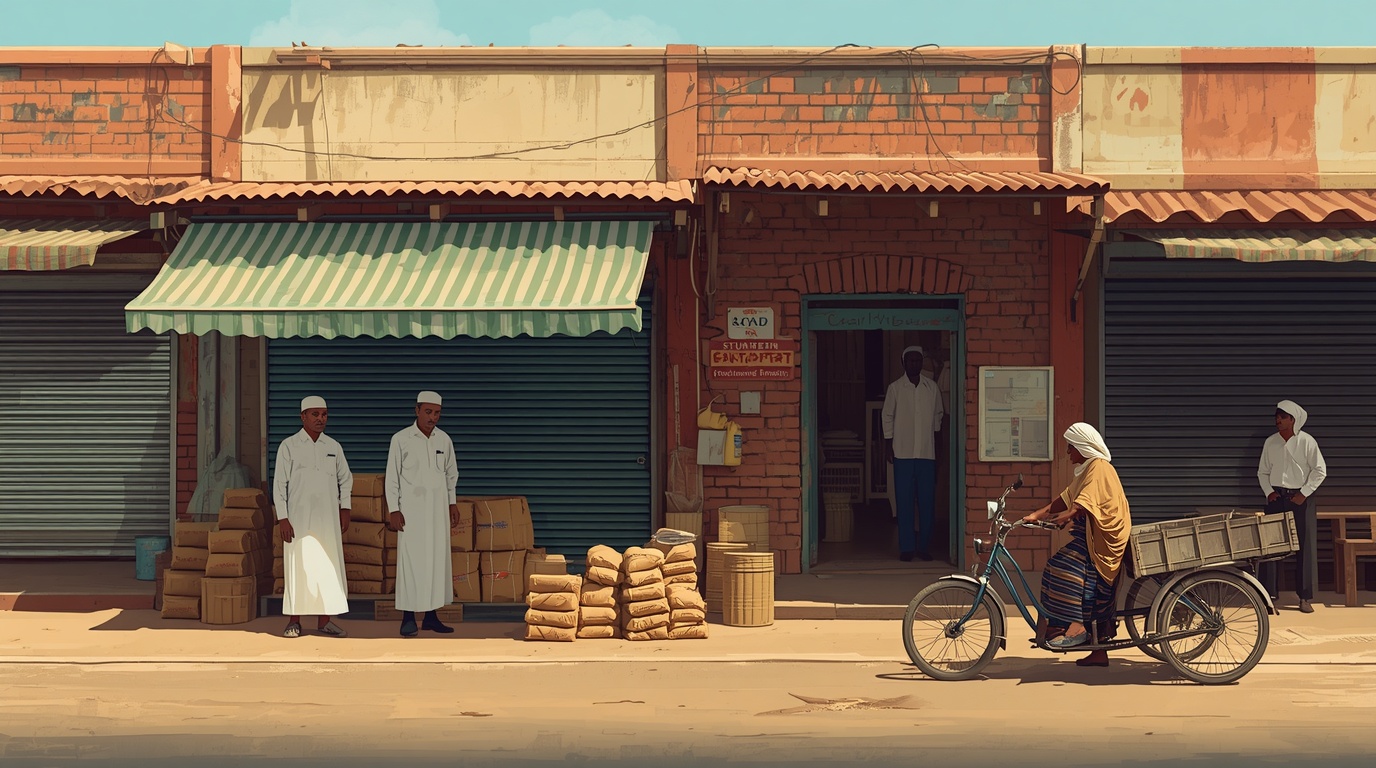
AI editorial illustration made with Leonardo AI, Lucid Origin, inspired by Omdurman market streets. Fictional people and businesses; not a documentary photograph.
A harvest is only the beginning
Consider a straightforward example, not a reported encounter. A farmer has harvested sorghum. A nearby mill has customers. Families need flour. Yet the transaction can still fail: the farmer cannot find affordable transport, the mill cannot obtain a replacement part, or the trader cannot pay until another customer settles a debt.
Nothing in that chain is solved simply by producing more grain. Between a field and a meal stand people who move, store, repair, process and sell. If those businesses stop functioning, the farmer may receive less while the household pays more.
That is the part of Sudan’s recovery that deserves more attention. The question is not whether to support farmers or businesses. It is how to rebuild the connections that make both useful to one another—and ensure the gains reach workers and consumers as well as owners.
What the new survey can actually tell us
IFPRI’s July 2026 THABAT study reports 100 completed interviews from 180 shortlisted agricultural enterprises. Its limitations section says selection was not random and some businesses had received grants before the baseline interview. This is useful evidence about participating firms, but not proof that grants caused better performance or a representative picture of all Sudanese businesses.1
That distinction changes the policy question. We should ask which constraints can be removed, for whom, and at what cost—not treat a promising programme description as a verdict. A firm that expects to expand may have sound plans; expectation is still not investment, and investment is not automatically a public benefit.
Kandaka’s argument therefore does not rest on this survey alone. UNDP and the International Trade Centre’s SAMRA assessment also examines disrupted production and markets across several agricultural chains. Its own methods acknowledge access restrictions and missing information.2 Agreement between reports strengthens the case for investigating these problems. It does not make every proposed intervention effective, nor turn shared background data into independent confirmation.
The expensive gap between buying and getting paid
A small processor needs more than a machine. It needs money to buy the crop before it sells the finished product. Economists call this working capital; in ordinary language, it is the money that keeps the business moving between payments.
Imagine a mill receives a new motor but has no funds to buy grain, sacks or fuel. The equipment grant has improved its assets without necessarily improving its ability to operate. Conversely, a loan may make little sense if an unsafe route prevents deliveries. The right instrument depends on the obstacle.
Kandaka proposes separating three problems before promising a solution. Temporary difficulty paying for a viable order may justify short-term finance. Destruction of essential equipment may require a recovery grant. A business with no plausible customers needs a different plan, not a larger debt. These are appraisal questions, not a claim that every bank or aid programme already follows this approach.
Inflation adds another trap: sales revenue can rise while the business buys fewer inputs and the owner becomes poorer. Support programmes should track physical throughput and purchasing power, not celebrate larger currency totals alone.
Repair the service, not just the building
A warehouse is useful when farmers can reach it, goods are protected, charges are understandable and buyers trust what is stored there. Its floor area is a poor measure of success if nobody can afford to use it.
The same applies to electricity. A connection does not guarantee power at milling time. Solar equipment can be part of a solution, but its suitability depends on the machinery, operating hours, storage needs, maintenance and replacement costs. A panel count is not an electricity service.
FAO’s Sudan brief dated 24 September 2026 reports continued disruption to farming and trade, including expensive fuel and inputs.3 That supports looking at the whole delivery chain rather than treating transport as a small expense after production. It does not establish the cost or commercial viability of a particular warehouse, route or solar installation.
Before funding new facilities, a practical local assessment should ask what existing capacity could restart with a repair, a safe connection or a dependable service contract. Sometimes a modest intervention will help many users. Sometimes rebuilding is unavoidable. Neither conclusion should be predetermined by the appeal of a construction announcement.
Small does not automatically mean fair
Supporting a local business can create useful work. It can also strengthen the only buyer in a district, leaving farmers with little bargaining power. “Locally owned” is a valuable aspiration, but ownership alone does not tell us whether prices are fair or workers are safe.
This is why access conditions matter. A publicly supported store could publish its fees and accept produce from non-members. A procurement programme could explain how suppliers qualify, disclose conflicts of interest and provide a channel for complaints. Producer organisations could help negotiate sales, provided their leaders answer to members rather than distribute opportunities among relatives.
Women running home-based processing businesses, displaced entrepreneurs, young technicians and people with disabilities should not disappear because an application assumes land ownership, a formal office or easy travel. Kandaka proposes alternative ways to demonstrate experience and demand, with checks proportionate to the grant. Inclusion should widen genuine opportunity, not simply add names to a beneficiary list.
Support must also be alert to geography. Firms reachable by an assessment team are not necessarily the firms with the greatest losses. Areas where insecurity prevents recovery investment still need humanitarian assistance and protection; they should not be written off as places that failed to submit a business plan.
Do not confuse a commercial strategy with a food strategy
SAMRA’s priority list is a programme choice, not a final ranking of everything Sudan should grow. The report explicitly explains why important crops outside its shortlist, including wheat, should not be considered unimportant.2
An export-oriented processor may earn foreign exchange and provide jobs. A small staple-food mill may matter more to affordable meals in a particular town. Both claims require examination. Export receipts should not be used as a shortcut for judging nutrition, and food-security language should not excuse permanently uncompetitive enterprises.
The sensible objective is a functioning food economy with several kinds of businesses. Where commercial demand can sustain a service, help remove the obstacle. Where people cannot afford enough food, social support remains necessary. A successful trader is not a substitute for assistance to a hungry household.
A recovery programme should be willing to learn
Start with a small, transparent set of interventions and record conditions before support begins. Follow supported firms and a credible comparison group, while acknowledging that differences in safety, location and selection can affect the result. If a programme expands, publish why.
The useful questions are concrete. Are more farmers being paid on time? Has the cost of getting a crop to market fallen? Are workers receiving regular wages? Can women-owned firms use the service? Does a repaired facility remain operational after the first grant is spent?
Count failures too. A machine that never operated, a route that became unsafe and a cooperative captured by its leadership each teach different lessons. Hiding them makes the next programme less effective.
Sudan needs large ambitions, but recovery also happens in an unremarkable moment: a mechanic finishes a repair, a processor pays a farmer, and a household buys food at a price it can manage. Rebuilding those ordinary transactions is not a lesser form of development. It is how development becomes real.
Forthcoming companion article: What Sudan’s Small Farmers Need to Rebuild looks at recovery from the farming household’s perspective—from timely inputs and irrigation to fair markets and safe access to land.
Sources and reading notes
This explainer combines Library resources with additional institutional checks. Its proposed funding tests and safeguards are Kandaka’s recommendations, not measured outcomes of THABAT. Evidence and source links were rechecked on 22 October 2026.
Abushama and colleagues, THABAT SME survey, IFPRI Sudan SSP Working Paper 29, July 2026; especially “Conclusions and Study Limitations,” printed pp. 25–26. The full report explicitly limits causal interpretation. ↩︎
UNDP/ITC, Sudan’s Agri-food and Market Resilience Analysis, 2026; methods and limitations, and section 2.3 on other strategic value chains, report pp. 7–9. ↩︎ ↩︎
FAO GIEWS, Sudan country brief, reference date 24 September 2026. This is a dated market and crop assessment, not a feasibility study for individual businesses. ↩︎