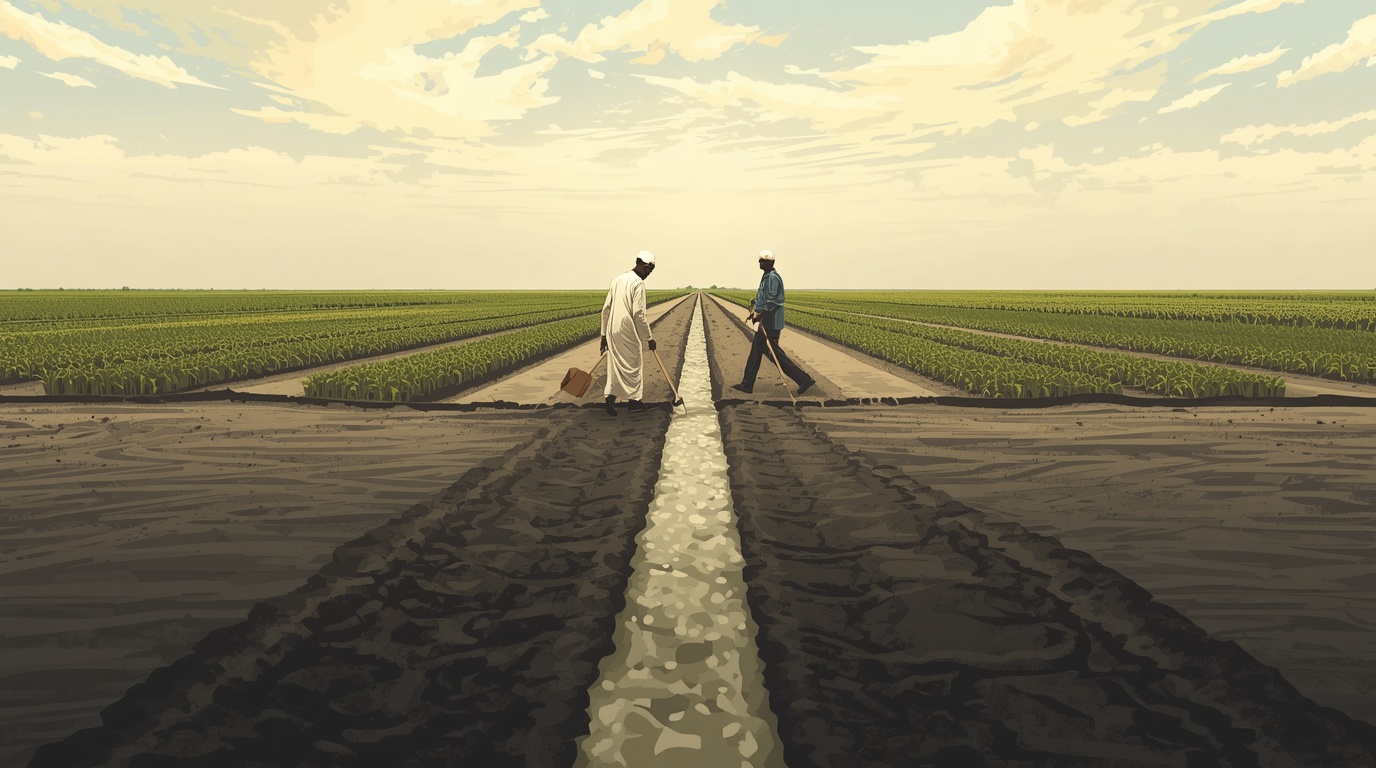
AI editorial illustration made with Leonardo AI, Lucid Origin, inspired by the irrigated landscape of Gezira, Sudan. A fictional scene, not a photograph of a particular farm or evidence of current crop conditions.
A farmer cannot plant a promise
Seeds delivered after the useful planting window do not become timely because a programme met its annual distribution target. A repaired pump does not irrigate a field without water, energy and someone able to maintain it. A farmer cannot safely return to land merely because a recovery plan marks the area as productive.
These are practical distinctions, but they change how agricultural recovery should be organised. The starting point is not a national production slogan. It is a household deciding whether it can plant, carry the crop through the season and keep enough of the proceeds to live and farm again.
That household may own land, rent it, work on another person’s farm or have been displaced from it. A useful policy must see those differences before choosing the package it intends to distribute.
Start with the survey, then look beyond it
IFPRI’s Farming in Crisis paper, published in 2026, draws on a 2024 survey in 13 of Sudan’s 18 states. Its account links displacement and losses of productive assets with pressure on livelihoods. It also reports some improvements in market and input access between the seasons it compares.1
Both parts matter. A blanket story of uninterrupted decline misses adaptation; a story of recovery built from a few improved indicators misses continuing hardship. And a survey conducted in 2024 cannot tell us exactly what a farmer faces in October 2026.
Who could answer matters too. The telephone survey did not reach Darfur, and its authors acknowledge that women were poorly represented. Those gaps limit whose experience the findings capture; they are not evidence that the missing communities had fewer problems. The report also gives inconsistent interview totals in its methods text and table, so this article does not reproduce a precise sample total.1
A separate FAO remote-sensing assessment in the Library examines cultivated area during the summer seasons of 2018–2024.2 Satellite evidence helps ask where cultivation is occurring. It cannot, by itself, tell us whether a family controls the field, whether the crop will be harvested, or whether the income will buy enough food.
Later evidence also prevents complacency. FAO’s 24 September 2026 brief identifies dry weather, insecurity and persistent input constraints affecting the current season.3 The policy lesson is not to choose whichever report sounds most hopeful or alarming. It is to match each source to the time, place and question it can actually address.
Safety is part of agricultural support
Agricultural assistance makes little sense if reaching the field exposes people to violence. Returning people to production cannot mean pressuring them to return to an unsafe place. Where access is not safe, food assistance, shelter and other support remain necessary; a seed package is not an adequate substitute.
Kandaka proposes making safe and voluntary access a condition of recovery planning, rather than a sentence added to the end of a project document. Communities should help identify which routes, fields and water points can be used. Suspected explosive hazards require qualified assessment and clearance—not instructions for farmers to make land safe themselves.
Land rights need similar care. Support based only on a recent list of occupants can disadvantage displaced people who cannot be present. Support available only to registered owners can exclude tenants and agricultural workers. The answer is not for an aid distributor to invent a new land settlement. It is to recognise disputes, avoid treating temporary use as permanent ownership and provide accessible routes for complaints and referral.
These are safeguards Kandaka recommends. They are not a claim that one method will resolve Sudan’s varied land systems or that every dispute can be settled during an emergency.
Organise around the season, not the delivery ceremony
Agriculture has deadlines that a budget calendar cannot move. Preparing land, obtaining suitable seed, controlling weeds, arranging labour and harvesting have to fit together. An input delivered alone or late may have much less value than the delivery record suggests.
A better programme would begin with local cropping calendars and farmers’ own priorities. It would test seed quality and suitability, explain what is being supplied, and establish who will repair shared equipment. Extension advice should be understandable and reachable, including for people without reliable internet or literacy in the language of a printed leaflet.
This does not mean identical packages everywhere. Irrigated farming, rain-fed cultivation and mixed crop–livestock livelihoods face different combinations of constraints. A water intervention that increases one group’s access may affect another’s; maintenance arrangements and users’ responsibilities need discussion before installation.
Nor should every farmer be pushed toward the crop that performs best in a national export presentation. Soil, water, household food needs, labour, buyers and risk all matter. Farmers need meaningful choice, not instructions that transfer the consequences of a failed strategy onto them.
A loan is not the answer to every loss
Credit can help a viable farm buy inputs before harvest. It cannot restore a destroyed livelihood simply by making the household owe money. Someone who has lost tools, animals and savings may need a recovery grant or asset replacement before a loan becomes reasonable.
Kandaka proposes separating emergency support from seasonal finance. Repayment schedules should reflect the crop cycle, and borrowers should understand charges and consequences before accepting an offer. Where insecurity or a major weather shock interrupts production, programmes need a stated response rather than improvisation after households fall into arrears.
There is an important counterargument: poorly designed grants can be diverted, and repeated subsidies can weaken local suppliers. That is a reason to design and monitor assistance carefully, not to replace every grant with debt. Publish eligibility rules, check delivery and quality, and compare procurement through functioning local businesses with direct supply where markets have broken down.
Cash can preserve choice when goods are available. Where they are not, cash alone cannot manufacture seed or reopen a road. The choice between cash, goods and services should follow local conditions, not an institutional preference for one instrument everywhere.
Growing more is not the same as earning more
The farmer’s balance sheet does not end with the harvest weight. Transport, storage, losses, fees, debt and the price received determine what remains. A good crop sold urgently to meet a debt can produce a disappointing income.
The UNDP/ITC SAMRA assessment, also in the Library, connects agricultural recovery with market and trade constraints.4 It is useful context, not proof that every export proposal or new processing facility will benefit small producers.
The immediate questions should be simpler. Can the farmer compare offers? Are scales reliable? Is payment prompt? Can a producer group arrange transport without its leaders taking the gains? Can a storage service justify its fee through a better eventual sale, rather than merely postponing it?
Food security has another dimension: agricultural workers and farming households also buy food. A policy that raises producer prices may help one household and strain another. Targeted assistance to people who cannot afford meals should accompany market recovery, rather than expecting every household to benefit in the same way.
Measure whether a household can farm again
A programme can distribute every promised bag and still leave people unable to complete the season. Its evaluation should therefore follow the household beyond receipt of assistance.
Did the input arrive in time? Was it suitable? What area was actually harvested, and what remained after costs? Did the household keep essential assets, pay workers and meet food needs without taking on unmanageable debt? Were women able to influence the decisions, and were tenants, displaced people and poorer households included?
Results should be separated by location and farming system where the data allow. A national average can hide a successful intervention in one district and exclusion in another. A bad season does not automatically mean a programme failed; a good season does not automatically mean it succeeded. Weather, safety and starting conditions must be considered alongside support received.
The ambition should be practical and demanding: help people regain the ability to make a living, exercise choice and withstand another difficult season. Sudan’s farmers do not need romantic praise for enduring hardship. They need conditions in which skill and effort can produce a more secure life.
Sources and reading notes
The article draws on Library publications and a fresh FAO check, rather than extrapolating the original survey into the present. Its programme design and safeguards are Kandaka’s proposals. The full survey report was retrieved through the publisher during final review; its methods, conclusions and limitations were checked. No new analysis of household microdata is claimed. Research checked on 11 October 2026.
Mohamed and colleagues, Farming in Crisis, IFPRI Sudan SSP Working Paper 27, 2026; full publisher report, methods pp. 2–4 and limitations p. 49; publisher’s catalogue. Observations refer to 2024, including the 2023/24 winter season and preparations for summer 2024. The methods narrative and Table 2-1 give different interview totals; the discrepancy is not resolved here. ↩︎ ↩︎
FAO, A Remote Sensing Assessment of Cultivated Cropland Area in the Sudan during the Summer Season, 2025. Area estimates are not household income or nutrition measurements. ↩︎
FAO GIEWS, Sudan country brief, reference date 24 September 2026. Seasonal warnings are not final harvest outcomes. ↩︎
UNDP/ITC, Sudan’s Agri-food and Market Resilience Analysis, 2026. Its access restrictions and data gaps limit precision, particularly in conflict-affected locations. ↩︎