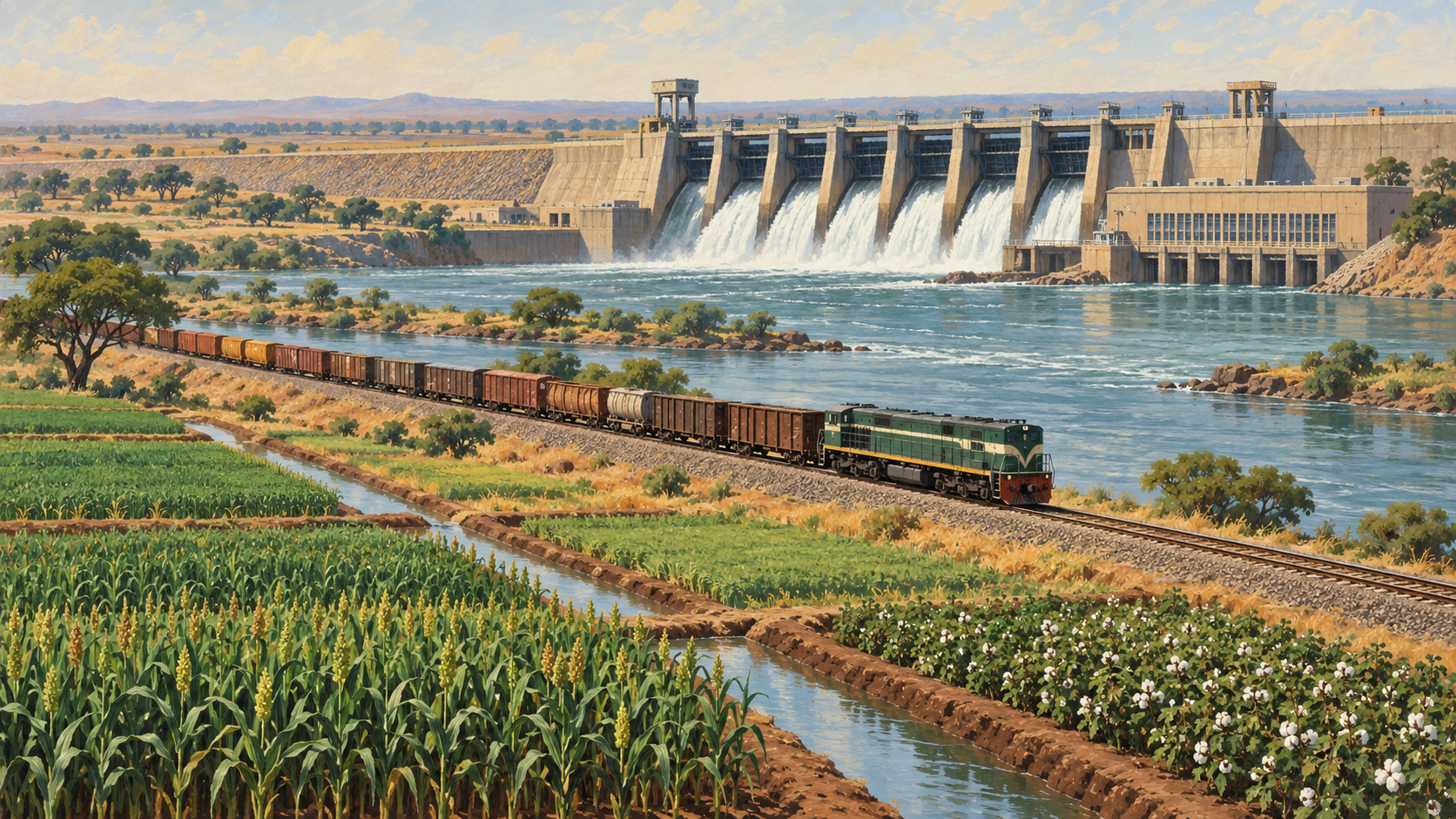
AI-generated editorial illustration created for Kandaka using OpenAI image generation. A fictional composite inspired by Roseires Dam, Sudan Railways and Gezira’s irrigated fields—not a photograph, an exact reconstruction, a single actual location or an approved project design.
Transformation is an outcome, not a price tag
Sudan’s most transformative investment might not be its largest structure. It might be the combination of a reliable power connection, a repaired irrigation system, a working freight link and a training programme that allows existing producers to sell more valuable goods. None makes a spectacular skyline. Together they can change an economy.
This is the standard against which a megaproject should compete. A proposal should not receive priority because it is technically impressive, politically symbolic or accompanied by a large foreign-investment announcement. It should demonstrate that its benefits justify the money, foreign exchange, skilled labour, land and administrative attention it would consume.
Kandaka is not arguing for a permanently small Sudanese ambition. It is arguing for ambition measured in useful services, productive capability and shared prosperity. A large project that passes that test deserves serious consideration. One that cannot explain its opportunity cost does not.
Use one scorecard before choosing a favourite
Every candidate should disclose whole-life cost, delivery time, foreign-currency exposure, realistic demand and the institution responsible for operating it. It should explain local jobs and skills, imports displaced or exports enabled, people receiving a reliable service, maintenance funding, environmental harm, displacement, security obligations and expected economic—not merely financial—returns.
The alternative must be explicit. A proposed railway should be compared with repairing critical existing links and improving logistics. A new dam should be compared with other ways of supplying firm electricity or water services. A prestige industrial city should be compared with servicing existing productive districts.
Kandaka proposes three decision stages: investigate; demonstrate feasibility and public value; then commit. A project should not acquire an entitlement to construction merely because money has been spent studying it. Nor should confidential negotiations replace an independent assessment of liabilities that the public may eventually bear.
Electricity: compare complete systems
Grid repair and expansion, distributed solar, storage, flexible generation and regional connections belong in a common electricity assessment. Their value depends on the service they jointly deliver, not on comparing isolated equipment prices.
IRENA’s 2024 cost evidence establishes the international competitiveness of renewable generation, but global averages are not a Sudanese tariff or a delivered-system quotation. Financing, security, storage, transmission, maintenance and load patterns must be assessed locally. IRENA, generation costs in 2024.
A solar corridor should therefore begin with identified demand and a credible connection plan. Building generation where its output cannot reach customers is not an energy strategy. Distributed systems can serve some needs without waiting for an entire national network, but they also require maintenance arrangements, quality standards and protection for consumers.
Kandaka’s initial preference is to investigate portfolios that can deliver useful increments while expanding. That is a sequencing judgment, not proof that every small installation is economical or that major grid investment is unnecessary.
Newer evidence strengthens the need for that distinction. IRENA’s 2026 study of round-the-clock renewables separates plant-level generation costs from the cost of supplying electricity at a specified reliability. Kandaka therefore proposes comparing complete service packages at the same reliability standard, not ranking solar, dams or nuclear power by incompatible headline prices. The report’s international modelling is not a Sudanese feasibility study. IRENA, 24/7 renewables, 2026.
Dams, irrigation and water transfer: count the people as well as the concrete
A dam must be evaluated for its specific purposes and alternatives. Electricity, flood management, water storage and irrigation are distinct benefits and should not be double-counted. Construction cost alone does not capture resettlement, sedimentation, downstream effects, ecosystem loss or long-term operating obligations.
Rehabilitating irrigation may sometimes yield more than expanding its footprint. The relevant outcome is reliable water service combined with drainage, agronomy, access to inputs and markets. Additional irrigated hectares are a weak success measure if producers cannot profitably use them.
Large water-transfer schemes require especially clear evidence about demand, energy needs and the rights of affected users. Desalination may merit examination for coastal needs, but an inland transfer proposal must include the cost and reliability of moving water over distance. Neither technology is a universal solution to water governance.
These projects should include women, pastoralists, farmers and displaced communities in decisions about access and compensation. A national economic return cannot be treated as permission to make particular communities carry uncompensated losses.
Rail and ports: start with freight that can actually move
National rail electrification should not precede a credible operating and traffic plan. Track condition, bridges, signalling, terminals, fleet maintenance and dependable electricity are complementary requirements. Electrifying an unreliable railway does not automatically make its service reliable.
High-speed passenger transport faces a different market from bulk freight. It should not borrow the economic case for moving agricultural output or industrial inputs. A decision requires route-specific demand and comparison with conventional rail and other transport options.
Ports likewise depend on the economy behind them. A deep berth without efficient customs, inland transport, storage and shipping services may add little value. Kandaka’s separate ports article examines that question in detail. Here the implication is simpler: assess the entire corridor and its operators, not the terminal in isolation.
The World Bank’s historical infrastructure study provides a baseline for asking sector questions, not a present-day engineering survey. War damage and subsequent changes require fresh asset inspections before investment decisions. Sudan infrastructure assessment.
Industrial cities, livestock and minerals: demand before monuments
A new industrial city should demonstrate why firms would locate there and continue operating after introductory concessions end. Water, electricity, freight, skills, services and a usable legal framework matter more than ceremonial land allocation. Rehabilitation of an existing productive cluster may be a stronger competitor than a remote greenfield site.
Livestock processing, cold chains, food manufacturing and agricultural services are potential comparators for major infrastructure spending. Their inclusion does not establish that any particular plant is viable. It asks whether the same public resources could generate broader participation and more sustained domestic value through a network of linked investments.
Gold formalization belongs in the comparison through safety, traceability, environmental responsibility and public revenue—not a presumption that higher extraction alone means development. Mineral projects must meet their own evidence and community standards.
Uranium deserves particular restraint. Kandaka’s source review found historical occurrence and sampling evidence, not proof of commercial reserves or profitability. Investigating phosphate-related opportunities is different from approving extraction, and both differ from choosing nuclear power. Kandaka’s uranium analysis.
Any investigation affecting communities in the Nuba Mountains should begin with local participation, land and water rights, independent environmental baselines and a transparent account of who would own the venture and receive its revenues. A possible byproduct route is a research question, not a promise of cheap recovery. Across all sectors, training and procurement should deliberately include under-served states, women and young people; accessible workplaces and services should include disabled and older residents. National totals cannot substitute for that distributional test.
Nuclear generation requires its own institutional, financing, safety and system assessment. Local uranium is not an economic shortcut around those obligations. The IAEA Milestones approach supplies a useful statement of the breadth of that undertaking, not a verdict on Sudan’s readiness.
Afforestation is not a tree-counting competition
Large restoration programmes can be assessed alongside physical infrastructure, but planting totals are insufficient. Species suitability, water, land rights, grazing access, survival rates and long-term stewardship determine whether planting creates value or merely a short-lived announcement.
Kandaka proposes judging restoration by durable ecological and livelihood outcomes. Local knowledge and paid maintenance should be central. Claims about future carbon revenue should be tested rather than used to conceal who controls the land or bears the risk of failure.
A plausible order of work
The following is an appraisal sequence proposed by Kandaka, not a costed investment plan. For repairs and modular power, the first hurdle is a usable asset and paying or publicly funded demand. For freight corridors and industrial districts, it is confirmed traffic or tenants and coordinated services. For dams, major water transfers and nuclear generation, it is a much broader commitment of institutions, finance and environmental safeguards. Afforestation needs durable land agreements and maintenance in every phase. Exact costs and completion dates remain project-specific; inventing common numerical rankings would conceal rather than resolve that uncertainty.
The immediate task should be to repair the evidence base and identify service bottlenecks. Asset surveys, traffic counts, power-system planning, water assessments and transparent project preparation are investments in better decisions. They should produce public explanations, not an endless consulting pipeline.
Next, investigate packages that restore usable capacity and can be expanded in stages. Power for productive districts, irrigation rehabilitation, freight reliability and coastal logistics are candidates for appraisal, not a pre-approved shopping list. Some may fail the tests. That is the point of testing.
Only then should irreversible megaproject commitments compete for financing. Independent reviewers should test lower demand, higher costs, delays, exchange-rate stress and weaker-than-promised operating performance. Guarantees and foreign-currency commitments must be treated as real public exposure.
Sudan should not have to choose between hopelessness and grandiosity. It can build a disciplined pipeline in which scale is earned by evidence. The best megaproject is the one that makes ordinary production and ordinary life work better—and continues to do so after the opening ceremony has been forgotten.