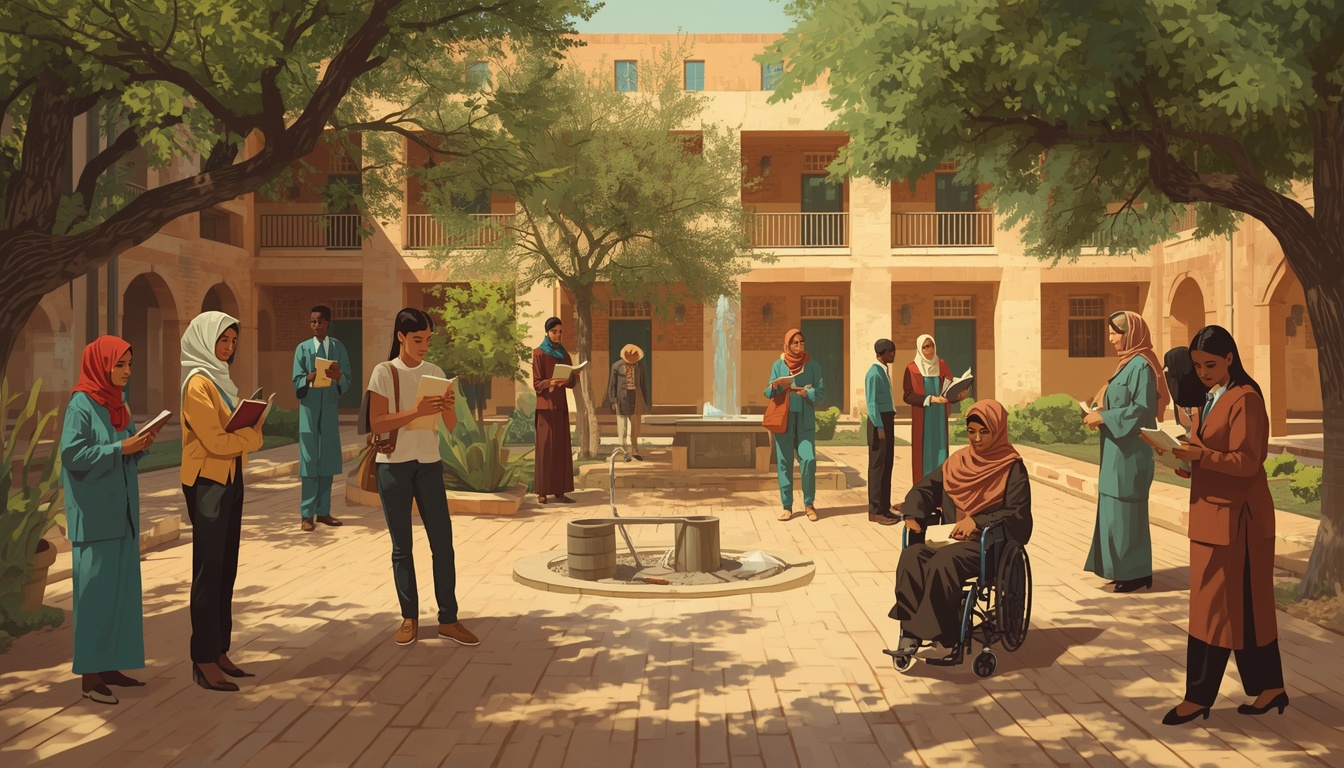
Editorial illustration generated with Leonardo AI, Lucid Origin. A fictional composite campus, not documentary photography.
Beyond reopening the campus
Rebuilding a university is not only a construction task. It is a decision about who can study, who can ask difficult questions, what knowledge is valued and how an institution relates to the society supporting it. A campus can reopen while these questions remain unanswered.
For Sudan, university recovery should have two ambitions. Students and staff need continuity, safety and credible qualifications. The country also needs institutions capable of helping it understand and solve public problems. The first ambition cannot wait for the second, but the second should influence how the first is pursued.
Kandaka’s central proposition is that a university should be both a place of rigorous learning and a public resource. It should not be reduced to a credential factory, a political recruitment ground or a prestige building detached from the people around it.
What Bishai contributes—and where the report belongs
Writing in 2008, Linda S. Bishai examines higher education as a political and civic institution. Her report links weakened academic autonomy, poorly resourced expansion and exclusionary educational practices to the university sector’s difficulties. She argues for stronger research and learning environments, public engagement and nonviolent civic participation. Its setting is the period following the 2005 Comprehensive Peace Agreement, before South Sudan’s independence. Bishai, USIP Special Report 203.
The report is a historically situated policy argument, not a contemporary national university census or a causal evaluation of a reconstruction programme. Its discussion of possibilities at that moment cannot be transferred unchanged to 2026. Nor should broad judgments about an educational system be turned into assumptions about the abilities or attitudes of every Sudanese student.
The useful question it leaves us is institutional: what conditions allow a university to contribute to a more open and capable society? The proposals below are Kandaka’s response to that question, not a claim that Bishai provided a ready-made plan for today’s circumstances. Her criticism of Arabic-centred nation-building concerns exclusionary effects on non-Arab communities, not the value of Arabic as a language of scholarship. Her account of expansion in the 1990s also warns that more places do not ensure better education when staffing and resources fail to keep pace.
Recovery begins with people and continuity
In April 2026, UNESCO reported that around 80 percent of Sudan’s higher-education institutions were non-operational. This is a dated assessment, not an independently verified October census. It nevertheless underlines why recovery discussions cannot be confined to ordinary campus improvement. UNESCO, 15 April 2026.
Kandaka proposes beginning with a practical continuity assessment: which students can continue, which staff can teach, which records survive and which programmes can operate safely? The answers should guide assistance without penalising institutions simply because they have the weakest administrative capacity.
Students need fair procedures for documenting previous study when records are missing. Such procedures should combine alternative evidence, professional judgment and safeguards against fraud. A lost document should not automatically erase years of learning, but emergency flexibility must still protect the credibility of qualifications.
Remote teaching can be one part of continuity, not an automatic solution. A programme that assumes dependable devices, connectivity, electricity and quiet study space may exclude precisely those students most affected by disruption. Low-bandwidth materials, accessible formats, flexible deadlines and safe shared learning arrangements should be assessed alongside online lectures. Practical and clinical competence cannot simply be assumed from attendance in a virtual classroom.
Regional inclusion is an operating principle
University policy should ask who reaches the institution, who remains enrolled and who completes a useful course of study. Admission numbers alone cannot answer all three questions.
Kandaka recommends a transparent student-support system that considers displacement, financial hardship, disability, family responsibilities and regional disadvantage. Support should follow demonstrated barriers rather than political connections. Students should know the criteria and have an avenue to challenge mistakes without exposing themselves to retaliation.
Recovery finance should not flow exclusively to institutions best able to produce polished applications. Smaller and regional institutions may need help preparing credible plans. Partnerships should strengthen their capacity rather than make them permanent dependants of larger universities.
This does not require every institution to offer every specialism. A coordinated system could share scarce facilities and expertise while protecting students from unreasonable travel and living costs. Decisions about consolidation, shared services or temporary relocation should be evaluated for their effects on access, not only their apparent administrative savings.
For women, an offer of admission is not enough if transport, accommodation, care responsibilities or harassment make attendance unsafe or impractical. Recovery plans should budget for these barriers and involve women in decisions about the response. The same principle applies to students from marginalized ethnic and religious communities: equal rules on paper must be tested against actual access and treatment.
Autonomy should be paired with accountability
Academic freedom and responsible management belong together. Universities need protection from partisan interference, while students and the public need protection from arbitrary decisions and opaque expenditure.
Kandaka proposes transparent leadership appointments, published academic rules, credible complaints procedures and meaningful representation of staff and students. Financial reporting should reveal how recovery resources are allocated and whether essential teaching needs are met. These proposals do not imply that every university currently lacks these practices; institutional assessment must distinguish existing strengths from actual gaps.
Freedom of inquiry also requires everyday safeguards. A student should be able to disagree respectfully without jeopardising assessment. A researcher should be able to report inconvenient findings without having to adjust them to a sponsor’s preferred conclusion. Such standards should apply across political, religious, regional and other affiliations.
Campus safety must not become a general excuse to suppress peaceful organisation. Rules against intimidation and violence should be clear, consistently applied and accompanied by fair procedures. A university should model disagreement governed by evidence and rights, not merely demand that disagreement disappear.
Teach knowledge that can be questioned and used
Reform should strengthen disciplinary competence rather than replace it with slogans about employability or citizenship. Students need to understand how claims are tested, how sources are evaluated and where uncertainty remains. These habits matter in engineering and medicine as much as in history and economics.
Language support should be designed around learning rather than symbolic rivalry. Students can benefit from strong academic Arabic, access to international research languages and respect for Sudan’s linguistic diversity. The appropriate balance will differ by subject and student needs; imposing a uniform answer without teaching materials and support would not solve the underlying problem.
Assessment should reward reasoning as well as recall. Supervised projects, careful written argument and practical demonstrations can help reveal what students understand. They also require staff time and resources. Reform plans should make those demands explicit rather than adding responsibilities to already overstretched teachers without support.
Make public service concrete
A university’s public role becomes credible through useful work. Kandaka proposes small, supervised partnerships around questions communities themselves identify: local water reliability, agricultural advice, documentation of heritage, accessible public information or the evaluation of a social programme.
Such projects should have defined responsibilities, appropriate ethics review and realistic limits. Students must not become unpaid substitutes for qualified public-service workers, and communities must not become convenient sources of data with no say in its use. Participation should be voluntary, and findings should be returned in an understandable form.
Diaspora collaboration can be organised around specific teaching, supervision and research commitments rather than ceremonial partnerships. The relevant measure is what capability remains with the Sudanese institution when a visit or grant ends. Shared supervision and sustained mentoring may matter more than a highly publicised agreement with little follow-through.
Brain drain cannot be answered by appeals to patriotism alone. Kandaka proposes making staff retention and voluntary return practical: predictable pay, safe working conditions, usable laboratories, manageable teaching loads and credible career progression. Remote diaspora participation should complement, not replace, investment in those who remain. Partnerships with industry should build technical competence and independent research, with safeguards against a sponsor controlling findings or narrowing all teaching to its immediate hiring needs.
Recovery should therefore be measured through functioning courses, student continuation, credible assessment, staff support and useful research—not simply the number of reopened buildings. The larger objective is a university system that can earn public trust by demonstrating competence, fairness and independence.
Sudan needs graduates who can practise their professions. It also needs institutions able to examine national choices without fear and work with communities without condescension. Rebuilding universities offers a chance to pursue both, provided that recovery restores more than the walls.