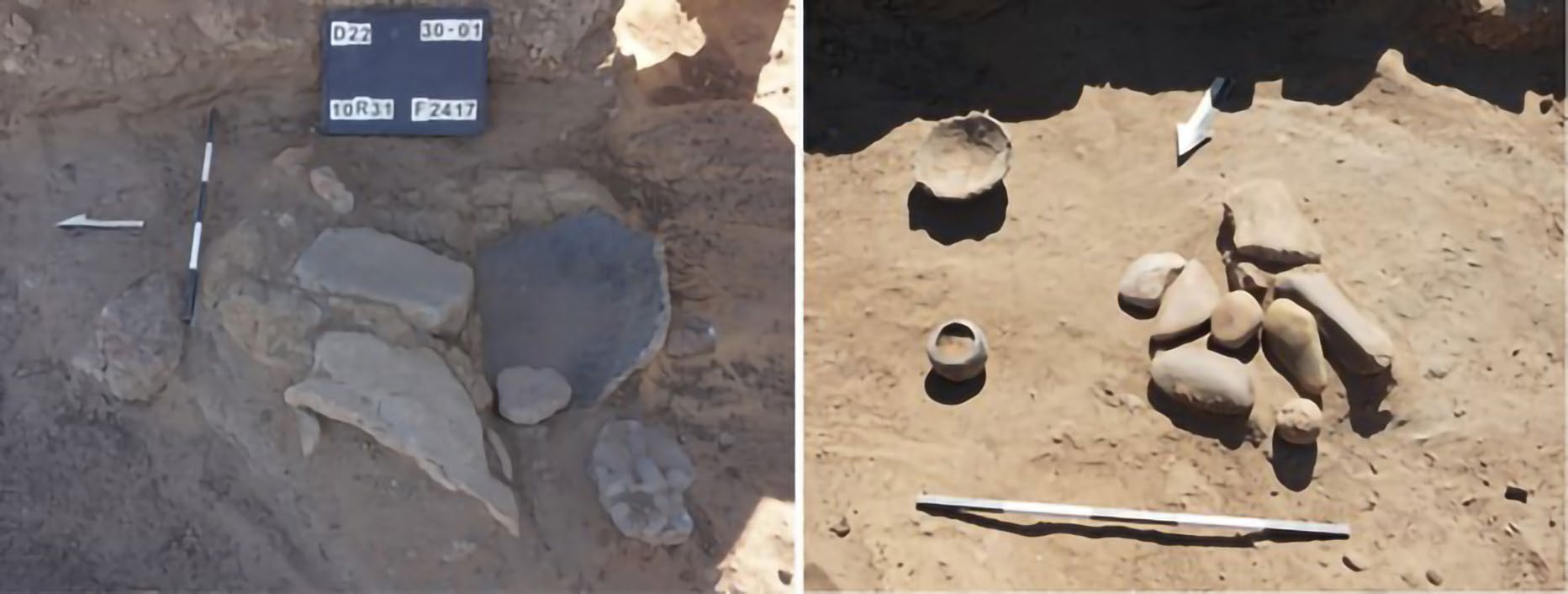
Photographs by Lorenzo de Lellis. Grinding equipment at Old Dongola, reproduced unchanged from figure 7, Nasreldein and colleagues. CC BY 4.0.
The most revealing object in an archaeological display is not always the most beautiful one. A grinding stone can ask a question that a royal monument cannot answer: what work did an ordinary morning require? A storage jar can bring a household into view. A floor, seemingly empty, may still preserve traces of what happened above it.
Sudan’s archaeology offers more than a procession of rulers and monuments. This story follows two places in the north of the country, Amara West and Old Dongola, through evidence of cooking, storage and the use of domestic space. They belong to different periods; they are not interchangeable illustrations of a single unchanging “Nubian life”. What connects them here is the kind of question we ask.
Read the kitchen before the palace
At Amara West, the British Museum’s presentation of a large house identifies spaces for grinding grain, storing supplies and baking bread, alongside a hearth. Plant remains include emmer wheat, barley and other foods. The evidence lets us begin with a sequence of tasks rather than a list of kings. British Museum: farming in the Nile Valley
Look at a grinding surface and think about the repeated action needed to produce flour. Look at the relationship between a storage area and an oven. Archaeology can make a house legible as a place of work, not simply as a rectangle on a site plan.
But it cannot automatically tell us who did each task, whether they enjoyed it, or what the household talked about. Those missing details matter. We can make a readable story without supplying imaginary dialogue or assigning every cooking implement to a woman whose identity we do not know.
A cooking pot is not a passport
Research at Amara West also considers Nubian-style handmade cooking vessels alongside Egyptian-style material. The researchers themselves ask whether this reflects inhabitants’ identities, cultural mixing, or preferences and access to particular cookware. The pots raise questions; they do not neatly label every user. British Museum: The Bioarchaeology of Amara West in Nubia, p. 125
That is an unusually useful lesson for the present-day reader. Objects travel, techniques are shared and people make practical choices. Treating the style of a pot as proof of the ethnicity of its owner would replace an interesting problem with an easy answer.
The pantry that survived
At Old Dongola, Mohammed Nasreldein and colleagues examined six botanical samples from two houses dating to the fifteenth and sixteenth centuries. Sorghum, wheat, barley and pulses give us a glimpse of household supplies. A basket of radish seeds may have held seed for planting. Neither the contents of two houses nor the presence of an ingredient tells us what everyone in the city ate. Nasreldein and colleagues
There is something engaging about a pantry as a historical source. A monument tells us what someone wanted to display. A store of food can show something intended to be used. Yet ingredients are not recipes. Finding a grain does not prove which dish was made, how it was seasoned, or whether its taste would be familiar to us.
This is also why a photograph of an excavated vessel needs a precise caption. “A pot from Sudan” is not enough. Place, context and interpretation are part of the story, not small print to be stripped away.
Even a swept floor can speak
A University of Warsaw project at Old Dongola examined chemical traces in domestic floors to investigate activities that left few visible objects. Its reported results emphasise flexible uses of household space, rather than a simple correspondence between a room’s shape and one permanent function. PCMA: household research results, 2024
This is detective work of a quieter kind than the discovery of treasure. An apparently empty space need not have been unused. Equally, an interpretation needs comparisons and supporting evidence; one chemical signal is not a photograph of an ancient activity.
The broader project also investigates compounds organised around shared courtyards. Its questions concern domestic relationships and how people occupied space. We should retain the difference between those research questions and demonstrated answers about family life. PCMA: Stories Imprinted on the Floors
The city between the monuments
Geophysical research at Old Dongola has traced domestic compounds and irregular streets beneath the surface. That makes the spaces between celebrated buildings part of the archaeological subject. A city was not merely a collection of important monuments with empty ground around them. Obłuski, Herbich and Ryndziewicz, 2022
For anyone interested in architecture, that shift is rewarding. Instead of asking only how tall a building stood, we can ask how a person moved through a doorway, where supplies were kept, and how activities shared a courtyard. The evidence may leave some questions open. Good public history lets the reader see those openings rather than hiding them behind certainty.
A past with room for ordinary people
This does not make the pyramids or royal halls less important. It makes Sudan’s history larger. There is room for the monumental and the modest, for a painted wall and a used cooking pot, for political history and the routines that continued between major events.
The same principle should shape how the story is presented today. Researchers, Sudanese heritage professionals and communities around the sites are participants, not an anonymous backdrop to discoveries. The recent PCMA publication on Old Dongola includes work explicitly addressing community engagement from a Sudanese perspective. That is a useful starting point for further reading, not proof that every heritage project has resolved questions of participation. PCMA publication contents, 2025
The pleasure of this archaeology lies partly in recognition. Not because an ancient household was identical to ours, but because storing food, making a meal and arranging a home are questions we can understand. A small object can make a distant time approachable without making it falsely familiar.