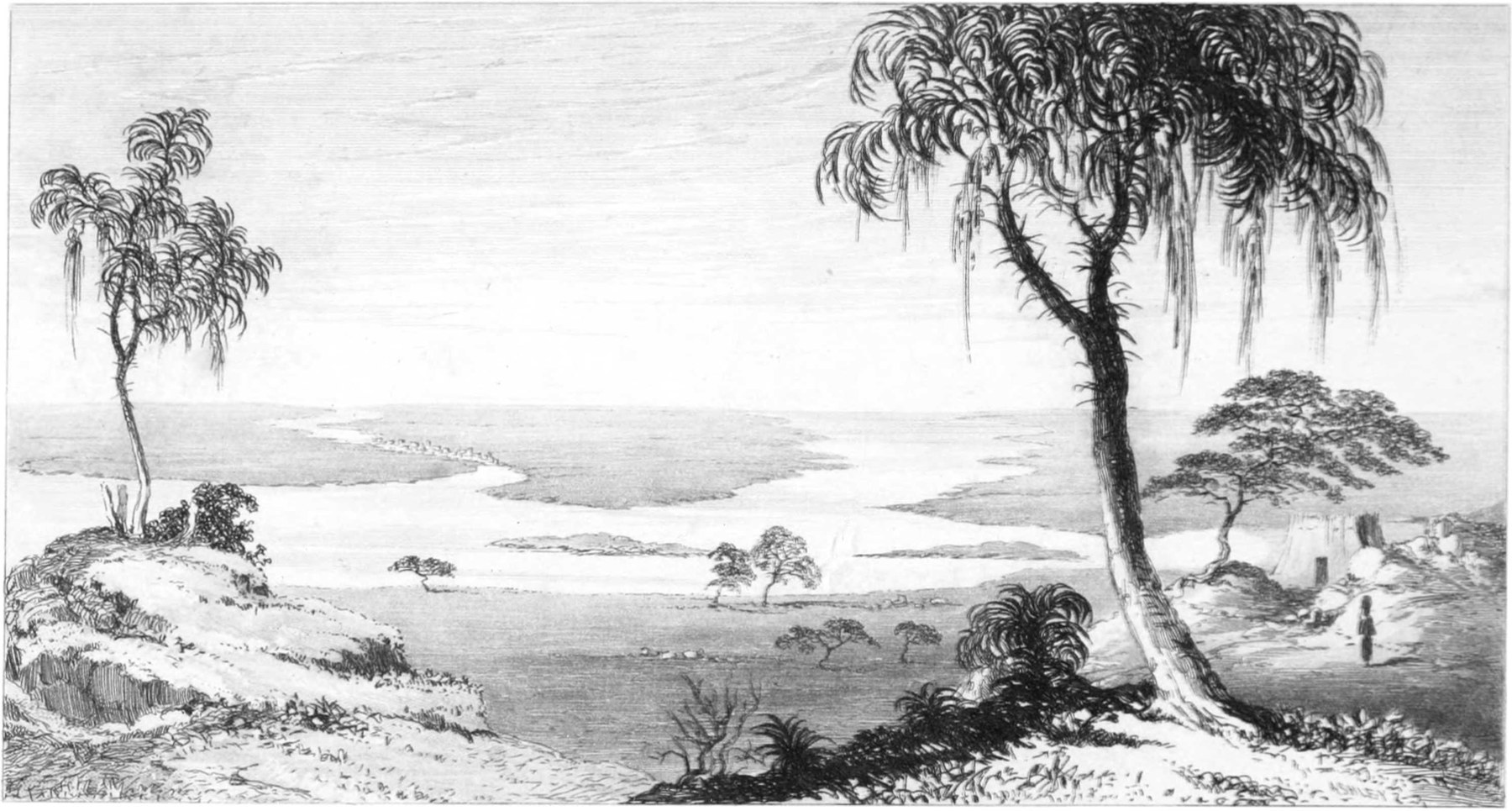
"Khartoum and the Niles", engraving from George Melly, Khartoum and the Blue and White Niles, Vol. I (London: Colburn, 1851), frontispiece. Public domain, via Project Gutenberg. Caption cropped; no colour or grayscale filter applied. Image source.
In late December 1850 an English family rode out of the Bayuda Desert and crossed to the meeting of the two Niles. Their son, George Melly, was twenty. He kept a journal, and the next year he published it in London as Khartoum and the Blue and White Niles. His chapters on the town give a close, dated description of Khartoum in the middle of the Turco-Egyptian period. (Melly, ch. V–VI)
A town of mud and gardens
Seen from the river, Melly writes, Khartoum was “a long mud wall,” with a few buildings showing above it: the governor’s offices, the old government house, and the Catholic church and mission. He estimated about 3,000 houses, almost all built of sun-dried mud. There were no broad streets, only an occasional open square. Yet the better houses stood in gardens of orange, lime, banana and pomegranate, and his family’s lodging looked over the Blue Nile from a high bank. He conceded that the gardens and pleasant climate could make living within mud walls agreeable. (Melly, ch. VI–VII)
People and faiths
Melly gives the population as about 30,000, including the garrison. These are a traveller’s figures, not a census. Muslims were the great majority. The Christians numbered about fifty, almost all connected with the Roman Catholic mission, which had three priests, a church and a small school. There were about twelve Jews. He describes the three communities living together mostly in peace, with occasional outbreaks of intolerance, and notes that all were taxed with little favouritism. (Melly, ch. VII)
Markets and trade
The market, he writes, had four covered streets and four open ones. The covered streets held the best shops, stocked with Manchester printed cottons, Sheffield knives and scissors, and Staffordshire pottery. The open streets were mostly stalls of senna, lichens, herbs and dried plants. Khartoum’s merchants sent out gum arabic, gall-nuts, senna, castor oil and large quantities of ivory. The goods went down the Nile to Berber, then by camel across the desert to Korosko in Egypt. Boat-building was busy along the river, mostly long open boats of palm wood. (Melly, ch. VII)
The governor and the “honourable exiles”
The family was received by the governor-general, Abd al-Latif Pasha (in office 1850–1852), whom Melly found generous: he gave them a house, lent them his own boat, and promised thirty camels to meet them at Berber. Melly also noticed how many senior officials were in Khartoum against their will. He calls it an “honourable exile.” The governor of Berber, Ali Bey Hasib, was one of them. So was Bayoumi Effendi, a mathematician trained at the École Polytechnique in Paris, who had been ordered to found a school in Khartoum with twelve teachers. Melly found no school building and no pupils, and judged the whole scheme a pretext to remove able men from Cairo. (Melly, ch. VI) The wider history of scholarly exile also includes Rifa’a al-Tahtawi, whose Sudan years, 1850–1854, are examined in a study by Tag Elsir Ahmed Harran. (Harran, 1976)
Rain and daily life
The worst season, Melly was told, was the rains. They came so suddenly and so heavily that a man visiting a friend might be stuck in his house for three or four days until the water went down. He also records everyday beliefs, such as avoiding the river on the last Wednesday of the year until after the afternoon prayer. (Melly, ch. VII)
Reading Melly today
Melly wrote as a young Englishman of his time. His book contains condescending judgments about the people he met, and harsh remarks about religion. His privileged reception by officials also shaped what he could see. Nile Book Store describes its new Arabic edition as complete, with notes addressing such passages and explaining names, places and measurements. Read critically, his Khartoum chapters offer a valuable but partial record of the city’s nineteenth-century life.
Read the full account in Arabic: الخرطوم والنيلان الأزرق والأبيض — الجزء الثاني (Sudan journey) and الجزء الأول (Egypt and Nubia), translated with notes, at Nile Book Store.
Sources and further reading
- George Melly — Vol. II, chapters V–VIII (first published 1851; linked digitization: second edition, 1852).
- George Melly — Vol. I, frontispiece, “Khartoum and the Niles” (engraving dated 1851).
- Tag Elsir Ahmed Harran — “Shaykh Rifaa Rafi al-Tahtawi in the Sudan, 1850–1854”, Sudan Notes and Records 57 (1976), pp. 1–9.
- ʿAbd al-Latif Pasha — secondary reference for dates of office.
- Nile Book Store — Arabic translations with notes: Vol. II, Sudan journey · Vol. I, Egypt and Nubia.