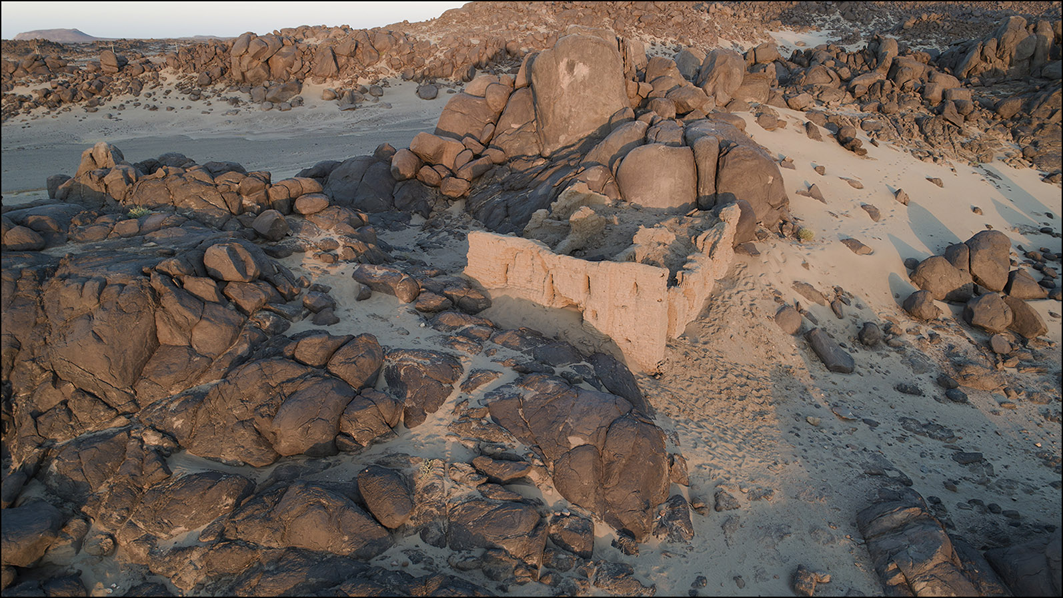
Church of Miseeda and the rock bearing the older petroglyph. Photograph © S. Lenarczyk, reproduced unmodified from figure 2 of Ciesielska and colleagues’ 2026 Antiquity article, published under CC BY 4.0. The article does not supply the photograph’s exact capture date. This is a site photograph, not an AI reconstruction or confirmation of present access.
Begin with what is actually there
In the published photograph of Miseeda, low walls sit among dark, rounded rocks. Behind them is an older carved figure. The scene is not a monumental skyline or a reconstruction of a royal court. Its interest lies in the relationship between things that were not made at the same time.
How did a place acquire meaning, lose some of it, and acquire another? What can a wall or a potsherd tell us? What must remain a question? Those are compelling ways into Sudanese history because they start with evidence rather than a ready-made national story.
Miseeda lies in the Mahas region of northern Sudan, in the Third Cataract landscape. The Good Shepherd of Miseeda project brings archaeological survey, rock-art analysis and ethnography together. Its 2026 report describes nearly 300 recorded sites and a church built around a much older petroglyph.1 This article considers what that combination makes possible—and why it does not give us permission to fill every gap.
A church beside a much older image
The project dates the church to the seventh century. It treats the carved figure as potentially representing a Kushite ruler, while explicitly leaving its precise date unresolved. The report also notes Christian imagery in surrounding rock art.1 A reader should keep those statements separate: the presence of a carving is an observation; the figure’s identity and the intentions of later builders are interpretations.
The setting raises a powerful question about reuse. Did builders value an already important location, respond to the physical rock, reinterpret an older image, or combine several motives? A surviving arrangement can make some explanations plausible without identifying what every participant believed. We should not convert architectural proximity into a claim that two religions were the same.
That restraint does not make the story less interesting. It allows us to see historical people making choices rather than acting out a single destiny. A place can remain important while the reasons for its importance change substantially.
Pottery can change the scale of the story
The most eye-catching object is not always the most informative evidence about everyday life. Pottery fragments can help researchers compare manufacture, use and connections between settlements. At Miseeda, the report discusses local and regional ceramic traditions and uneven representation of different periods.1
But “few finds” is not automatically “few people.” A survey records what survives, what is visible and what its methods can identify. Burial grounds and settlements may preserve different kinds of material. Later occupation can disturb earlier deposits. These are reasons to ask how an interpretation was reached, not reasons to reject archaeology altogether.
A useful public explanation would show the steps: what was found, how it was classified, what comparison supports a date, and what alternatives remain. That is more honest—and often more engaging—than presenting a timeline in which every century appears equally well documented.
A borderland is not an empty margin
Describing Mahas as a frontier can be helpful if it directs attention to movement and interaction. It becomes misleading if it turns residents into passive recipients of influences from larger capitals. A pot with familiar features does not by itself establish the ethnicity of its maker or the political allegiance of its user.
Kandaka’s reading is that local history deserves to be treated as more than a footnote between famous kingdoms. The questions should include work, exchange, settlement and the use of ordinary space—not only whether a royal name can be attached to an image. Connections matter, but connection is not the same as dependence.
This is particularly important when telling Sudan’s history through objects that resemble material found elsewhere. Resemblance can prompt investigation of trade, training, movement or adaptation. It should not become a shortcut to claiming that local creativity was absent.
Living memory is evidence of a different kind
The project’s ethnographic work examines local understandings of archaeological places, changing names and sacred associations. The report describes shifts in the importance attached to the church and other locations, including the shrine of Sheikh Kuman.1 These accounts are valuable in their own right, not simply clues to be mined for an ancient answer.
An oral tradition can tell us how people understood a place when the account was recorded. On its own, it cannot establish the date of the much older carving. Conversely, an excavated wall cannot tell us everything a present-day community values. The two forms of evidence answer different questions and become stronger when their limits remain visible.
Researchers and writers should therefore avoid describing local beliefs as quaint additions to the “real” history. They also should not present one account as the view of every resident. Consent, attribution and the right to withhold sensitive knowledge matter as much as a compelling narrative.
Who gets to interpret the landscape?
A comparison from elsewhere in northern Sudan helps widen the discussion without pretending to confirm Miseeda’s chronology. Writing about Amara West, Neal Spencer acknowledges that no Sudanese archaeologists or colleagues were consulted or involved in the project’s initial research design. He describes a later development towards community engagement and the community-owned Beit Abri lil-Turath.2 That is a reflection on research practice at a different site, not independent archaeological proof for Miseeda.
The lesson Kandaka draws is institutional. Local participation should begin when questions are chosen, not only when workers are recruited or results are displayed. Sudanese researchers and communities should have meaningful access to records, opportunities to challenge interpretations, and visible credit for their contributions.
An English-language paper can travel widely while remaining difficult to use near the place it describes. Arabic explanations, locally appropriate language choices and accessible formats can help close that gap. Translation alone is not shared authority, but withholding understandable results is a poor basis for it.
Make uncertainty visible—and protect the place
Imagine a small teaching resource built around three layers: a dated photograph, a clearly labelled drawing of an interpretation, and an explanation of what remains unknown. Students could compare them instead of mistaking a reconstruction for a surviving building. The aim would be to teach how history is made from evidence, not only what answer to memorise.
That is a proposal, not an account of an existing Miseeda programme. It should be developed with relevant Sudanese institutions and the community, and it need not depend on travel or new construction. Public education must not invite visitors into unsafe conditions or encourage the collection of surface finds.
Nor should a heritage feature promise rapid tourism revenue. Access, conservation capacity, local consent and safety require separate assessment. A place’s importance does not rise or fall with its ability to attract paying visitors.
Miseeda offers something more durable than an easy slogan about timeless identity. It lets us ask how people have used a landscape differently, how evidence survives unevenly, and how present communities belong in the telling. Sudan’s history becomes richer when we allow both connection and change—and when we leave room for the next discovery to revise the story.
Joanna A. Ciesielska and colleagues, Miseeda: between kingdoms, through epochs—reconstructing a history of the Mahas region (Sudan), Antiquity, 24 September 2026, DOI 10.15184/aqy.2026.10427, CC BY 4.0. This is a project report with preliminary interpretations. Its cited earlier surveys are part of the same research history, not automatically independent confirmations. No site visit or reanalysis of archaeological material was undertaken for this article. ↩︎ ↩︎ ↩︎ ↩︎
Neal Spencer, ResearchSpace? Genesis, ownership and access to archaeological data, 4 May 2021. Used as a comparative first-person account of research governance, not a current condition report or evidence for Miseeda’s dates. Educational and governance proposals above are Kandaka’s analysis. ↩︎