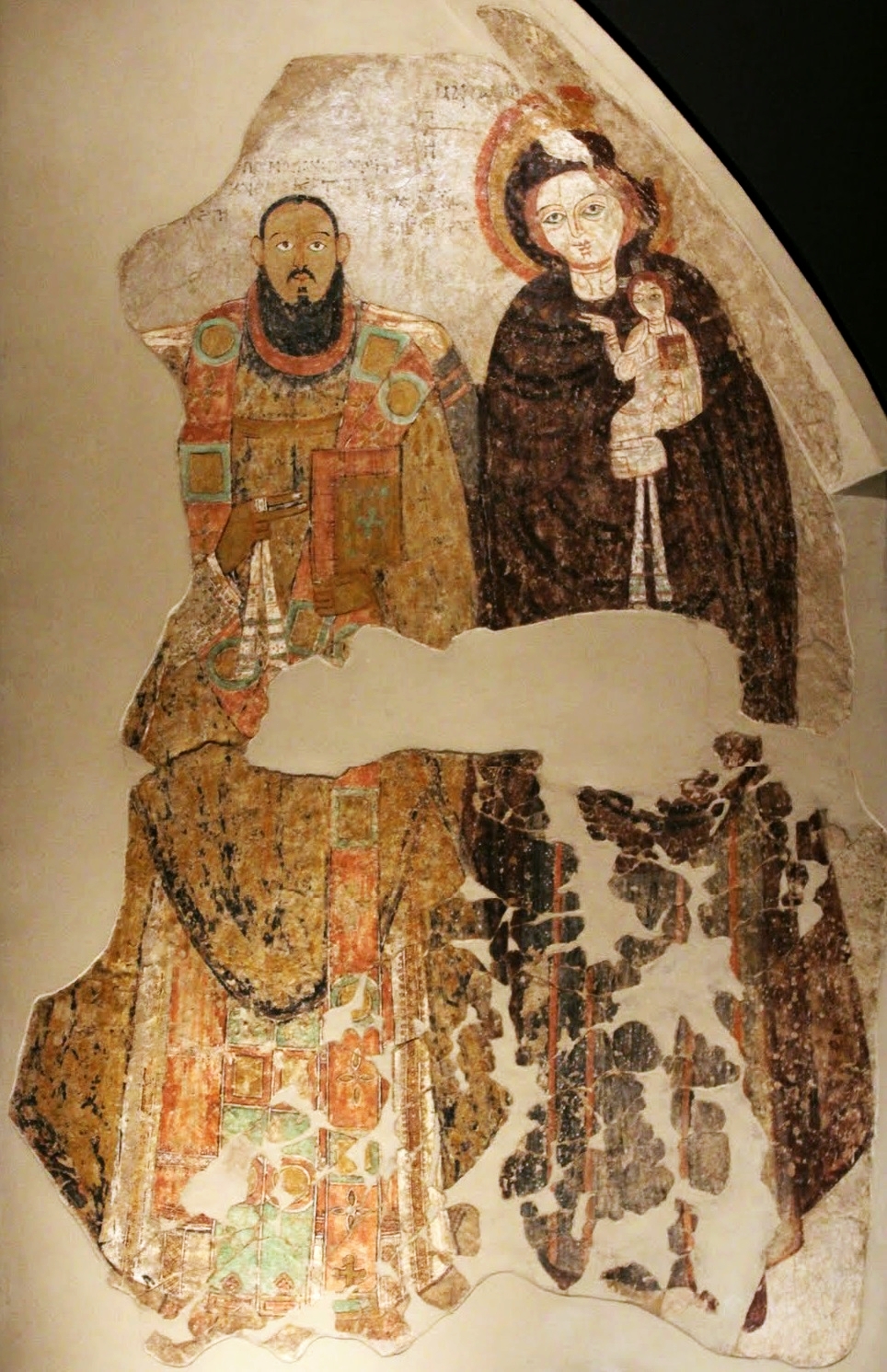
Anonymous Nubian artist, Madonna and Child with Bishop Marianos, 1005–1036, from Faras in present-day Sudan. National Museum in Warsaw collection. Photographic reproduction and source record, marked public domain on Wikimedia Commons. This is a photograph of the surviving mural, not an AI reconstruction.

Read the clothing before the crown
We recognise authority through clothing every day. A judge’s robe, a uniform or a ceremonial garment can tell us how someone expects to be treated before they speak. That does not make clothing an infallible guide to power. It makes it a useful place to start asking questions.
The same approach opens a remarkable window onto medieval Nubia. The robes, headdresses and decorated fabrics in its paintings were not incidental colour around important faces. They helped present people as holders of an office, members of a ruling family or figures under sacred protection.
But these images were composed, not snapped. To read them well, we need to distinguish the person, the painter’s message and the modern researcher’s interpretation. The history becomes more interesting, not less, when those differences remain visible.
A Sudanese history that is not an empty interval
Faras, in present-day northern Sudan, was a centre of medieval Nubian Christian culture. Its cathedral paintings were recovered during the international campaign preceding the flooding associated with the Aswan High Dam. Museum records identify portraits of bishops, including Petros and Marianos, among its surviving works.1
These paintings matter because they place identifiable institutions and artistic choices in a period too easily squeezed between ancient Kush and later Sudanese histories. Medieval Nubia was not a waiting room for another civilisation to arrive. Its communities made buildings, images and material objects through which we can investigate their own priorities.
Nor should its Christian heritage be treated as foreign to Sudan because most Sudanese people today are Muslim. A country’s past need not share one religion, language or political identity to belong in its public history. This is an argument for a fuller national story, not for turning a medieval kingdom into a modern nation-state before its time.
What happens when a painting becomes clothing?
The Costumes of Authority project reconstructed five outfits representing two kings, two royal mothers and a bishop, drawing on images and textile evidence. Its 2026 Antiquity report considers how garments shaped appearance and movement.2
Making a garment can expose questions that looking at a flat image leaves hidden. Where does the cloth fasten? How many layers would a wearer carry? Can the figure move as the painting suggests? Does a proposed cut actually hold its shape?
Such experiments are valuable precisely because they can test a proposal. If a reconstruction is impractical, the explanation may be wrong, the materials inappropriate, or the painted image deliberately idealised. None of those possibilities should be concealed by a persuasive photograph of the finished outfit.
A successful reconstruction shows that one interpretation can be made to work. It does not prove that the original had exactly that cut, weight or colour. Modern models’ reactions cannot recover what a medieval congregation felt. A reconstruction is a reasoned invitation to imagine, with boundaries—not a photograph returned from the past.
Let the threads question the picture
A separate 2021 textile study examined 59 samples using chemical analysis to identify dyes. Its findings document varied colouring practices and textiles that include both local products and imports.3 This is a different kind of evidence from a royal portrait: surviving material rather than a representation.
That distinction gives the article a way to question, not merely repeat, the reconstruction project. Paint can indicate an intended colour, while fibres and dye residues can help constrain what was materially possible. Neither automatically identifies a particular painted robe’s manufacturing history.
The two studies are not wholly independent: Magdalena Wozniak contributed to both, and the later project cites the earlier research. A university catalogue reproducing the same abstract is not another experiment. What broadens the evidence here is the change of method—from reading images to examining cloth—not the number of websites carrying the findings.
There is also a larger story behind a spectacular outfit. Someone had to obtain fibre, spin, weave, colour, cut and maintain cloth, whether locally or through trade. Those activities invite research into skilled work and exchange. They do not let us calculate the size of an industry, name its workers or assume that every fine fabric was made in Nubia.
Royal women deserve attention, not an easy slogan
The project includes royal mothers, not only kings and clergy. That is a useful corrective to a version of history in which authority is pictured almost exclusively as male.2
Yet an impressive royal woman is not evidence that all women enjoyed equal rights or that a whole society can be described with one sweeping label. A ceremonial title, a family relationship and actual control over property or government are different questions. Each needs its own evidence.
We should also resist collapsing medieval royal mothers into the much earlier Kushite kandakes. Putting them together can make an engaging discussion of women and political representation across time. Treating them as one unchanged office would erase the very history we are trying to recover.
A better explainer asks what the portrait emphasises, which relationships it makes visible and what remains unknown about the woman’s life. Respect for historical women is strengthened by specificity, not by replacing their distinct experiences with a flattering legend.
Borrowing a style is not surrendering a culture
The National Museum in Warsaw describes Faras art through the meeting and local adaptation of several traditions.1 That is a more useful starting point than a contest to decide whether every feature was purely Nubian or borrowed.
People can adopt a visual form and give it a new meaning. Conversely, resemblance alone cannot establish the direction of influence, political obedience or the maker’s intentions. A crown that looks familiar does not prove that a distant court governed the wearer.
The reconstruction study reads changes in court clothing as signs of changing identity and authority.2 Those are interpretations worth discussing, not measurements of how confident a population felt. Alternative explanations—changes in patronage, available materials or artistic convention—deserve consideration where the evidence cannot distinguish between them.
That is not a reason to abandon interpretation. It is a reason to show readers the steps between an observation and a conclusion. “This detail appears in the painting” is one statement; “this means the court was asserting independence” is another.
Bring the knowledge home without inventing the past
Kandaka’s proposal is a public history that makes this process visible. A bilingual exhibition or digital feature could place an original image beside a clearly labelled reconstruction, then explain which details come from the painting, which from surviving textiles and which required a modern choice.
Sudanese historians, conservators, artists, textile workers and communities should help shape that interpretation. Classroom material could ask students to compare evidence rather than memorise a grand claim. Designers could find inspiration while naming their sources and making clear that new work is contemporary, not an authenticated medieval replica.
Documentation must be careful about place and time. An old catalogue establishes that an object was recorded in a collection; it does not by itself establish the object’s current condition or location after war. Nor should a generated cover be passed off as an excavation photograph or a reconstruction validated by specialists.
The best reason to explore these clothes is not to prove that Sudan once possessed splendour. The evidence is more demanding and more rewarding: it offers ways to think about authority, craftsmanship, religious life and the choices people made in a connected world. We should let the clothes raise questions as well as admiration.
Sources and reading notes
This article uses the Library’s costume study as a starting point, checked against museum documentation and published textile research. The museum and project share parts of the same archaeological evidence; institutional variety is not complete evidentiary independence. No claim of unbroken continuity with contemporary dress is made. Research checked on 24 October 2026.
National Museum in Warsaw, Faras Gallery and collection account. These provide archaeological and curatorial context; historical collection descriptions are not a current inventory of objects in Sudan. ↩︎ ↩︎
Innemée, Jacobson-Cielecka, Wozniak and Zielińska, Costumes of prestige and authority in Christian Nubia: insights from archaeological reconstruction, Antiquity, 2026. Full project article consulted; its political interpretations are attributed rather than presented as uncontested facts. ↩︎ ↩︎ ↩︎
Wozniak and colleagues, Textile dyeing in Medieval Sudan evidenced by HPLC-MS analyses, Journal of Archaeological Science: Reports 38, 2021. Publisher preview and University of Copenhagen research record consulted; no claim of a fresh laboratory replication or full technical audit. ↩︎