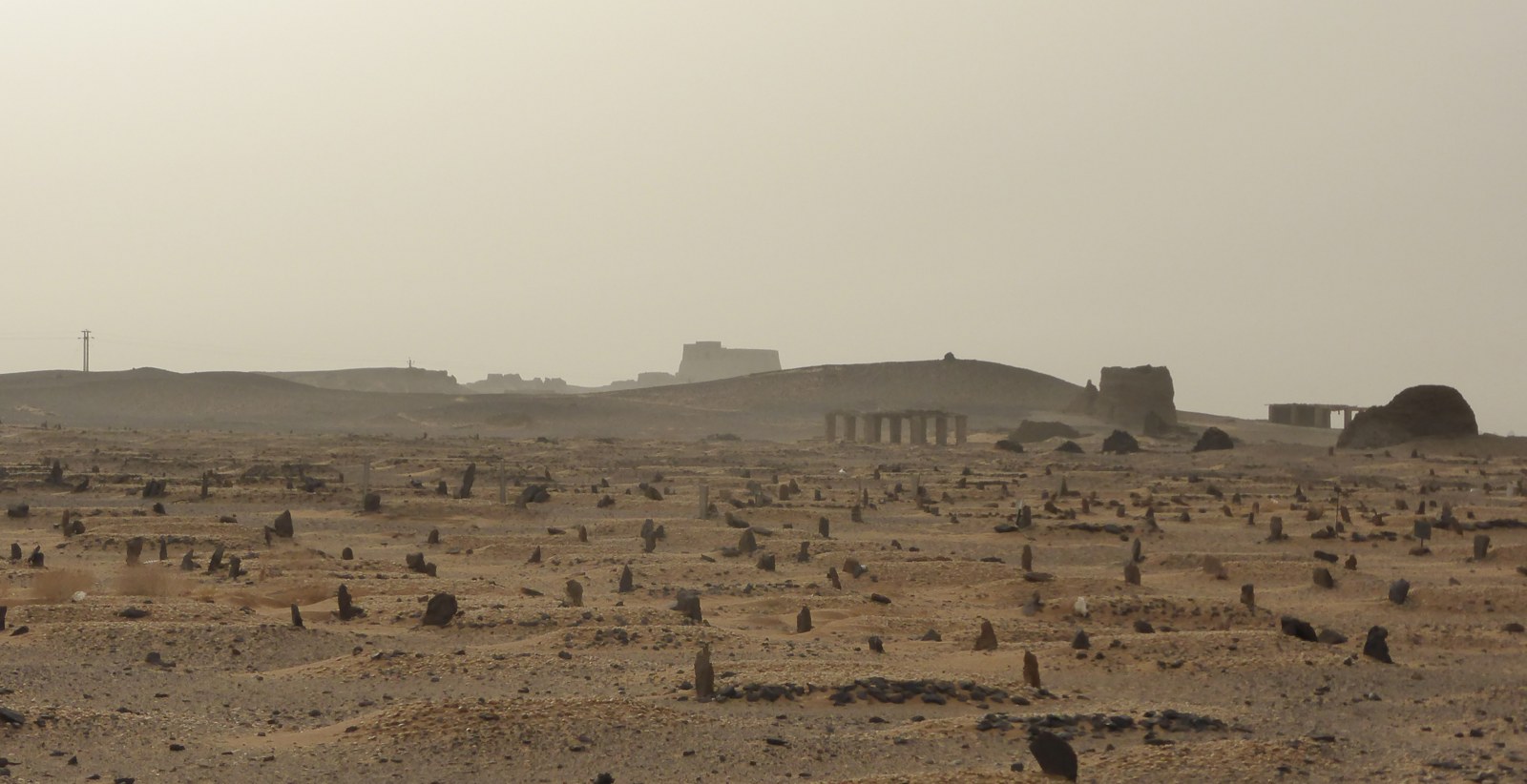
Landscape with graves and ruins at Old Dongola, 18 March 2017. Context photograph; it does not show Qashqash’s letter or identify the House of the Mekk. Photograph: Hans Birger Nilsen. Source · CC BY-SA 2.0. Resized and recompressed without cropping or colour changes.

A king needs someone to collect a ewe and her offspring. He needs goods handed over to the right people, and he wants the matter completed promptly. Across a small sheet of paper from Old Dongola, authority appears as a chain of practical instructions: receive, give, collect, deliver.
That is the distinctive value of the document studied by Tomasz Barański, Artur Obłuski and Maciej Wyżgoł in Azania. Published online on 6 February 2026, their article edits an Arabic order issued in the name of King Qashqash. The document, excavated in 2021, concerns exchanges involving textiles and livestock. It brings a named ruler into the documentary record while opening a less familiar question: how was royal power exercised through ordinary transactions?1
Old Dongola is often approached through Makuria’s churches, royal monuments and Christian paintings. Those histories matter. So does the city that continued after the medieval kingdom’s political transformation. Qashqash’s order gives that later Dongola something unusually direct: a piece of writing produced within its own networks of command and obligation.
A king on a small sheet
The surviving paper measures about 10.5 by 9.5 centimetres and carries writing on both sides. It addresses a man named Khidr. The edition identifies Hamad as the scribe, although the reading of the expression preceding his name requires interpretation. Qashqash’s authority reaches the page through another person’s writing and depends, in turn, on an intermediary able to act on it.2
Following the authors’ interpretation, Khidr is to receive three units of a commodity from Muhammad al-Arab and arrange for him to receive a ewe and her offspring. The animals are to be collected from another participant, whose name the editors read as Abd al-Jabir. Further instructions on the reverse concern goods to be given to that man in return. This is a connected sequence involving several people, rather than a simple purchase between a king and a seller.2
Some details remain unresolved. The first commodity name, transcribed by the editors as ʾRDWYĀT, probably refers to textiles, but its precise meaning is uncertain. A faded expression on the reverse may refer to fine cotton cloth and another item, or to cotton headwear. Infrared photography improved the reading without settling it. It would therefore be misleading to turn this passage into a confident inventory of royal garments—or to calculate a definite exchange rate between cloth and sheep.3
What survives more securely is the arrangement: a ruler issues instructions, a subordinate coordinates delivery, and named participants pass goods between them. The smallness of the transaction makes the mechanism of authority visible.
Power carried in goods
The authors argue that these exchanges are best understood within relationships of patronage and reciprocal giving. A gift to a ruler might secure recognition, access or future assistance; something received from a ruler might carry standing as well as material value. They also discuss other possibilities, including royal mediation between parties. The paper does not establish the participants’ motives beyond doubt.4
This distinction matters. Calling the order an account of trade alone would leave out the social weight goods could carry. Calling it a proven ceremonial gift exchange would claim more than the words permit. The most useful reading keeps both the instruction and the interpretation in view: the document records transfers; the wider political relationships are reconstructed from context and comparison.
Cloth was well suited to crossing these boundaries. It could be worn, stored, transferred and displayed. A separate textile study by Magdalena M. Woźniak examines material from the House of the Mekk, including blue cotton and checked fabrics, to investigate dress and exchange. Later chemical research on seventeen textile samples from seventeenth- and eighteenth-century layers at Old Dongola identified several dyes and distinguished fabrics interpreted as local products from imports. Those studies show a material world richer than the letter’s uncertain vocabulary alone can recover. They do not identify a surviving fragment as the cloth named by Qashqash.5
Seen together, the studies encourage a history of power that pays attention to the people and skills behind prestigious objects. Cloth did not arrive in a king’s hands without work. Its political life depended on making, moving and recognising it, as well as on royal instructions.
The house and the rubbish
The order was found in Building A.1, a large residential compound in Old Dongola’s citadel, associated in local tradition with the mekk, or ruler. Its finds include textiles, a gold ring and other objects that support an elite identification. The Arabic document adds weight to the connection with a royal household, but the researchers’ argument combines several kinds of evidence; the building’s modern name is not treated as sufficient proof by itself.6
The paper was recovered among rubbish in Room U128. Seven documents came from that room, part of a larger group of twenty-three paper texts excavated in the house between 2019 and 2021. The authors caution that the room’s group is not coherent enough to call an archive in the strict documentary sense. Papers discarded together need not have been written together or preserved for the same reason.6
That also complicates dating. The order contains no date. Coins found on an earlier floor help establish that the papers entered the overlying deposits after the early seventeenth century. Radiocarbon analysis of associated organic material favours a later, eighteenth-century setting for the rubbish. Neither test directly dates the writing of the order. Comparing the named ruler with historical traditions, the authors place its composition most plausibly in the late sixteenth or early seventeenth century.7
Writing, keeping, reusing and throwing away are different moments in a document’s life. We do not know why this sheet survived before its final disposal. Its history cannot be reduced to the date of the layer that protected it.
A name between document and memory
Before this study, Qashqash was known through later traditions rather than a contemporary document bearing his name. The researchers compare him with Kashkash in Wad Dayfallah’s Kitab al-Tabaqat, a collection of biographies of religious figures assembled from oral accounts near the end of the Funj period. Those narratives preserve valuable historical relationships alongside hagiographic material.8
The names most likely refer to the same ruler, the authors argue, while explicitly allowing that more than one ruler might have borne the name. The order therefore provides direct evidence for a king called Qashqash and strengthens a historical identification. It does not independently verify every genealogy, episode or miracle in the later accounts.
Nor should local memory enter the story only when excavation appears to validate it. The association of Building A.1 with kingship helped frame a question that archaeology could investigate. The University of Warsaw’s account of the research emphasises exchanges of knowledge with people living around the site, among whom the ruler remains remembered. Documents, material remains and living traditions can be brought into conversation without pretending that they all answer the same questions.9
Arabic writing, a multilingual society
The order is also evidence of Arabic being used to conduct royal business. Its spelling and grammar depart in places from Classical Arabic. The researchers discuss the possibility that it was an informal note or a draft, rather than a polished public document. Those features should not become a story about a society unable to communicate: the surviving text conveyed instructions, names and obligations.10
It does not tell us what everyone spoke. The authors distinguish Arabic written communication from daily speech and note the persistence of Nubian languages. We cannot use a royal letter to measure literacy across the population, establish the language of every household or announce a single moment when Arabic replaced Nubian. Religious change, written practice and spoken language followed related but uneven paths.
The most revealing feature of Qashqash’s order may be its limited ambition. It sets out a task for particular people. In doing so, it preserves the dependence of kingship on scribes, intermediaries and relationships that had to be maintained. Old Dongola’s later history becomes easier to see when we follow those connections: a ruler giving instructions, a writer making them portable, and goods whose movement linked material resources to social standing.
Related Kandaka reading
Karanog and Dongola’s Throne Hall examines a different building and earlier architectural history. The Funj Sultanate offers a broader regional overview.
Sources and notes
The main study was read in the author’s publicly available full text, which carries a CC BY 4.0 notice. This article offers an original interpretation of the published research, not a new edition or independent reading of the manuscript. References to its pages use the numbered, 26-page online-first text.
Tomasz Barański, Artur Obłuski and Maciej Wyżgoł, The King of Nubia at work: archaeological context and text edition of a sixteenth/seventeenth-century Arabic document from Old Dongola, Azania (online 6 February 2026), abstract and introduction; author-uploaded full text. The University of Warsaw’s research account identifies the 2021 fieldwork. ↩︎
Barański, Obłuski and Wyżgoł (2026), pp. 11–14, edition, translation and commentary. The sequence follows their interpretation; this article does not resolve manuscript readings independently. ↩︎ ↩︎
Same study, pp. 15–16, entries for ʾRDWYĀT and mandūf (wa?) al-raʾs. Both commodity identification and parts of the reading remain uncertain. ↩︎
Same study, pp. 18–19, discussion of royal patronage, reciprocal giving and alternative interpretations. Motives and office-holding are hypotheses, not explicit statements in the order. ↩︎
Magdalena M. Woźniak, Textile material from Old Dongola: preliminary observations on trade and sartorial practices in the Ottoman period, Polish Archaeology in the Mediterranean 29/2 (2020), journal abstract; Magdalena M. Wozniak, Bartłomiej Witkowski, Tomasz Gierczak and Magdalena Biesaga, First dye identification analyses conducted on textiles from Old Dongola (Sudan, 17th–18th centuries CE), Archaeometry 66/2 (2024), 406–424, abstract, introduction and conclusions (first online 23 October 2023). The textile research supplies separate context, not object-level identification for the letter. ↩︎
Barański, Obłuski and Wyżgoł (2026), pp. 9–10 and 17–18, archaeological context and interpretation of Building A.1. ↩︎ ↩︎
Same study, pp. 10–11 and 17, deposition chronology and historical estimate of composition. Radiocarbon analysis concerns associated organic material, not a direct test of this paper. ↩︎
Same study, pp. 7, 14 and 17, treatment of the Tabaqat, name variants, identification caveat and chronology. The earlier literary work is discussed through the authors’ study; a fresh collation of its editions has not been made for this draft. ↩︎
University of Warsaw, The existence of the king confirmed by the UW researchers, 16 March 2026. This institutional report represents the research team’s account; it is not independent confirmation of descent claims. ↩︎
Barański, Obłuski and Wyżgoł (2026), pp. 13–14 and 19–20, scribal practice, possible draft status and language change. The broader spread of Arabic speech cannot be read directly from this single document. ↩︎