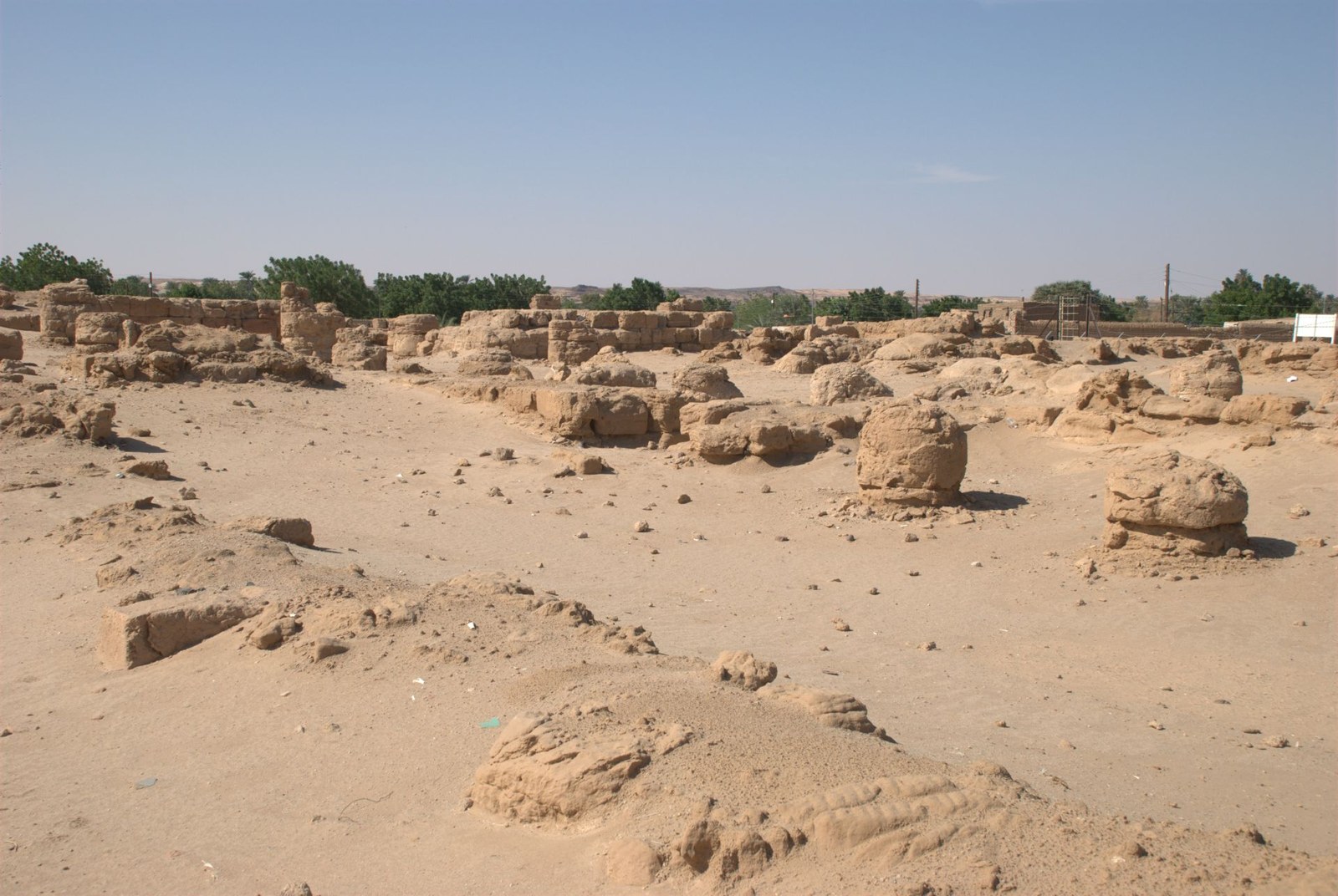
Remains of Taharqo’s temple at Sanam, viewed from the southeast in December 2008, before the 2018–2020 excavations discussed here. This is a view of the temple, not the excavated workshop. Photograph: Bertramz. Source · CC BY-SA 3.0. Resized and recompressed without cropping or colour changes.

A royal object can conceal the work that made it possible. A small glazed figure placed in a tomb seems to belong to the world of kings and ritual. Its manufacture belongs to another world: materials gathered and ground, mixtures prepared, moulds filled and fires tended. At Sanam, in northern Sudan, archaeology is bringing those worlds back together.
Immediately outside a temple built by the Kushite king Taharqo, excavators identified three firing pits and two mudbrick basins. Around them lay ash, broken and rejected faience, hundreds of coloured beads, vessel fragments, grindstones and thousands of tiny shells. The remains make Sanam a securely identified centre of faience production in Napatan Kush. More significantly, they let us follow part of the route from workshop to royal tomb.1
The research was published in Antiquity on 19 October 2026 by Rennan Lemos, Kathryn Howley, Siobhan Shinn and Shadia Abdu Rabo, of Sudan’s National Corporation for Antiquities and Museums. It reports excavations undertaken in 2018–2020, rather than a discovery made this October. The authors place the workshop in the seventh century BCE. Their larger argument concerns the relationship between production, temples and royal authority. That argument is persuasive evidence for debate, not an excavated administrative record spelling out who owned every tool or directed every worker.1
A temple with work at its edge
Sanam belonged to the wider Napatan heartland around the Fourth Cataract. Taharqo’s sandstone temple was part of a landscape of royal and religious institutions, with the royal burial ground at Nuri nearby. Its monumental walls are familiar evidence of kingship. The workshop invites a closer look at what sustained that visible authority.
The link between temple life and craft was not discovered all at once. Early twentieth-century excavations recovered moulds for small funerary figures called shabtis and for amulets, but did not locate the production areas. The renewed Sanam Temple Project set out to investigate the monument’s place in the lives of the people around it. Its earlier project account already described beads, manufacturing waste and promising deposits behind the temple. The 2026 study develops that work into a fuller interpretation of the workshop and its political significance.2
The distinction matters. A fine object found in Sudan might have travelled there. A mould suggests manufacture but can be displaced. A group of firing facilities, raw materials, production debris and finished or partly finished objects in archaeological layers provides a much stronger case for making things on the spot.
At Sanam, even the working surface contributes to the picture. Beneath the production deposits lay a compacted layer of pottery fragments, largely from substantial storage jars. The researchers interpret this as preparation to stabilise the workspace. Above it, ash accumulated around repeated firing. They cannot yet establish whether substantial kiln structures stood over the pits or whether removable covers were used. The evidence supports an organised production area without requiring an imagined factory whose entire architecture survives.1
Skill in a handful of shells
Faience here means a manufactured material rich in silica, with a bright, glassy surface. Its blue, green and white colours could make small objects visually striking. Producing that finish required choices about ingredients and heat; it was not simply a matter of shaping ordinary clay.
The shells make those choices especially interesting. The researchers interpret them as a source of lime for the faience mixture. Grinding traces and the association of shells, basins and grindstones support a sequence in which shells were crushed before firing. In a sandstone region where limestone is scarce, this offered a locally adapted way to supply an essential ingredient.1
Some shells also point beyond the river. The team identifies marine bivalves most probably belonging to a Red Sea species. The gastropods are less certain: their appearance could fit Nile or marine species, and a mixed assemblage remains possible. The ongoing war has prevented further analysis. It would therefore be wrong to label every shell a Red Sea import, or to turn their presence into a precise map of a supply route.
What the evidence does suggest is that apparently modest workshop materials could depend on relationships extending beyond Napata. The authors propose either direct access to distant resources or negotiation with desert groups involved in transport. These alternatives have different political implications. A king’s capacity to obtain materials does not, by itself, tell us whether every community along the route was under his direct rule.
Julien Cooper’s wider study of northeast African nomad–state relations is useful context here. It asks historians to treat desert communities as actors with their own economies and political interests. In that light, the space between the Nile and the Red Sea becomes a field of relationships, rather than an empty corridor through which royal supplies simply passed.3
From a mould to a royal tomb
The clearest connection to royalty comes from shabtis. A mould recovered inside the temple matches a fragmentary green faience figure from the workshop. Moulds found during the earlier excavations also match shabtis recovered from royal tombs at Nuri. Together, these correspondences strongly support the interpretation that temple workshops such as Sanam supplied royal funerary objects.1
The social setting changes their meaning. According to the authors, shabtis in Napatan Nubia were reserved for royalty, unlike their use across a wider range of social groups in Egypt. Making a familiar kind of object did not mean reproducing an identical social system. A form could travel while its users, recipes and political significance changed.
This is where Sudanese craftsmanship becomes central to the story. Kushite makers were doing more than receiving finished goods or copying a distant model. They worked within local material conditions and institutions, turning technical knowledge into objects whose restricted use helped mark royal status. The identities and biographies of those craftspeople remain largely beyond the surviving evidence. Their skill is nevertheless present in the archaeological sequence.
Nor was every faience object royal. Beads and pendants also occur in non-elite contexts. The authors suggest that workshops outside state institutions may have supplied such goods, while acknowledging that this wider production landscape still needs investigation. The Sanam workshop cannot stand for every maker or consumer in Kush.
Power made through relationships
The Sanam findings complicate a simple choice between a tightly centralised kingdom and a political world held together only by local alliances. The authors see evidence for institutional coordination: obtaining materials, concentrating production beside a royal temple and making objects reserved for kings. Such activity could reinforce distinctions between rulers and other people.
Yet the extent of that control remains an interpretation. The workshop does not supply a wage list, a record of recruitment or a complete inventory of other producers. It cannot tell us exactly how much autonomy individual craftspeople possessed. Claims about temple labour, monopoly or direct rule over distant territories need to remain proportionate to those gaps.
The achievement of this research is to move the question of royal power into a place where people worked. Napatan authority was expressed in monuments and burial, but its material forms had to be made. Behind a shining funerary figure were skills, resources, institutions and relationships. At Sanam, the discarded fragments allow those connections to become visible again.
Related Kandaka reading
Karanog and Dongola’s Throne Hall explores how Nubian communities adapted connected material worlds in other periods and settings.
References and further reading
Rennan Lemos, Kathryn Howley, Siobhan Shinn and Shadia Abdu Rabo (2026), “Crafting power in Kush: faience production and state control in the Napatan region”, Antiquity, First View, 1–20, published 19 October. See especially “The Sanam Temple faience workshop,” “Production and consumption” and “Rethinking the Kushite state.” Open access, CC BY 4.0. This Kandaka essay is an original synthesis, not a translation of the paper. ↩︎ ↩︎ ↩︎ ↩︎ ↩︎
Kathryn Howley, “Sanam Temple Project”, Egypt Exploration Society. Earlier project account; the page displays a 2018 date but includes 2019 fieldwork updates, so its header is not used to date all its contents. ↩︎
Julien Cooper (2022), “Beyond the Nile: Long term Patterns in Nomad-State Interactions across Northeast Africa”, Mare Nostrum 13(1), 37–86. Used for the wider interpretive context, not as independent confirmation of the Sanam shells or their route. ↩︎