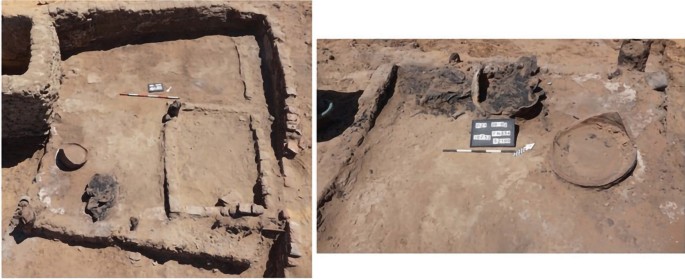
Photographs by Agata Deptuła. Room U192 at Old Dongola, showing burnt seeds preserved in their excavated contexts. Complete image reproduced unchanged from figure 4, Nasreldein and colleagues (2025). CC BY 4.0. The cover shows Old Dongola, not Amara West.
At Amara West, a house became two homes. Archaeologists could follow the earlier building beneath the later arrangement: house E13.3 had been divided into E13.3-N and E13.3-S. The change required new front doors and a staircase, giving the smaller dwellings their own access to the street and roof. Someone had done more than put up a partition. They had changed how people could enter, move through and use the place. Neal Spencer’s excavation account
We do not know whether a growing family divided the house, whether new residents arrived, or whether another arrangement lay behind the work. The building sequence establishes a physical change; it does not supply the occupants’ relationships or motives.
That distinction gives us a way into the history of a home. A plan records walls at a particular stage. Read the changes between stages and a house becomes something people worked on: dividing space, arranging access and making room for tasks and supplies. Four excavations in Sudan bring different parts of that process into view.
One house, different ways in
Amara West belongs to Egypt’s New Kingdom occupation of Kush. Spencer’s account describes repeated adjustments within the town’s houses: new floors, grinding installations moved to different positions and spaces blocked off. The divided house is a particularly clear example because the alterations changed the routes between dwelling, street and roof. Amara West excavation account
A doorway can look like a small detail on an excavation plan. For the people living there, it determined which route was available. A new entrance could let a smaller dwelling function separately. A blocked opening could make an earlier passage unusable. These changes let us ask how a home worked without inventing a conversation between its occupants.
They also remind us that the last visible arrangement was not necessarily the first, or the only one. Calling a space a house is the beginning of the enquiry. We still need to ask which house, at which stage, and what evidence belongs to that stage.
Making room for work and supplies
Soba, the medieval capital of Alwa, offers a different kind of evidence. Archaeologists used a geophysical survey to choose where to excavate. In one building they found large storage vessels along the inner walls, smaller containers for preparing and serving food, and a semicircular furnace in a corner. The arrangement suggests a place for storing and preparing food within a larger architectural complex. It does not establish that the complex belonged to a single family. University of Warsaw field report
Here the relationship between walls and equipment matters. A large vessel set beside a wall occupied space that could not simultaneously be a clear passage. A furnace required a place within the room. We can ask how these tasks fitted together, while leaving open how many people used the complex and who directed their work.
Old Dongola brings us closer to a decision about what to keep. Nasreldein and colleagues studied six botanical samples from two domestic structures dated to the fifteenth and sixteenth centuries. A basket of radish seeds may have held planting stock. This is a small, bounded example of saving for another season—not a reconstruction of every household’s diet or proof that the seeds were later planted. Old Dongola crop study
The point is not to assemble a menu. It is to notice that space inside a home had to accommodate things being used now and things kept for later. The finds allow that question; they do not reveal who made each decision.
A household within a town
At Hamadab, near Meroe, Babiker’s account of Meroitic urbanism places modest mudbrick homes, and the field training involved in recording them, within the history of a Kushite town. These dwellings belong on the city plan alongside its public buildings. Their outlines help us consider routes and proximity, but cannot by themselves tell us who owned a home or how many relatives shared it. Hamadab excavation and training account
Hamadab is later than New Kingdom Amara West; Soba and the domestic contexts discussed at Old Dongola belong to other periods again. Bringing them together does not establish an unchanged Sudanese house or a single family arrangement across centuries. It lets us compare different questions: how a dwelling was divided, how work and storage occupied a room, and how small homes fitted into a town.
The people living in those places encountered buildings with particular possibilities and limits. We can investigate their responses where walls, installations and deposits preserve evidence of them. We should resist filling every gap with a familiar modern family story.
Who gets to read the house?
The Soba team reports that discussions with residents raised the idea of a museum bringing ancient and present-day crafts and everyday objects together. Such an encounter could make a plan or vessel the start of a conversation, rather than the end of an explanation. A builder might ask how an opening was supported; a basket maker might ask how a container was closed. Those are questions to take back to the evidence, not quotations from interviews that have not taken place. Soba research and community discussions
Change is part of what makes these houses historical evidence. A grinding stone helps us recognise a task. A moved installation, a divided house or a new entrance asks what happened when an existing arrangement no longer served in the same way. Sometimes the reason will remain beyond reach. The change itself can still be part of history.
Return to the house at Amara West. The later plan shows two dwellings; the sequence shows that somebody made them so. Sudan’s domestic past includes that work of adaptation, alongside the decisions to build something new. A home was not finished simply because its first walls were standing.