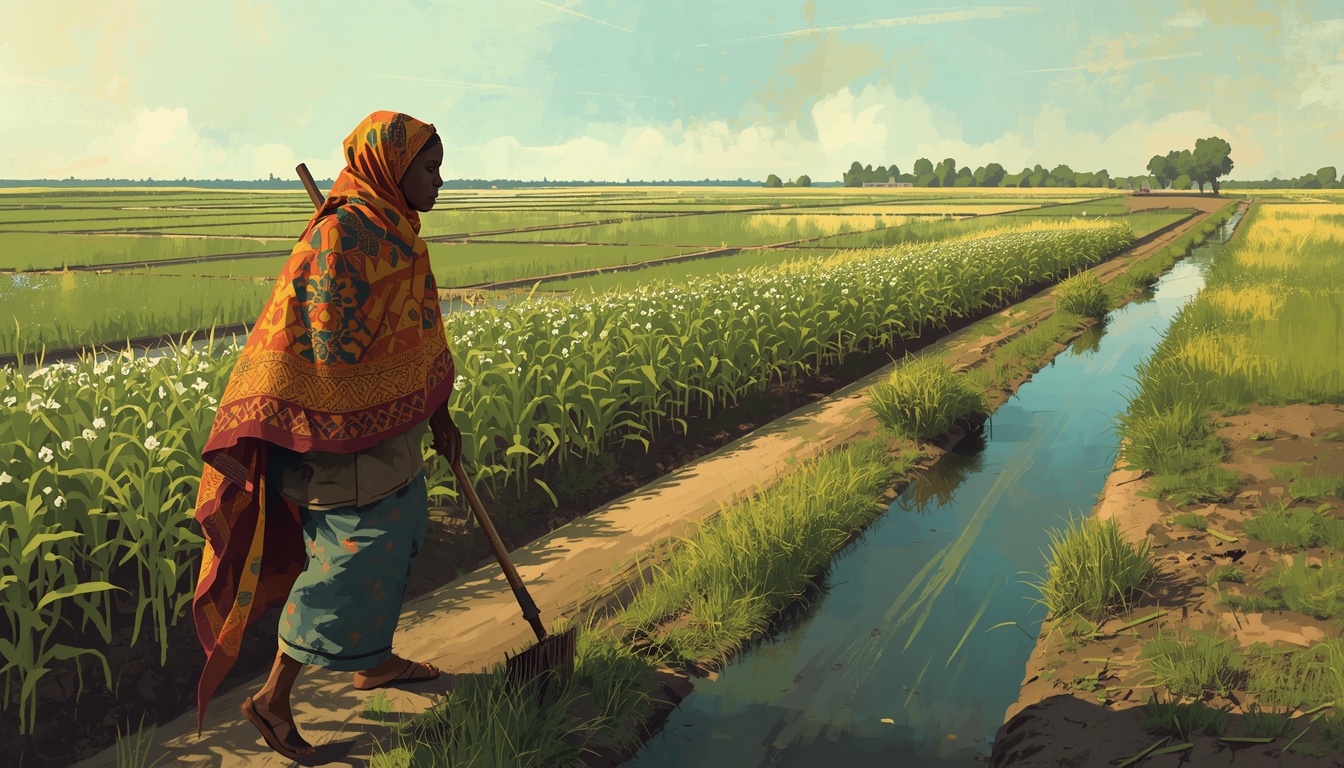
In 1925, a single canal changed the history of central Sudan. The Sennar Dam on the Blue Nile and the network of irrigation channels it fed transformed the Gezira Plain — a flat, semi-arid expanse between the Blue and White Niles — into one of Africa’s most productive agricultural zones. At its peak, the Gezira Scheme irrigated over 880,000 hectares of cotton, sorghum, and wheat, generating a third of Sudan’s export revenues and employing hundreds of thousands of families. The concept was simple: bring water to flat land that already had soil.
That concept works. It worked in 1925 and it works today. The question that Sudanese planners have never adequately answered is why it was applied so narrowly — why, nearly a century later, the same logic has not been extended to the millions of additional hectares that sit flat, fertile, and dry across the country, waiting for water.
The Numbers Sudan Is Not Using
Sudan has approximately 80 million hectares of arable land — among the largest reserves on the continent. Currently, roughly 2.5 million hectares are under cultivation in any given year. Of that, only about 2 million hectares are irrigated. The rest depends on rain.
Rain is unreliable in Sudan. The Sahel’s rainfall is variable, seasonal, and increasingly erratic under climate change. The droughts of the 1980s devastated agriculture and displaced millions. Rainfed farming, even in good years, produces lower and less predictable yields than irrigated farming.
Meanwhile, Sudan holds an allocation of 18.5 billion cubic metres of Nile water per year under the 1959 agreement with Egypt — a figure that was negotiated at independence and has never been fully utilised. The Nile flows through the country carrying water that, by international treaty, Sudan is entitled to use. Much of it flows unused to Egypt and the sea.
The arithmetic is stark. Sudan has flat land. Sudan has sun. Sudan has water rights. What Sudan lacks is the infrastructure to connect them.
The Gezira Lesson
The Gezira Scheme is both a proof of concept and a warning. It demonstrated, definitively, that large-scale canal irrigation in Sudan works. When properly managed, Gezira farmers produced cotton that financed independent Sudan’s first development budgets. The scheme became a model studied by agricultural economists worldwide.
But the Gezira also became a study in institutional decay. By the 1990s, the scheme was in crisis: canals silted and uncleared, drainage inadequate, water distribution inequitable, farmers unable to access credit or markets. The collapse was not caused by any flaw in the irrigation concept — it was caused by chronic underinvestment in maintenance and by policy failures around pricing, trade, and farmer organisation.
New canal systems would need to learn from this. The engineering is not the hard part. The governance — the institutions that manage water allocation, maintain infrastructure, support farmers, and connect them to markets — is where irrigation schemes succeed or fail.
Where New Canals Could Go
Several areas of Sudan are well-suited for expanded irrigation:
The Butana Plain. The plateau east of the Nile between Khartoum and Kassala is vast, flat, and largely uncultivated despite reasonable soil quality. Pumped irrigation from the Blue Nile and Atbara rivers could transform sections of it. The challenge is the distance from water sources — pumped systems are energy-intensive, which is why solar power and canal irrigation are naturally complementary investments.
Kassala and Gedaref States. The east of Sudan around the Gash and Baraka rivers already has some seasonal irrigation, but it is underdeveloped. Permanent canal infrastructure connected to Blue Nile water storage could stabilise production in one of Sudan’s most agriculturally promising regions.
The Managil Extension and Beyond. The Managil Extension to the Gezira Scheme, added in the 1960s, showed that the original Gezira design could be expanded. Further extensions, with upgraded main canals, remain technically feasible on the existing Blue Nile hydraulic infrastructure.
The Jonglei Canal. The most ambitious proposal in this space — and the most controversial — is the Jonglei Canal, designed to bypass the Sudd wetland in what is now South Sudan, reducing evaporation losses and adding an estimated 4 billion cubic metres to the Nile’s downstream flow, shared between Sudan and Egypt. Construction began in 1978 and was halted in 1983 when civil war made the site inaccessible. The partially completed canal sits in the South Sudanese bush, 260 kilometres of earthworks abandoned mid-project. Whether it will ever be completed depends on South Sudanese politics and environmental negotiations that remain unresolved, but the water it would deliver — to Sudan as much as Egypt — is a resource that neither country can afford to ignore indefinitely.
The Investment Case
Irrigated agriculture in Sudan generates, under reasonable productivity assumptions, between $1,500 and $3,000 per hectare per year in output — roughly three to five times the value of rainfed cultivation in comparable areas. At the lower end of that range, 500,000 additional irrigated hectares would generate $750 million per year in agricultural output.
The cost of developing that irrigation? Infrastructure investment estimates for canal systems in comparable African contexts run at $3,000 to $8,000 per hectare for main canals, distribution networks, and drainage — meaning a 500,000 hectare programme would cost $1.5 to $4 billion over ten to fifteen years. The payback period, at current agricultural prices, is in the range of five to ten years. No other infrastructure investment in Sudan offers returns of that order.
This is the kind of project that development banks exist to finance. The African Development Bank, the World Bank’s International Development Association, the Islamic Development Bank, and the Gulf sovereign wealth funds that have historically invested in Sudanese agriculture all have both the capital and the mandate for exactly this type of long-term agricultural infrastructure.
The Barriers Are Not Technical
Digging a canal is not a new technology. Sudan has been doing it for five thousand years — from the Nubian irrigation terraces along the third cataract to the Sennar Dam headworks that feed the Gezira today. The engineering knowledge needed to extend irrigation to the Butana Plain or the Kassala region is not exotic or expensive. It is available. The barriers are elsewhere, and they are formidable precisely because they are human.
Land tenure and the political economy of water. Water in Sudan is not simply a resource to be allocated — it is power. In the Gezira Scheme, access to irrigation water has historically determined who prospers and who does not. New canal systems that bring water to previously dry areas will create winners and losers: farmers who gain access, and pastoralists whose traditional routes are disrupted; new investors who buy land expecting irrigation to come, and smallholders who are pushed off it. Land tenure disputes are among the most common causes of rural conflict in the Sahel. Any expansion of irrigation infrastructure must be accompanied by a clear framework for land rights, water rights, and pastoralist corridor protection — not as an afterthought, but as a precondition. The countries where irrigation expansion has worked — India’s canal districts, Morocco’s Draa Valley, Israel’s Negev — are those where water allocation rules were settled before the cement was poured.
The maintenance funding trap. The Gezira Scheme’s decline is one of the most studied cases in African agricultural economics, and its central lesson is simple: large irrigation schemes require continuous, substantial maintenance budgets, and those budgets must come from somewhere predictable. Canals silt up. Drainage channels block. Headworks corrode. Pump stations break. In the Gezira, maintenance fell to the Sudan Gezira Board, a parastatal body whose budget was perpetually squeezed between cotton price collapses, fiscal crises, and the political temptation to use the scheme’s revenues for other purposes. By the 1990s, farmers were paying water fees that went not to maintenance but to government salaries. The lesson is that maintenance must be funded through ring-fenced mechanisms — ideally through water fees paid directly to an autonomous authority — and that the political protection of those funds is as important as the initial capital investment.
Farmer organisation and market access. Building a canal is the easy part. What happens after the water arrives determines whether the investment was worthwhile. Farmers who have just gained access to irrigation need seeds adapted for irrigated conditions, input supplies (fertiliser, pesticides), credit to bridge the gap between planting and harvest, storage facilities to avoid selling at harvest-time low prices, and buyers offering fair prices for their output. None of this happens automatically. Sudan’s agricultural cooperatives, at their strongest in the 1960s and 1970s, provided many of these services — and their collapse in the 1980s and 1990s is directly correlated with the decline in agricultural productivity. Rebuilding cooperative infrastructure is not a nostalgic exercise; it is an economic necessity. New irrigation cannot realise its potential in a market vacuum.
The Nile diplomacy constraint. Sudan’s irrigation potential is bounded, ultimately, by international treaty. The 1959 Nile Waters Agreement allocated 55.5 billion cubic metres per year to Egypt and 18.5 billion to Sudan. Ethiopia’s Grand Ethiopian Renaissance Dam has fundamentally changed the upstream hydrology of the Blue Nile, threatening Egypt’s allocation and creating a regional crisis that has not been resolved. Sudan occupies an ambiguous position in this dispute: it benefits from GERD’s regulation of Blue Nile flows (smoother, less flood-prone delivery of water) while also being subject to the 1959 framework that constrains its own use. Any major expansion of Sudanese irrigation must navigate this geopolitics. New schemes that draw more heavily on Sudan’s 18.5 billion cubic metre allocation will need to be carefully designed not to become flashpoints in the Nile basin political conflict — even as Sudan asserts its legitimate right to use water it has never fully drawn.
The governance architecture for water allocation. Who decides which farmer gets water, and when? In the Gezira, water was allocated through a complex rotational system managed by the Gezira Board. In new schemes, this question needs an answer before the first farmer plants. Water allocation governance — transparent, predictable, enforceable, and resistant to corruption — is a political institution that takes years to build. Countries that have built it successfully (Morocco, Egypt, Spain’s acequia system) have invested in water courts, local water user associations, and grievance mechanisms over decades. Sudan would be building these institutions in a post-conflict environment, with weak state capacity and high potential for conflict. Starting small — with a scheme of tens of thousands of hectares rather than hundreds of thousands — allows governance institutions to be built before the scale of the scheme overwhelms them.
The Preconditions: What Must Come Before the Canal
Engineering can proceed once four non-technical preconditions are in place. Without them, new irrigation infrastructure will follow the Gezira into institutional decay.
First, a land rights framework that protects smallholders and pastoralists from displacement, and that gives irrigated farmers clear tenure over the plots they cultivate. This requires new legislation and a functioning land registry in the target areas — achievable, but slow.
Second, ring-fenced maintenance funding: a water fee structure, enforced from day one, that finances operation and maintenance without government subsidy. The fee must be high enough to actually cover costs and low enough that farmers will pay rather than circumvent the system.
Third, farmer cooperatives or water user associations with genuine decision-making authority over water schedules, local infrastructure maintenance, and collective marketing. These do not need to be large; a cooperative covering fifty families managing 500 hectares can function well and scale up.
Fourth, market linkages: guaranteed buyers for at least the first three harvest cycles, through government procurement, WFP contracts, export agreements, or private offtake agreements. Farmers who cannot sell what they grow will not invest in growing more.
The Larger Vision
Sudan’s agricultural potential has been described and quantified in dozens of reports over seventy years of independence. Every World Bank analysis, every AfDB strategy paper, every academic survey of the Sudanese economy has noted the same fundamental fact: the country has extraordinary natural endowments — land, water, sun, and soil — that are profoundly underutilised.
The vision of Sudan as a breadbasket — for the Arab world, for East Africa, for itself — is not a fantasy. It is an engineering problem with known solutions, manageable costs, and documented returns, sitting behind a set of institutional and governance challenges that are hard but not impossible. The canal is not a metaphor. It is a ditch in the ground that carries water from where there is too much to where there is none.
But the breadbasket vision only makes sense if it is understood correctly. Sudan growing more sorghum and exporting it raw is a step forward. Sudan growing more sorghum, milling it into flour, and exporting the flour is a bigger step — more value retained, more employment created, more sophisticated productive capacity built. Sudan growing sorghum, milling it, using the bran for animal feed, and exporting both flour and livestock products is bigger still. The canal creates the agricultural base. What happens next — the processing plants, the cold storage, the packaging facilities, the logistics chains — is where the development actually occurs.
This is not a novel argument. Alexander Hamilton made it in 1791 when he argued that the United States should not simply export raw cotton to British mills but should build the capacity to turn cotton into cloth. Every country that has successfully developed has followed some version of this sequence: first the productive infrastructure, then the industries that use it, then the exports that reflect value added rather than raw endowment. Sudan’s canal network is infrastructure in Hamilton’s sense — not just useful in itself, but the physical precondition for the manufacturing and processing sector that should follow.
The countries that advise Sudan to “stick to its comparative advantage” in raw agricultural exports are, consciously or not, advising it to remain in a permanent position of subordination to those who add value downstream. That advice should be heard, understood, and rejected.
Sudan has been digging irrigation ditches for five thousand years, since the Nubians first channelled the Nile onto their fields. The only question is whether the country will find the governance and the financing to do it at the scale the land deserves — and the political clarity to insist on capturing the value of what grows there.
Further Reading — Kandaka Library
- The Gezira Scheme: Perspectives for Sustainable Development — FAO — The authoritative assessment of what went right and wrong with Sudan’s flagship irrigation project, with reform recommendations still relevant today.
- The World Bank and the Gezira Scheme in the Sudan — Institutional history of international financing and the lessons from a century of irrigation investment.
- The Agricultural Potential of Sudan — Abdalla Ahmed Abdalla — A comprehensive analysis of Sudan’s land and water resources and the investment pathways to realise them.
- Technologies to Construct a Canal — Engineering options for canal construction in the Sudanese context, from earthen channels to concrete-lined systems.
- Water Resources in Sudan — Overview of available water, usage patterns, and the gap between what Sudan is entitled to use and what it currently draws.
- Nile Basin Farming Systems and Productivity — Nile Basin Initiative — Comparative analysis of agricultural systems across riparian countries, including productivity benchmarks for irrigated versus rainfed cultivation.