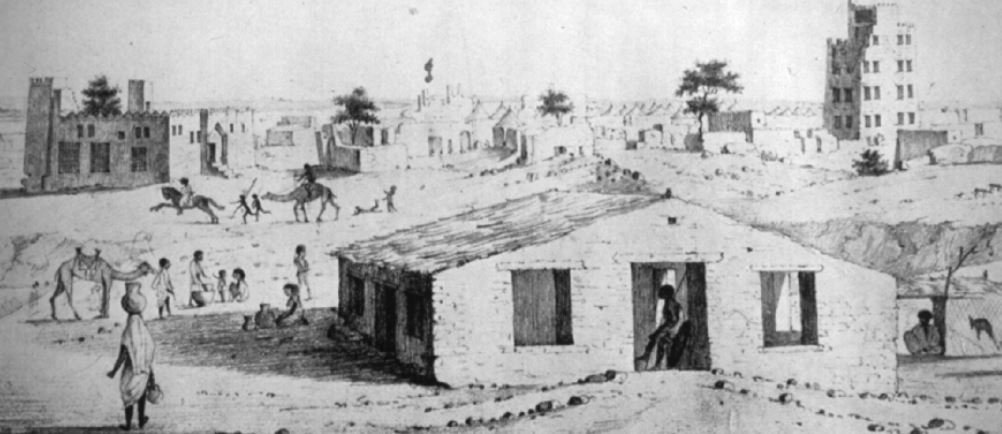

Sennar in 1821, sketched around the time of the Turco-Egyptian conquest — by then a city already reduced to ruins. Source: Wikimedia Commons, public domain.
In June 1821, a Turco-Egyptian army under Ismail bin Muhammad Ali reached the banks of the Blue Nile and marched on a city they had been told, for three centuries, was one of the wealthiest in Africa. What they found instead was a heap of ruins. The last Funj sultan, Badi VII, surrendered without a fight. A kingdom that had once stretched from the Third Cataract of the Nile to the Ethiopian highlands, that had governed an ethnically diverse population under a divine monarchy, and that had for a time made its capital “close to being the greatest trading city” on the continent, ended not in a great battle but in a quiet capitulation to an empire that no longer had to fight for what it wanted.
The Funj Sultanate is not a well-known chapter of Sudanese history outside specialist circles, and that is itself worth pausing on. It ruled for 317 years — longer than the United States has existed as an independent country — over a territory that at its height covered most of what is now central and eastern Sudan, parts of Eritrea, and parts of Ethiopia. It is the polity that made Arabic the lingua franca of the central Nile Valley, embedded Islam as the region’s dominant faith, and set the administrative and cultural patterns that later Sudanese states, including the Mahdist state and the modern republic, inherited and built upon. Understanding what it was, how it rose, how it fell, and what it left behind is not an antiquarian exercise. It is a direct line to the institutional questions Sudan is still working through today.
What It Was, and Where
The Funj Sultanate — also called Funjistan or the Sultanate of Sennar, after its capital, and known to contemporaries as the “Blue Sultanate” (al-Saltana al-Zarqa), using the old Sudanese Arabic convention of calling black-skinned people “blue” — was founded in 1504 by a nomadic-pastoralist people, the Funj, whose precise ethnic origin remains genuinely disputed among historians. Some scholars argue they were Nubian or Shilluk in origin; others contend “Funj” described not an ethnicity at all but a social class, a ruling stratum drawn from multiple peoples. Sudanese oral tradition offers yet another account, tracing the ruling dynasty to Umayyad Arab descent. The uncertainty is not a gap waiting to be filled by better archaeology. It reflects the reality of a frontier polity assembled, as most premodern states in this region were, from many peoples rather than one.
What is not disputed is the geography. The Funj built their capital at Sennar, on the Blue Nile roughly 300 kilometres southeast of what is now Khartoum, and from there governed a state that, according to the founding ruler Amara Dunqas’s first envoys, controlled territory from the region south of the confluence of the Blue and White Niles as far north as Dongola. At its peak in the late seventeenth century, Funj authority extended from the Third Cataract in the north to the Ethiopian highlands and the Sobat River in the south, from the Red Sea coast in the east to Kordofan and the Nuba Mountains in the west — a vastly larger footprint than most people today associate with any pre-colonial Sudanese state.
The Funj arrived into a power vacuum. The medieval Christian Nubian kingdoms of Makuria and Alodia had been in decline since the twelfth century; by 1365 Makuria had collapsed into a rump state, and Alodia’s capital at Soba had ceased to function as a real seat of power well before the Funj appeared. Into that vacuum had already moved Bedouin Arab tribes carrying Islam and the Arabic language northward and westward across the region, and a local chief, Abdallah Jammah of the Abdallabi, who had built a tribal federation and finished off what remained of Alodia. When the Funj arrived from the south in the early sixteenth century, they did not conquer an intact Christian empire — they filled the space one had already vacated, absorbing the Abdallabi as subordinate partners rather than eliminating them, a partnership that would later become one of the sultanate’s central political fault lines.
The Ascent: A Nile Valley Trading Power
The reigns of three sultans in succession — Rabat I, Badi II, and Unsa II, spanning roughly the mid-to-late seventeenth century — mark the high-water period of Funj power. Sennar was established as a fixed, permanent urban capital for the first time in the state’s history, and it grew rapidly into what contemporaries described as one of the great commercial cities of Africa: a hub for caravans running north to Egypt and east to the Red Sea ports, and for the annual pilgrimage traffic passing through from western Sudan toward Mecca. Diplomatic missions connected Sennar to the wider Islamic world. Foreign merchants — Copts, Ethiopians, Greeks, Armenians, even Portuguese — settled in the city.
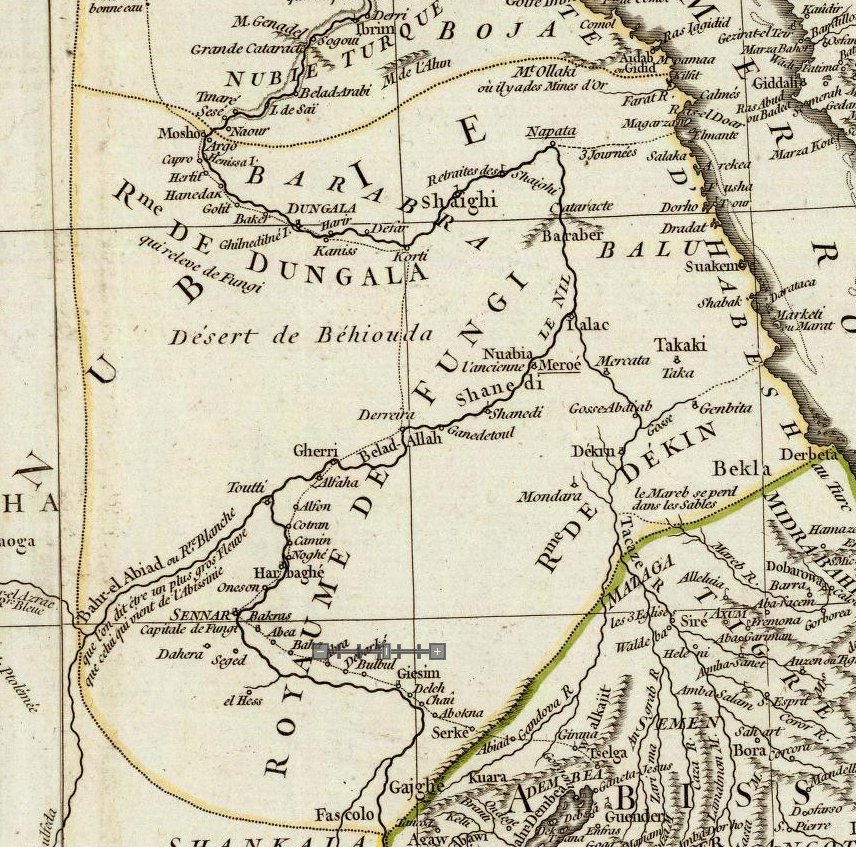
A European rendering of the Funj Sultanate's territory, drawn by the French cartographer J. B. B. d'Anville around 1745-49 — evidence of how far the kingdom's reputation had travelled. Source: Wikimedia Commons, public domain.
The economic model behind this prosperity was, in effect, a royal monopoly. All caravans and the gold supply that functioned as the state’s principal currency were controlled directly by the monarch. Customs revenue from the Egypt and Red Sea trade routes, and from pilgrims transiting the kingdom, flowed to the crown. This was not a market economy in any modern sense — it was a centrally directed commercial state, and for a period it worked extraordinarily well, generating enough wealth that by the reign of Badi III in the late seventeenth and early eighteenth centuries, Sennar could plausibly be described as nearly the greatest trading city on the continent.
Funj material culture from this period survives in ways that are unusually vivid for a state so thinly documented in its own written records. A Funj-style ceramic plate held today by Sudan’s National Corporation for Antiquities and Museums — decorated in an Islamic geometric idiom alongside Mamluk-influenced metalwork from the same milieu — is a small but concrete artifact of a kingdom plugged into the wider trading and artistic networks of the Islamic world, from Cairo to Andalusia.
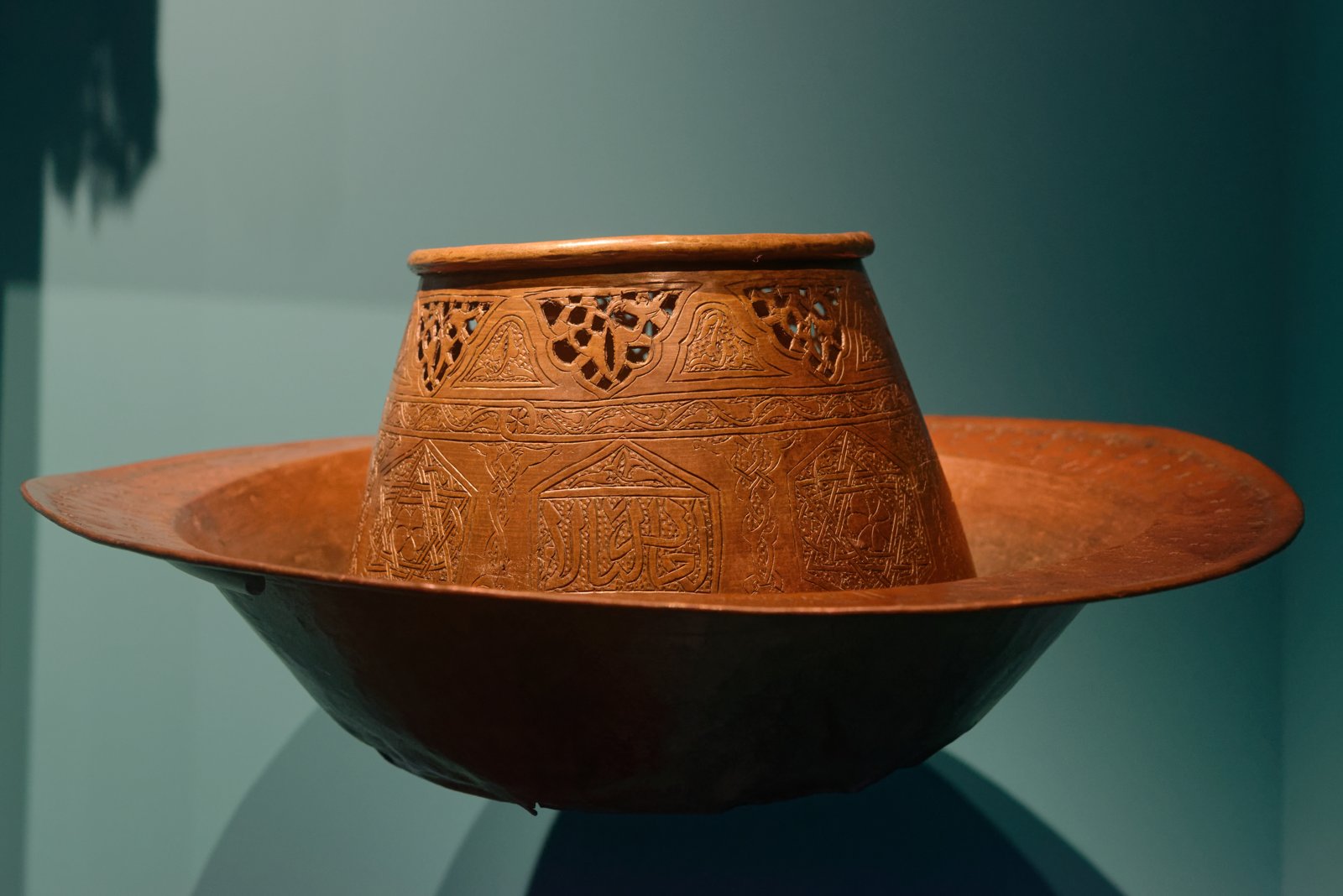
A Funj-style plate and Mamluk-style container from Sudan, held at the National Corporation for Antiquities and Museums (NCAM) — physical evidence of the sultanate's place in wider Islamic trade networks. Source: Wikimedia Commons, public domain.
Politically, Funj governance was more constrained than the image of a divine, secluded monarch suggests. The sultan rarely appeared in public, ate unseen, and governed through a small circle of officials; but he was not an absolute ruler. A council of twenty elders had a real say in state decisions, and beneath the king stood a structured bureaucracy — a chief minister (the amin), a market supervisor and intelligence chief (the jundi), and a royal executioner (the sid al-qum) whose grim but constitutionally important role was to kill all rival brothers of a newly enthroned sultan, precisely to prevent the succession wars that plagued so many premodern monarchies. The state itself was organised as a layered federation of provinces under governors called manjils, each subdividing into smaller units under local makks, all bound to Sennar through annual tribute and through the calculated practice of marrying provincial governors to women of the royal clan, who then functioned as the crown’s eyes and ears in every province. It was, in Acemoglu and Robinson’s terms, a hybrid system: extractive in its foundations — built on tribute, slave raiding, and a royal trade monopoly — but with enough distributed and consultative authority, in the Great Council and the provincial marriage-alliance system, to hold a genuinely vast and diverse territory together for two centuries without the kind of fragmentation that destroyed weaker neighbouring states more quickly.
The sultanate’s military reflected the same layered, federal structure. Each noble house fielded its own cavalry, measured in horsemen; the bulk of the infantry was drawn from slave soldiers captured in annual raids on non-Muslim peoples of the Nuba Mountains; and by the late seventeenth century the Funj could field an estimated 5,000 horsemen alongside a much larger slave infantry, armed with lances, throwing knives, and long two-handed broadswords, riding horses armoured in thick quilting and copper plate. Surviving weapons from the later Funj and Hamaj period — including a sword belonging to Nasir ibn Badi IV, the Hamaj regent who effectively ruled the state in the sultan’s name in the late eighteenth century — are now held in Sudan’s national collections, tangible objects from a military culture that briefly experimented with imported firearms and cannon under Badi III before abandoning them, partly because the traditional cavalry elite correctly recognised that gunpowder weapons would erode the basis of their own power.
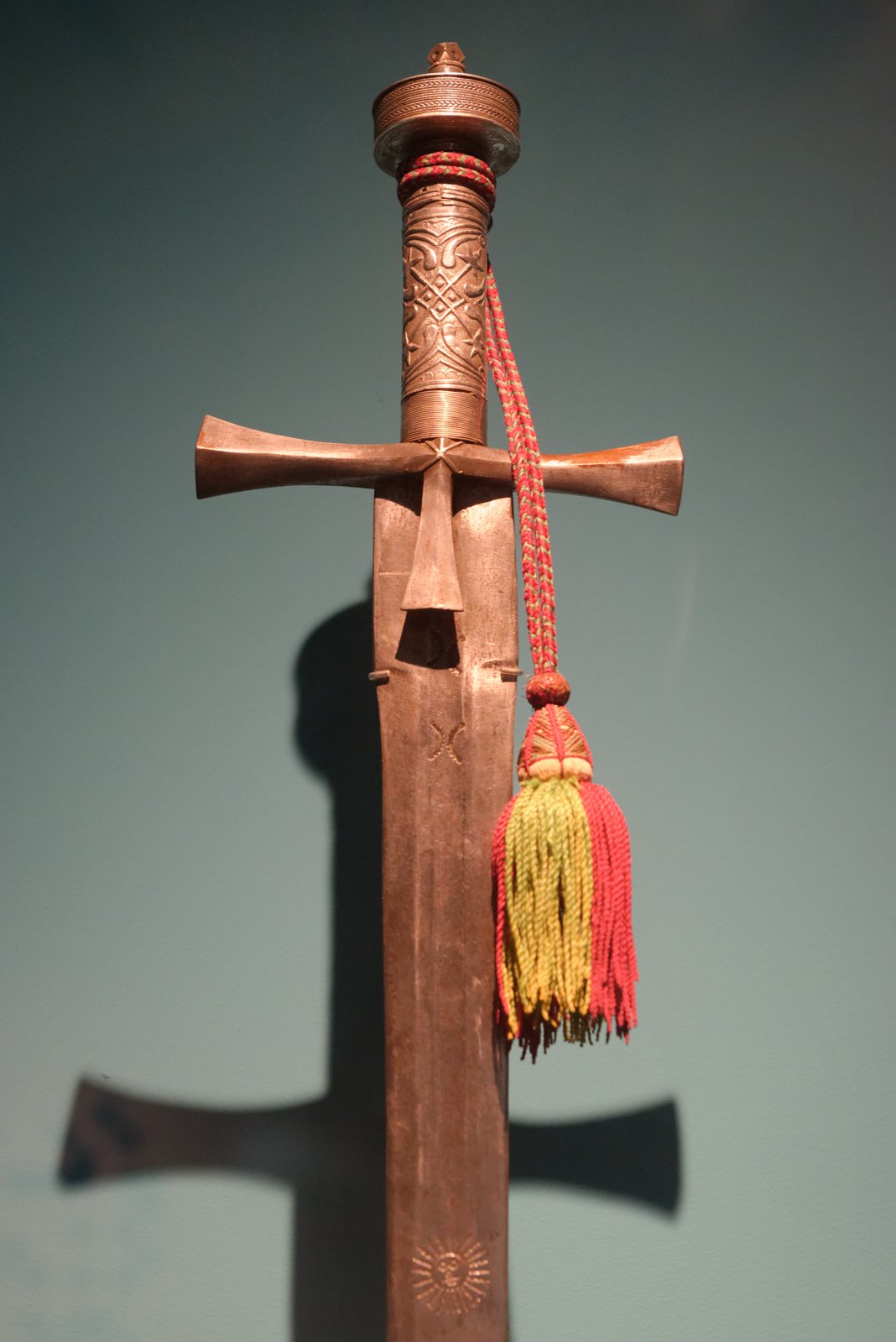
The sword of Nasir ibn Badi IV, a Hamaj regent who ruled in the Funj sultan's name during the eighteenth-century decline. Source: Wikimedia Commons, public domain.
The Unraveling: Merchants, Scholars, and Regents
Sennar’s peak, at the close of the seventeenth century, contained the seeds of its own undoing. The very trade that had made the sultanate wealthy also created a new merchant middle class — literate, well-travelled, and increasingly engaged with Islamic scholarship from the wider Muslim world. Until the eighteenth century, Funj Islam had been, in the historian Roland Loimeier’s description, more a “façade” than a lived faith: the Funj had converted nominally around 1523 primarily to ease governance of Muslim subjects and to facilitate trade, while continuing to eat pork, brew and drink beer, practice forms of divine kingship recognisable across the wider African political tradition, and — as late as the 1690s — greet visible Christians in the streets of Sennar by reciting the Islamic profession of faith, a gesture that only makes sense in a society where genuine religious boundaries were still fluid.
The newly wealthy, literate merchant class that Sennar’s trade had produced did not share the old tolerance for this ambiguity. They read widely in Islamic law and theology, and they grew concerned — genuinely, on religious grounds, but also as a rising class asserting its own claim to authority — about the kingdom’s lack of orthodoxy. The rise of a merchant-funded ulama, insisting it was their religious duty to administer justice independent of the crown, became, in the eighteenth century, the single greatest challenge to royal authority the sultanate had yet faced. This is worth sitting with, because it is not simply a story of religious reform. It is a story of an economic and intellectual class using genuine Islamic scholarship to contest a political monopoly — a dynamic recognisable throughout Islamic history, in which the ulama repeatedly functioned as an independent check on rulers precisely because religious legitimacy could not be monopolised by the palace the way trade and tribute could.
The political collapse that followed was rapid by the standards of a state that had endured for two centuries. In the 1690s and early 1700s the introduction of foreign coinage broke the crown’s direct grip on the market; an unregulated commercial system took hold, and the sultans lost control of the economy to the merchant class that traded in it. Royal matrilineal succession — the custom by which succession ran partly through the maternal line, a practice that Middle Eastern Islamic visitors had found culturally shocking — was formally abandoned in 1719, itself a sign of a monarchy trying to shore up its legitimacy by conforming more closely to an outside orthodoxy it had once held at arm’s length. Sultan Badi IV attempted, after defeating an Ethiopian invasion in 1744, to break the old aristocracy entirely, executing his own vizier and redistributing land away from the traditional Funj nobility toward loyal clients recruited from the kingdom’s western and southern periphery — among them a Hamaj cavalry commander named Muhammad Abu Likaylik.
That decision proved fatal to the dynasty it was meant to protect. Abu Likaylik, tasked with pacifying gold-rich Kordofan on the sultan’s behalf, instead built an independent power base there, and by 1762 marched on Sennar itself, deposing Badi IV — who fled to Ethiopia and was murdered the following year — and installing Badi’s own son as a puppet ruler while governing as regent in fact. This was the start of the Hamaj Regency, a fifty-nine-year period in which Funj sultans continued to sit on the throne in name while the Hamaj regents held real power, and in which the two centres of authority spent as much energy fighting each other as governing the state. By 1800 the sultanate had disintegrated into unending civil war between urbanised fragments; peripheral provinces — Kordofan to the Fur Sultanate, Dongola to the Shaykiyya, Taka and the Tigre lands to local rulers — broke away one by one, until, after 1802, the crown’s real authority extended little further than the immediate Gezira region around the capital itself. A brief stabilisation under the regent Muhammad Adlan after 1808 could not survive his assassination in early 1821, on the very eve of the Turco-Egyptian invasion — an invasion, notably, that many of the sultanate’s own exhausted and fractured provincial elites welcomed rather than resisted.
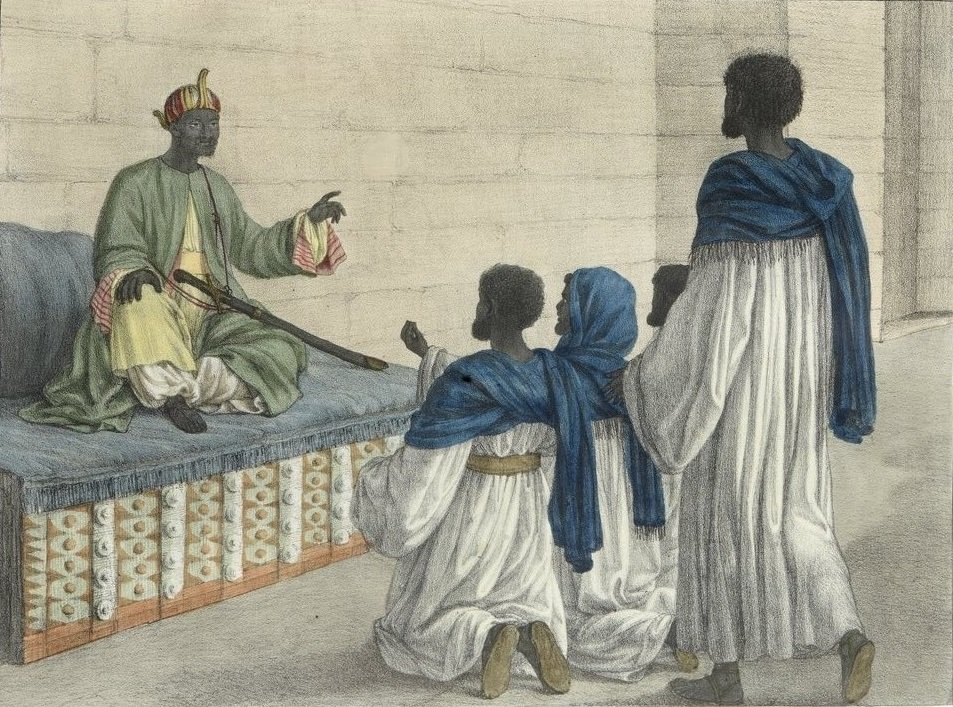
"Le roi de Sennâr donnant audience à ses ministres" — a depiction of a Funj king receiving his ministers, drawn shortly after the 1821 Turco-Egyptian conquest of Sudan. Source: Bibliothèque nationale de France, via Wikimedia Commons, public domain.
What the Funj Left Behind
It would be a mistake to read the Funj Sultanate’s history as simply a rise-and-fall curve ending in 1821. Its deeper impact was cultural and linguistic, and it long outlived the dynasty itself. Arabic, already used by the earlier Christian Nubian kingdoms for diplomatic correspondence with Egypt, became under Funj rule the lingua franca of trade, administration, and eventually religion across the central Nile Valley, gradually displacing the Nubian languages that had dominated the region for a thousand years — though Nubian speech persisted far longer than is commonly assumed, surviving as a first or secondary language among riverain communities well into the nineteenth century, and Hill Nubian dialects held on in parts of Kordofan into the twentieth. Islam, similarly, moved from the nominal “façade” faith of the sixteenth century to a genuinely embedded orthodoxy by the eighteenth, carried less by royal decree than by the same merchant and scholarly class that eventually helped bring the monarchy down. Sufi orders, Quranic schools, and a written Islamic legal and administrative culture — the oldest surviving Funj administrative document dates to 1654, from the reign of Badi II — took root across the Gezira in this period and shaped religious life in central Sudan for the two centuries that followed. Christianity did not vanish overnight either: Franciscan travellers recorded a “debased” Christian community south of Dongola as late as 1742, and folk practices with clear Christian origins — the marking of crosses on children’s foreheads, coin talismans against illness — were still documented among Muslim Sudanese communities in the Gezira and Kordofan as late as the 1930s, a quiet reminder that religious transitions in this region were gradual and layered rather than sudden replacements.
The Funj state also left an administrative template. The pattern of a Nile Valley polity governing a genuinely multi-ethnic population — Nubian, Arab, Nuba, Shilluk, Dinka, and others — from a riverain capital, through a hierarchy of provincial governors bound to the centre by tribute and marriage alliance, prefigures the administrative geography that Turco-Egyptian, Mahdist, and later British colonial rule all had to contend with and, in different ways, adapted rather than invented from scratch. Sennar itself, though reduced to ruins by 1821, was recognised in 2017 as a UNESCO-linked “Capital of Islamic Culture,” an explicit modern acknowledgment that the city’s significance to Sudanese and regional Islamic heritage did not end with the dynasty that built it.
Lessons for a Modern State
Read through the institutional framework Daron Acemoglu and James Robinson developed in Why Nations Fail, the Funj Sultanate’s trajectory is almost a textbook case of a hybrid order sliding from broadly functional toward narrowly extractive. Its early and middle-period strength did not come from being an inclusive state in any modern sense — it was a monarchy resting on tribute, a royal trade monopoly, and slave raiding — but it distributed enough real authority, through the Great Council of elders and the provincial governorship system, to hold together a large and genuinely diverse territory for two centuries, longer than most of its regional neighbours managed. What broke it was not external conquest, which arrived only at the very end and against a state already hollowed out. What broke it was the royal court’s own choice, faced with a rising merchant and scholarly class it could not fully control, to double down on narrow extraction: Badi IV’s purge of the old nobility in favour of loyal clients was a classic extractive-elite manoeuvre, consolidating power in the short term while destroying the broader coalition — including the very Hamaj clients he had elevated — that might have sustained the dynasty in the long term. Abu Likaylik’s coup did not build a more inclusive alternative; it substituted one narrow, extraction-dependent elite for another, and the fifty-nine years of Hamaj Regency that followed were a story of two competing extractive centres fighting each other into mutual exhaustion rather than either one governing.
Walter Rodney’s argument that underdevelopment is something actively done to a society, not a natural starting condition, applies with real force to the sultanate’s final act. The Turco-Egyptian conquest of 1821 was not an encounter between a thriving kingdom and a stronger neighbour — it was the absorption of an already-fragmented, tribute-exhausted territory into an extractive imperial system explicitly organised around slave conscription and revenue extraction for Muhammad Ali’s Egypt, a system that deliberately dismantled what remained of Sennar’s own commercial and administrative capacity rather than building on it. The ruins the Turco-Egyptian army found in 1821 were not simply the product of internal Funj decay; they were the starting point for a further round of externally imposed extraction that Rodney’s framework describes precisely.
The role of the ulama in the sultanate’s final century also deserves reading through the lens of the Islamic intellectual tradition on its own terms, not only as a symptom of state collapse. The merchant-funded scholars who challenged royal authority in the eighteenth century were not simply opportunists exploiting a moment of weakness. They were operating within a long Islamic tradition in which religious scholarship provided an independent source of legitimacy and a genuine check on rulers — the same tradition, running from classical jurisprudence through the Sufi orders that spread across the Gezira in this period, that has repeatedly given Sudanese Islam its own distinctively decentralised, scholarly, and locally rooted character, quite different from the more centralised, state-controlled religious institutions found elsewhere in the region. That the sultanate’s own rulers eventually lost the peasantry’s loyalty to these independent religious authorities is a reminder that legitimacy built purely on tribute and force is brittle in a way that legitimacy grounded in genuine intellectual and moral authority is not.
Even Ha-Joon Chang’s infant-industry framework, developed for a very different historical context, offers an oblique but genuine lesson here. The Funj crown’s tight control of caravan trade and the gold supply was, in effect, an early and unusually successful instance of a state directing and protecting its own commercial base rather than leaving it to unregulated actors — and it was precisely the loss of that directed control, as foreign coinage and an unregulated merchant market took hold after 1700, that coincided with the unravelling of royal authority. The lesson is not that markets are dangerous; it is that a state which builds its legitimacy on controlling an economic function needs an institutional plan for what happens when that function inevitably slips from direct royal control into a wider, more distributed market — a transition every developing economy eventually faces, and one Sennar’s monarchy met with purges and civil war rather than adaptation.
There is, finally, a smaller but real point of contrast with William Foote Whyte’s account of the Mondragón cooperatives: nothing in the Funj system remotely resembled a genuine cooperative economic structure, and that absence is itself instructive. Funj prosperity was built on a strictly hierarchical, tribute-and-monopoly model in which wealth flowed upward from provincial subjects to a royal centre and back down again only through patronage; there was no equivalent institutional mechanism, comparable to Mondragón’s worker ownership, for binding the merchant class’s growing economic power to the political system’s long-term survival rather than to its eventual capture of that system for narrower ends. A state that had found some way to give its rising commercial and scholarly class a durable institutional stake in governance, rather than forcing it to either submit to or overthrow the crown, might well have found a longer and less violent path through the very transition that instead destroyed it.
Sudan’s present moment, rebuilding institutions after a war that has fractured the country’s own centre in ways not entirely unlike the Hamaj Regency’s, is not a repeat of 1821. But the underlying institutional questions — how a state distributes real authority across a genuinely diverse territory, what happens when an economic transition outpaces a political system’s capacity to absorb it, and whether rising centres of legitimate authority are brought into governance or forced to fight for it — are the same questions the Funj Sultanate answered well for two centuries and badly for one. That history is worth knowing on its own terms, not only as an instructive parallel.
Sources. This essay draws on the Wikipedia article “Funj Sultanate”, which is itself built on the standard academic literature in the field — principally R.S. O’Fahey and J.L. Spaulding’s Kingdoms of the Sudan (1974) and Jay Spaulding’s The Heroic Age in Sennar (1985), together with A.C.S. Peacock’s research on Ottoman-Funj relations, Roland Werner’s and Rüdiger Loimeier’s work on religious change in Nubia and Sudan, and the eyewitness travel accounts of James Bruce and Johann Ludwig Burckhardt. Readers who want to go past a single-article summary should start with the Kandaka Library titles below, several of which engage directly with the same primary sources and historiography.
Further Reading — Kandaka Library
- The Sudan of the Three Niles: The Funj Chronicle — Abdalla Ahmed Abdalla. A translation and analysis of the Funj Chronicle itself, the closest thing the sultanate left to its own written record.
- A Black Power in the Blue Nile: Military History of the Funj Sultanate — A military history of the sultanate’s rise and control of the Blue Nile region.
- The Ottomans and the Funj Sultanate in the Sixteenth and Seventeenth Centuries — A.C.S. Peacock. A scholarly examination of Ottoman archival sources documenting the diplomatic and religious relationship between the two powers.
- Sennar: Capital of Islamic Culture 2017 — Harry Jones. A record of Sennar’s modern recognition as a Capital of Islamic Culture, and the Funj legacy that recognition honours.