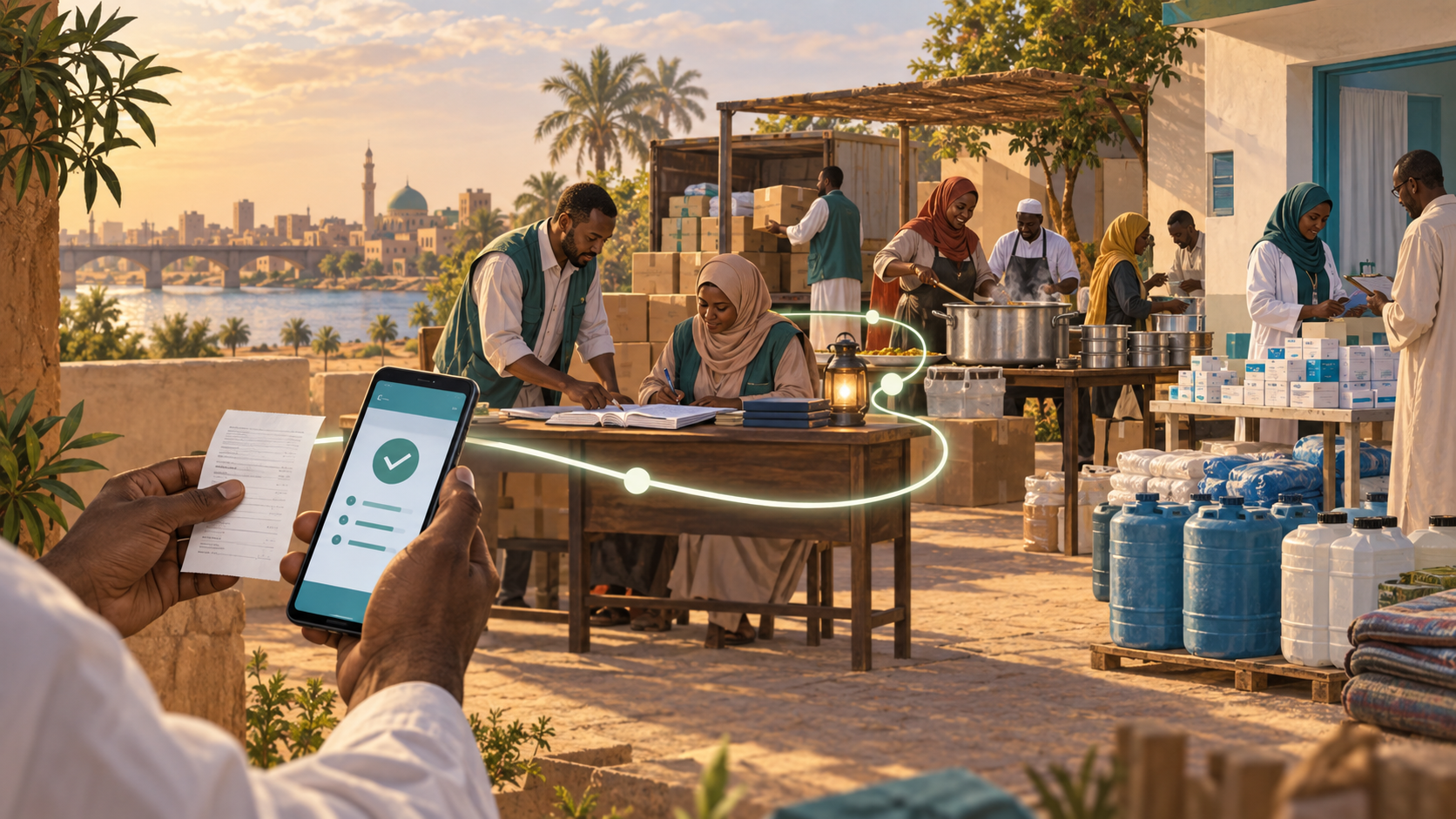
Cover: Original editorial illustration commissioned by Kandaka, 2026. It is symbolic, not documentary, and depicts no identified aid recipient.
Last verified: 19 September 2026. Humanitarian access, donation routes and organizational finances change. Use only the official links in this guide and recheck the destination before paying.
Following Aid From Donation to Delivery
The easiest part of helping Sudan is pressing a donate button.
The difficult part is knowing what happens next.
Does the money buy food inside Sudan, support refugees in a neighboring country or enter a global emergency fund? Can the organization reach the place it names? Does it work through Sudanese partners? Are its results independently audited, internally reported or merely advertised? How much flexibility does it need when a road closes, a bank stops operating or a town changes hands?
There is no organization that can answer every need across Sudan. A large international agency may have audited accounts, warehouses and cross-border logistics but be unable to enter a besieged neighborhood. A local Emergency Response Room may know exactly which community kitchen has run out of flour but cannot safely publish names, bank transfers or locations. Medical organizations, protection agencies and food programmes do different work.
The honest answer is therefore not a permanent list of “good charities.” It is a method for choosing—and a dated assessment of organizations for which Kandaka found a legal donation identity, current Sudan operations and a meaningful public evidence trail.
The practical recommendation is to divide support between:
- Sudanese-led local response, for speed, local knowledge and access;
- specialist Sudanese medical organizations, for hospitals and clinical services; and
- large humanitarian agencies, for food supply chains, vaccines, shelter, water systems, protection and cross-border operations.
No single route should be mistaken for the entire response.
The Scale of the Need
UNICEF’s August 2026 mid-year report estimated that 33.7 million people in Sudan required humanitarian assistance, including 17.3 million children, and reported more than 9.1 million internally displaced people. By the end of June, UNICEF had mobilized $351 million for its 2026 Sudan appeal but still faced a 64 percent funding gap. UNICEF Sudan mid-year report.
WFP’s current Sudan emergency page says more than 19 million people face acute hunger, it is reaching more than four million people each month, and it urgently needs $579 million for operations through October 2026. WFP Sudan emergency.
Funding is only one constraint. Convoys, hospitals and aid workers have been attacked. Border permissions change. Communications fail. Commercial banking and supplier payments are disrupted. Floods and damaged bridges isolate communities. The cost of security, transport, warehousing, monitoring, financial compliance and staff is therefore not automatically waste. In Sudan, those functions can be the difference between supplies reaching a clinic and remaining at a port.
What “Trustworthy” Should Mean
Kandaka cannot certify any organization as permanently trustworthy. Leadership, access, finances and programmes change. Instead, test the evidence that can be refreshed.
1. A real legal and donation identity
The organization should identify its legal entity, registration or fiscal sponsor, official website and payment processor. The name on the payment page should match the entity described. A social-media post or personal bank account is not enough.
2. Verified current Sudan operations
Look for dated country reports, locations, activities and delivery figures. “Helping the Sudan crisis” may mean work inside Sudan, in Chad or Egypt, or across the whole region. All can be valuable, but donors should know the scope.
3. Financial reporting
For established organizations, look for audited statements, annual reports, tax filings where applicable and an explanation of restricted and unrestricted funds. For newer grassroots channels, look for a named fiscal sponsor, transfer controls, budgets, receipts, narrative reports and independent confirmation of delivery.
4. Evidence of results—not only spending ratios
A programme-expense percentage cannot prove that aid arrived or helped. Results should connect money or supplies to services: meals, consultations, treated children, functioning water points, shelter kits or verified cash transfers. Label self-reported numbers as such.
5. Local participation and accountability
Organizations should explain who identifies needs, chooses recipients and handles complaints, and whether Sudanese partners have decision-making power rather than serving only as subcontractors.
6. Geographic and sector fit
A donor who wants to support maternal care in Darfur should not assume that a general food organization will do it. Ask what sector and geography the appeal covers and whether the donation can be restricted.
7. Safe and lawful transfer
Use official donation pages and registered intermediaries. Do not use cryptocurrency, cash couriers or disguised payment descriptions merely to bypass controls. A legitimate organization should explain its transfer method without asking donors to conceal the purpose.
8. Honest uncertainty
Perfect public reporting is impossible in an active war. Publishing the names of volunteers, survivors or transfer agents can endanger them. Safety-sensitive confidentiality is different from refusing all accountability.
The Current Shortlist
This is a dated evidence assessment, not a guarantee or permanent endorsement. “Strong public evidence” means Kandaka found current operations plus substantial financial or operational reporting. “Developing public assurance” means the channel appears credible and important but has a shorter audit history or less independently verifiable delivery evidence.
| Organization or channel | Best fit | Evidence verified by 19 September 2026 | Important limitation | Evidence level |
|---|---|---|---|---|
| Mutual Aid Sudan Coalition / Emergency Response Rooms | Community kitchens, health support, water, evacuation, shelter and direct neighborhood response | Named US fiscal sponsor; official donation route; published allocation and reporting process; current ERR activity | Newer channel; 95 cents-per-dollar figure is MASC’s own claim; limited long-term independent audit history | Important local channel; developing public assurance |
| Sudanese American Physicians Association (SAPA) | Hospitals, mobile clinics, nutrition, vaccination, maternal and child health | US 501(c)(3); public IRS filing; 2025 report; financials page; active donation channel | Many programme totals are organization-reported; latest public IRS data currently covers 2024 | Strong current evidence for Sudan-focused medical giving |
| World Food Programme (WFP) | Food, nutrition, cash and humanitarian logistics | Current Sudan emergency reporting; country reports; audited global accounts; active appeal | Gifts may be pooled or used where need is greatest depending on the donation page | Strong public accountability and scale |
| UNICEF | Child nutrition, health, vaccines, water, education and protection | Current Sudan appeal and situation reports; supply and funding data; UN audit and transparency systems | Broad mandate; routing can be global or Sudan-specific depending on the page and national committee | Strong public accountability for child-focused response |
| International Committee of the Red Cross (ICRC) | Conflict surgery, hospitals, water, family tracing, missing persons and protection | Active Sudan-specific donation page; current Sudan operations; public finances; longstanding presence | Neutrality and security limit operational detail; verify the restriction shown at checkout | Strong conflict-specific evidence |
| Médecins Sans Frontières / Doctors Without Borders (MSF) | Independent emergency medical care and treatment for survivors of sexual violence | Current Sudan programme reporting; audited international financial report; private-donor funding model | MSF asks donors to prefer unrestricted gifts and moves funds according to operational need | Strong independent medical evidence |
| UNHCR | Displacement, shelter, cash, protection, refugees and host communities | Active Sudan emergency appeal; 2026 appeal and country data | The emergency covers Sudan and neighboring countries, not only delivery inside Sudan | Strong regional displacement evidence |
| UNFPA | Maternal and reproductive health and gender-based-violence services | September-published July 2026 Sudan report; state and service coverage; funding data | Survivor confidentiality limits case-level verification; a general contribution may not be Sudan-earmarked | Strong specialist evidence for women and girls |
An organization not listed is not necessarily untrustworthy. It means Kandaka has not completed enough current verification to include it here.
Sudanese-Led Aid: Emergency Response Rooms
Emergency Response Rooms are decentralized networks of Sudanese volunteers. They organize community kitchens, evacuations, medical support, water repairs, shelter, education and other services according to local conditions. Their great advantage is presence. Volunteers may remain in a neighborhood after an international organization has evacuated or reach places that a marked convoy cannot.
The problem for an overseas donor is the bridge between a credit card and a local room.
The Mutual Aid Sudan Coalition offers one such bridge. Its official donation page identifies Proximity2Humanity, EIN 99-2897200, as its US 501(c)(3) fiscal sponsor. MASC says Emergency Response Rooms submit activity plans and budgets; a Localization Coordination Council agrees memoranda with them; funds are transferred; and the rooms submit financial and narrative reports. MASC donation page; MASC process.
This is materially better than donating to an unknown personal account. It creates a legal recipient and an articulated chain of control.
However, donors should understand the remaining uncertainty. MASC says 95 cents of every donated dollar reaches local responders. Kandaka did not find a long series of independent audited accounts proving that ratio or a public project-level ledger capable of safely confirming all onward transfers. Proximity2Humanity and MASC are comparatively new.
The right conclusion is not to exclude ERRs until they report like a fifty-year-old UN agency. That would punish the organizations closest to communities. The right standard is proportional accountability: fiscal sponsorship, sanctions screening, secure confirmations, sampled audits, complaints mechanisms and aggregated public reports that do not expose volunteers.
For donors who prioritize local control, MASC is a reasonable current channel to consider—with the explicit understanding that its public assurance system is still developing.
Sudanese Medical Giving: SAPA
The Sudanese American Physicians Association offers a different form of localization: a diaspora professional organization connected to Sudanese health providers.
SAPA identifies itself as a US 501(c)(3), EIN 83-3464851. Its site publishes a 2025 report and links to financial material. ProPublica’s reproduction of IRS data shows that its 2024 Form 990 reported approximately $7.25 million in revenue, $5.83 million in expenses and $2.36 million in net assets. Those figures establish a real filing organization at meaningful scale; they do not independently prove every impact claim. SAPA annual reports; ProPublica filing record.
SAPA’s 2025 report describes emergency health care, nutrition, vaccination, maternal and child health, psychosocial support, facility rehabilitation and workforce training. Many output totals remain organization-reported, so future audited accounts should be checked against major programme claims.
For a donor seeking specifically Sudanese medical work, SAPA currently has one of the strongest combinations of local professional connection, legal identity, public filings and current operational reporting found in this review.
Which Large Agency Fits Which Need?
Food and nutrition: WFP
WFP operates large food and cash programmes and shared humanitarian logistics. Its current Sudan page says it is reaching more than four million people per month and has delivered assistance in all eighteen states since the war began. Its accounts are audited. WFP Sudan emergency and donation route; WFP audited accounts.
Choose WFP when scale, food supply and logistics are the priority. Confirm whether the payment page restricts the gift to Sudan or allows WFP to use it in the greatest global need.
Children, water, vaccines and education: UNICEF
UNICEF’s 2026 mid-year report says it screened 5.3 million children for acute malnutrition, treated 174,700 children with severe acute malnutrition, supported primary health care, vaccination, safe water, education and psychosocial services. These are UNICEF-and-partner reported reach figures, not an independent census of unique beneficiaries. UNICEF Sudan appeal; UNICEF mid-year report.
Choose UNICEF for a broad child-centred response. It is not an orphanage fund. Responsible child protection prioritizes family tracing, reunification, kinship care and supervised alternative care rather than unnecessary institutionalization.
War surgery, water and missing family members: ICRC
The ICRC works under a conflict-specific mandate and engages armed parties on international humanitarian law. Its Sudan reporting covers hospitals, medical supplies, water systems, cash and household assistance, missing people and family contact. ICRC Sudan operations; ICRC Sudan donation page; ICRC finances.
Choose ICRC when the priority is conflict medicine, essential systems, protection or restoring family links. For a missing relative, use the ICRC’s tracing service rather than treating a donation as a request for individual case action.
Independent medical action: MSF
MSF reports continuing medical programmes in Sudan despite attacks and restrictions. Its 2025 international financial reporting is audited, and its donation page says 98 percent of 2025 income came from private donors, supporting operational independence. MSF Sudan operations; MSF reports and finances; MSF donation page.
Choose MSF for emergency clinical care and an independent medical presence. Do not assume a general MSF donation can be earmarked to one hospital; its ability to shift funding is part of how it responds to changing access.
Shelter, displacement and regional refugees: UNHCR
UNHCR works with refugees, internally displaced people and host communities. Its emergency page explicitly covers Sudan and seven neighboring countries and includes people displaced inside Sudan as well as those who crossed borders. UNHCR Sudan emergency; UNHCR donation page.
Choose UNHCR if displacement, shelter or protection is the priority. Supporting Sudanese refugees in Chad or Egypt is helping the Sudan crisis, but it is not the same as delivery inside Sudan.
Women, childbirth and sexual-violence response: UNFPA
UNFPA specializes in sexual and reproductive health and gender-based-violence services. Its latest available report, published in September and covering July 2026, says partners provided reproductive-health services in 52 localities across 17 states and reached more than 90,000 people with GBV prevention, risk mitigation and response services. The $129.2 million appeal was 34 percent funded. These are UNFPA-and-partner reported totals. UNFPA July 2026 report; UNFPA Sudan emergency.
Choose UNFPA for maternal care, reproductive health, dignity supplies and survivor services. Detailed case information should not be public: survivor safety and confidentiality are themselves requirements of responsible practice.
A Practical Donation Strategy
Most donors do not need to find one winner. They can build a small portfolio.
One reasonable structure is:
- a portion to a vetted Sudanese-led channel such as MASC for flexible neighborhood response;
- a portion to a Sudanese specialist such as SAPA if health is a priority; and
- a portion to the large agency that best matches the chosen sector—WFP, UNICEF, ICRC, MSF, UNHCR or UNFPA.
A recurring monthly donation can be more useful than one large response to a viral headline because it lets organizations plan. Unrestricted funding can also be valuable: it allows responders to move money when a crossing closes or an outbreak begins. If geographic certainty matters more, use a clearly labelled Sudan-specific appeal and save a copy of the restriction terms.
Before donating:
- type or verify the organization’s official domain rather than trusting a forwarded payment link;
- confirm the legal name and, where applicable, charity number or EIN;
- read whether the gift is restricted to Sudan, the regional crisis or global operations;
- retain the receipt and campaign wording;
- subscribe to operational and financial updates; and
- review the organization again before renewing next year.
Direct Aid to a Family
Sending money to a family you know can be immediate, dignified and efficient. It can pay rent, food, medicine, transport or school costs in a way no programme would choose as quickly.
It is not the same as a charitable programme.
The donor carries the verification, security and fairness risk. The recipient may face transfer fees, theft, coercion or questions from financial institutions. Public fundraising can expose names and locations. Money sent to one family does not necessarily reach the households with greatest need.
If giving directly:
- confirm identity through a second trusted channel;
- avoid publishing sensitive personal documents or locations;
- use a lawful regulated payment method;
- never write a false transfer purpose;
- agree whether the gift is private support or a public fundraiser requiring reports; and
- do not promise tax deductibility unless a qualified organization receives the donation.
Direct solidarity and institutional aid can coexist. They solve different problems.
What Not to Send
Do not organize a shipment of clothes, food or medicine unless a credible organization has requested the exact items and confirmed transport, customs, storage and distribution.
Unrequested goods can cost more to ship than to buy locally, arrive after the need has changed, undermine local markets or expire in storage. Medicines require correct formulations, temperature control and professional management. Cash to a capable responder is usually more flexible.
Do not donate to:
- a newly created social account with no legal recipient or verifiable local relationship;
- a personal appeal using stolen photographs or refusing live identity confirmation;
- any fundraiser that mixes humanitarian help with weapons, armed mobilization or political payment;
- an “orphan rescue” that cannot explain safeguarding, family tracing and alternative-care standards;
- an organization that guarantees access everywhere in Sudan; or
- a channel that tells donors to disguise the purpose of a transfer.
What Donors Should Demand
From large agencies:
- How much of the Sudan appeal is funded?
- How much was spent inside Sudan versus neighboring countries?
- Which work is delivered by Sudanese partners, and how much funding reaches them directly?
- What happened when access was denied?
- Are reach figures people, visits, services or households—and are repeat recipients counted more than once?
From local channels:
- Who is the legal recipient and fiscal sponsor?
- Who approves allocations and handles conflicts of interest?
- How is receipt confirmed when banks and communications fail?
- Are financial and narrative reports sampled or independently checked?
- How can communities complain safely?
- What information is withheld for security, and who can review it confidentially?
Transparency should not mean forcing a volunteer in a war zone to publish a spreadsheet that identifies the kitchen they operate. It should mean that somebody independent can follow the chain without exposing the people inside it.
Kandaka’s Current Recommendation
- For locally led, flexible aid: consider the Mutual Aid Sudan Coalition’s official ERR channel, recognizing its developing independent audit history.
- For Sudanese-led medical work: consider SAPA, which has a registered US entity, public tax filings and current operational reports.
- For food and logistics: WFP.
- For children, nutrition, vaccines, water and education: UNICEF.
- For conflict surgery, water infrastructure, missing people and humanitarian protection: ICRC.
- For independent emergency medicine: MSF.
- For displaced families, shelter and refugees across the region: UNHCR.
- For maternal health and services for women and survivors of gender-based violence: UNFPA.
This list must be rechecked. Donation pages, access, leadership, financial reports and programmes can change. Kandaka will date material corrections rather than silently preserving an outdated recommendation.
The final question is not whether every dollar can be traced to a photographed bag of grain. That standard can encourage misleading marketing and endanger recipients.
The real question is whether a donor can identify the organization, understand its mandate, confirm present operations, examine its controls, see credible evidence of delivery and learn honestly what could not be delivered.
Sudan does not need blind generosity.
It needs informed solidarity that stays long enough to ask what happened next.
Principal Sources
- UNICEF Sudan Humanitarian Mid-Year Situation Report 2026 and Sudan appeal.
- WFP Sudan emergency and audited annual accounts.
- Mutual Aid Sudan Coalition donation route and allocation/reporting process.
- SAPA annual reports and public IRS filing record.
- ICRC Sudan operations, Sudan donation route and financial reporting.
- MSF Sudan operations, reports and finances and donation policy.
- UNHCR Sudan emergency and donation route.
- UNFPA July 2026 Sudan situation report and Sudan emergency page.
Research Limitations
Verification closed on 19 September 2026. Kandaka checked official operational pages, official donation routes, available financial reports and public filings, but did not audit transfers or independently observe delivery. The MASC cost ratio and most programme outputs are organization-reported. Wartime confidentiality limits what local responders and survivor-services programmes can safely disclose. Inclusion here is not investment, legal or tax advice and does not guarantee future access or performance.