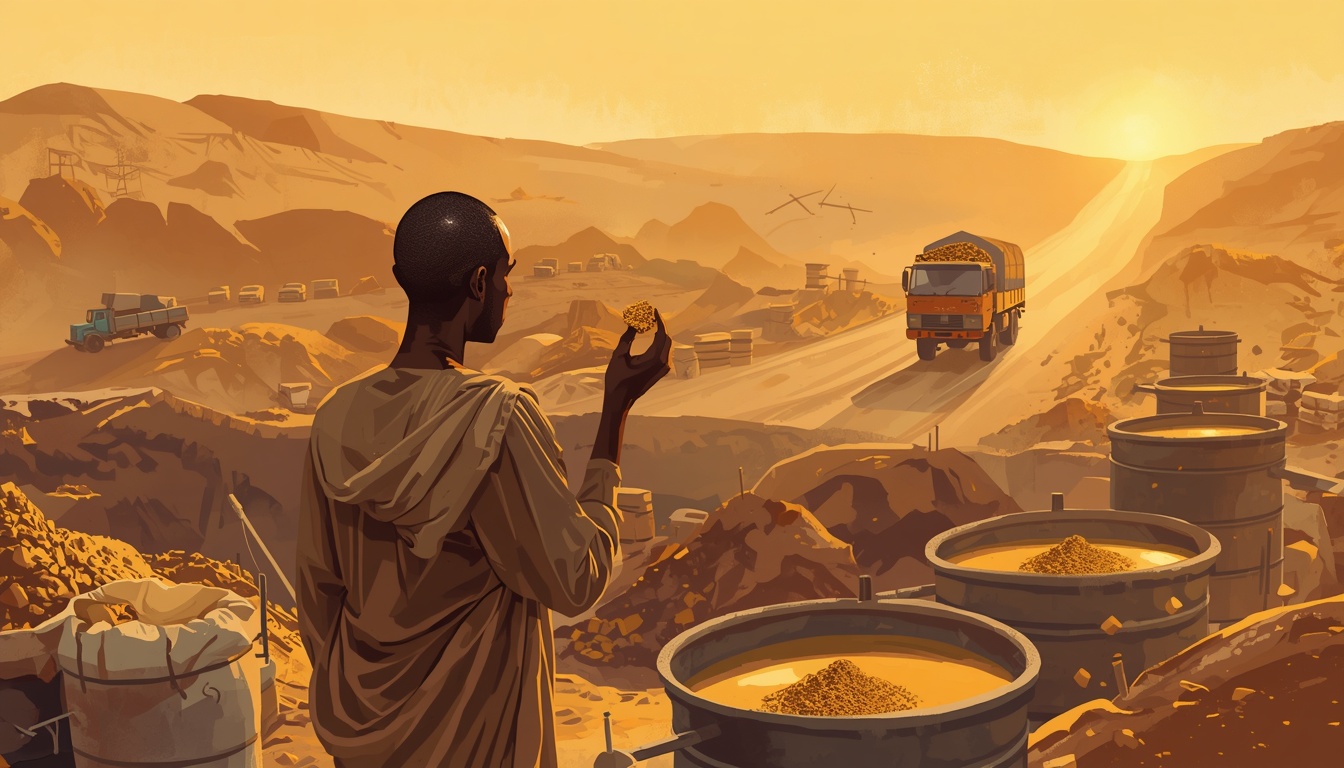
Sudan is one of Africa’s largest gold producers. In recent years before the 2023 war, official exports exceeded 40 tonnes annually — and the informal, undeclared trade was estimated to be several times larger. The country also holds substantial reserves of chromite, iron ore, copper, zinc, manganese, uranium, and several other commercially significant minerals. By geological endowment alone, Sudan is not a poor country.
Yet almost none of this wealth has translated into development. The gold gets extracted, much of it illegally, and moves — through the UAE, primarily — into international markets with minimal benefit to Sudan beyond whatever the diggers themselves earn in often dangerous conditions. The processing, refining, trading, logistics, and finance that capture most of the value in a mining supply chain all happen elsewhere.
This is the fundamental problem, and solving it is not simply a matter of enforcing better rules. It requires building a Sudanese mining sector with the institutional depth to actually capture value — not just a Sudanese mining hole.
What Sudan Has Underground
The geological surveys conducted since independence, and the detailed work by the Geological Research Authority of Sudan, have mapped a mineral endowment that spans most of the country’s territory.
Gold is the headline resource. The Nubian Shield — the ancient Precambrian rock formation that runs through northeast Sudan into Eritrea and Ethiopia — contains one of the highest concentrations of gold mineralisation in Africa. The Gebel Amir district in North Darfur, the Ariab belt in Red Sea State, the Gebeit area: these have been producing gold for centuries. The modern artisanal mining sector, with hundreds of thousands of small-scale miners, has expanded dramatically since 2012. The problem is not finding the gold. It is who captures the value once it is found.
Chromite is Sudan’s second most significant mineral commercially. The Ingessana Hills in Blue Nile State contain chromite deposits assessed as among the largest in Africa. Chrome is a critical input in stainless steel manufacturing — a sector with sustained global demand. Sudan has exported chromite ore, but has never moved into ferrochrome production (the first processing step that multiplies the ore’s value several times over).
Iron ore deposits exist in several regions, most significantly in the Fodikwan area. At scale, these could support a domestic steel industry — the upstream foundation for construction, engineering, and manufacturing across the economy. Sudan currently imports virtually all its steel.
Uranium deposits have been identified by the Geological Research Authority, concentrated in areas including Hofrat en Nahas and parts of Darfur and the Red Sea Hills. These have not been commercially developed but represent a strategic long-term resource.
Copper, zinc, and lead occur in the Red Sea Hills and other zones. Several concessions have been granted to foreign companies over the years, with limited development progress.
The picture is consistent: Sudan has identified the resources but has not built the infrastructure, institutions, or industrial capacity to do anything meaningful with them beyond extracting raw ore.
The Gold Sector: A Cautionary Tale
Sudan’s gold sector illustrates the structural problem with perfect clarity. Since the mid-2010s, artisanal and small-scale gold mining (ASM) has expanded to involve an estimated one to two million people, making it one of the largest employers in Sudan. The activity is diffuse, largely informal, and spread across dozens of sites from North Kordofan to the Red Sea Hills.
The gold produced flows through a chain of traders, consolidators, and exporters — many of them connected to politically influential networks — and arrives, predominantly, in the UAE. Dubai has become the world’s largest gold trading hub partly because of its willingness to accept gold from sources that Western-regulated markets would scrutinise. Sudan’s gold, including gold extracted and traded in violation of sanctions and without proper documentation, has found a ready market there.
Global Witness and other investigators have documented how this system works and who benefits. The short version: the miners earn subsistence-level incomes, the state collects limited revenue because declaration and taxation are evaded, and the political and commercial elite capture the rents from trading, export licensing, and logistics. The 2019 revolution was partly a response to exactly this kind of extraction — wealth generated in Sudan, captured by a narrow class, and exported.
The formal mining sector — companies operating under concession agreements — has had its own problems. A succession of international juniors and mid-tier miners have signed agreements, conducted exploration, and either failed to develop their assets or departed when political conditions shifted. The institutional environment for mining investment has been characterised by opaque licensing, inconsistent regulatory enforcement, and the influence of military-connected commercial entities that compete with, rather than facilitate, formal investment.
What a Different Path Would Look Like
The extractive model — dig up raw material, export it, import the processed product at much higher cost — is not inevitable. Countries have moved beyond it, though it requires deliberate policy and institutional investment over years or decades.
The first step is transparency and revenue capture. Sudan cannot build a mining sector without knowing what is being extracted and by whom. A credible mineral registry, mandatory declaration and assay of artisanal production, and a transparent licensing system are the foundation. These are not technically complex requirements — they exist in Ghana, Tanzania, and a dozen other African mining countries. They require political will to implement against the interests of those who profit from opacity.
The second step is domestic processing. Raw ore is worth a fraction of what it is worth after processing. Chromite smelted into ferrochrome is worth three to five times the ore. Gold refined to London Bullion Market Association standard commands a significant premium over unrefined gold. Sudan could establish a national refinery — several African countries have done this for gold — and make export of unrefined gold by artisanal miners conditional on sale to the refinery at a certified price. This keeps the refining margin in Sudan and provides traceability that legitimate international buyers require.
The third step is linkage to domestic industry. Iron ore that feeds a Sudanese steel mill is worth more to the economy than iron ore that is exported and then reimported as structural steel for construction projects. The linkage does not happen automatically; it requires that the steel industry exists (which currently it largely does not), and that the regulatory environment incentivises domestic supply over export. This is a longer horizon goal — five to fifteen years — but it starts with the decision to treat minerals as inputs to an industrial economy, not just exports.
The fourth step is training and local content. The technical skills for modern mining — geology, drilling, metallurgy, mine engineering, safety management — can be built in Sudanese universities and technical institutes. Several Sudanese engineers have built careers in mining sectors across Africa and the Gulf. A deliberate local content policy in mining concession agreements, combined with genuine investment in geological and mining engineering education, would begin the transition from a country that hosts mining to a country that has a mining industry.
The Risk of Getting It Wrong Again
Minerals wealth has a well-documented tendency to produce bad outcomes in weak institutional environments. The academic literature on the “resource curse” is extensive, and Sudan’s history provides supporting evidence: oil revenues from the south, before secession, funded a military state rather than a developmental one. Gold has similarly enriched connected elites rather than the country.
The risk is not hypothetical. Any post-war reconstruction that opens Sudan’s mineral sector to rapid foreign investment without first building domestic institutions, revenue transparency, and processing capacity will simply reproduce the extractive model. The money will flow out. The environmental and social costs of mining — land degradation, mercury contamination from artisanal processing, water use, displacement — will remain.
Getting it right requires sequencing: institution-building before licensing, transparency before scale, training before concession, and domestic processing before export liberalisation. This is harder than simply inviting investment. But a Sudan that builds a genuine mining industry — not just a mining hole — will be materially better off for decades.
Further Reading — Kandaka Library
- Feasibility Study: Block 14 Gold Project, Sudan — Detailed technical and commercial feasibility study for a major Sudanese gold deposit.
- Minerals Potential and Resources in Sudan — Comprehensive overview of Sudan’s known mineral reserves and their commercial potential, presented at UNCTAD.
- Uranium in Sudan: Way Forward — Geological Research Authority assessment of Sudan’s uranium deposits and strategic options.
- Bad Company: How Dark Money Threatens Sudan’s Transition — Global Witness investigation into the politically connected networks profiting from Sudan’s gold trade.
- Sudan Country Economic Memorandum — World Bank analysis of Sudan’s economic diversification options, including the mineral sector.