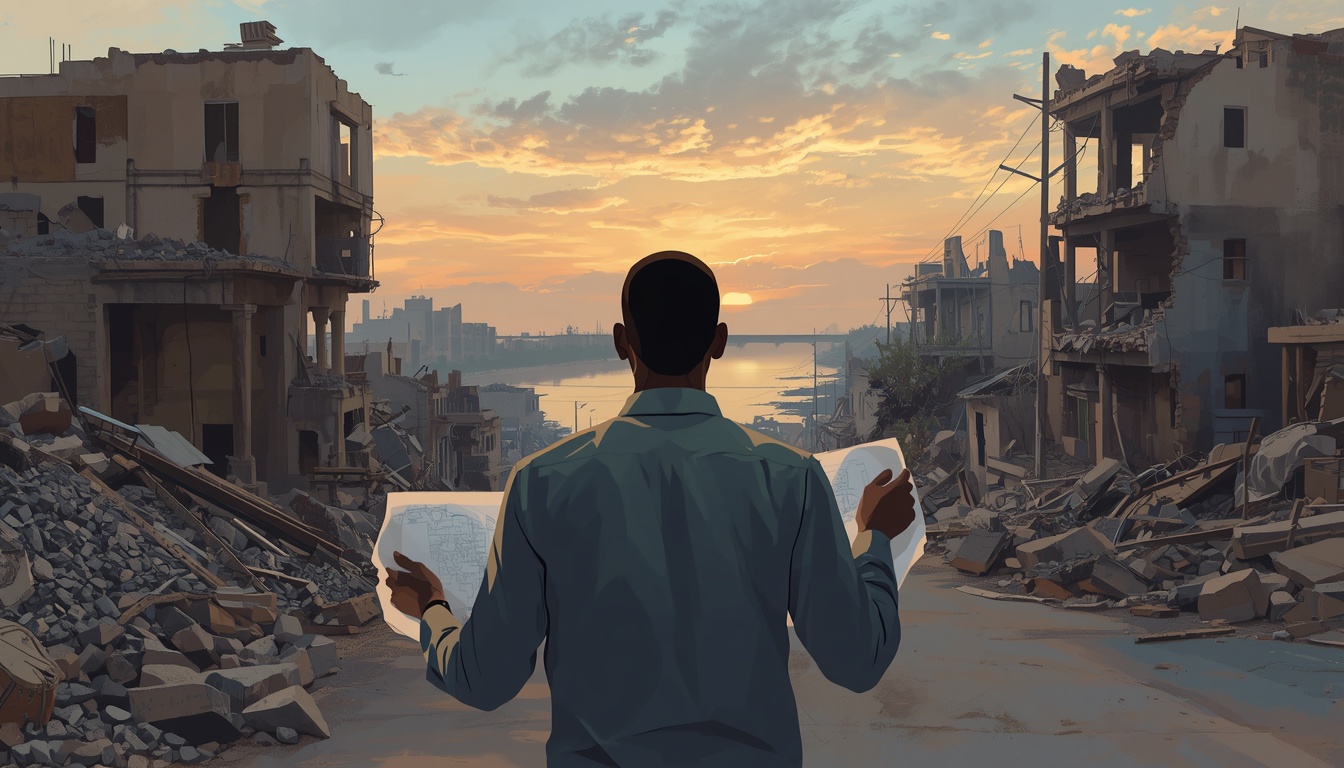
Khartoum was not a beautiful city. Decades of under-investment, uncontrolled sprawl, and governance failures had produced a capital with inadequate water, intermittent power, congested roads, inadequate sewerage, and housing that lagged far behind population growth. The urban planning studies conducted before the war documented these problems in detail. Then the war came, and made everything worse by an order of magnitude.
What Sudan’s urban war has done to Khartoum — and to Omdurman, Khartoum North, and the metropolitan area that is home to some eight to ten million people — is still being quantified. But the scale is clear enough: residential neighbourhoods destroyed, public buildings gutted, utilities infrastructure shattered, the central business district a battlefield, hospitals looted and bombed, entire quarters of Omdurman reduced to rubble. The displacement has been the largest internal movement of people in Sudanese history.
When the war ends, and reconstruction begins, there will be pressure to rebuild quickly — to restore what was there before. This pressure should be resisted, not because speed doesn’t matter, but because “what was there before” was itself a failure. The opportunity to rebuild Khartoum is also the opportunity to build it better. That opportunity will not come again.
What Khartoum Got Wrong
The pre-war city had accumulated failures that any reconstruction plan must confront honestly.
Unplanned sprawl consumed the metropolitan area. Khartoum tripled in population between 1980 and 2010, but the formal city planning structure never kept pace. Informal settlements — some long-established communities, others recent arrivals — occupied land without title, services, or connection to the city’s economic life. The 2008 urban master plan attempted to address this but was never implemented at the scale required.
Transportation was among the worst failures. The city was designed around private cars, but most residents could not afford them. Public transport was a chaos of overlapping informal minibus routes with no integrated network, no fixed fares, and no reliability. The Khartoum Sky Trains proposal — a monorail/light rail concept — was studied repeatedly without ever being built. The result was a city that spent enormous quantities of human time and energy on movement, with most of the economic cost borne by the people who could least afford it.
Water and sanitation never reached the whole city. The Khartoum North water treatment works were the primary supply for the metropolitan area, complemented by groundwater extraction and water vendors charging inflated prices in unserved areas. Large parts of the metropolitan fringe had no sewerage connection whatsoever, relying on pit latrines and illegal discharge to the Nile.
Housing was chronically deficient. Government schemes built housing for middle-class and upper-middle-class residents. The majority of the population occupied sub-standard informal housing in settlements that ranged from long-established neighbourhoods with functioning communities to precarious squatter camps with none of the city’s basic services.
The riverfront was perhaps the most egregious wasted asset. Khartoum sits at the confluence of the Blue and White Niles — one of the great urban waterfronts of the world. Instead of parks, promenades, cultural institutions, and public access, the riverbanks were occupied by private clubs, military facilities, government compounds, and neglected land. The river was effectively closed to most of the city’s population.
What Reconstruction Must Do Differently
The reconstruction of Khartoum is not only a technical or financial challenge. It is a political choice about what kind of city Sudan wants, and who it is built for.
Land and tenure first. The single most important decision in Khartoum’s reconstruction will be what happens to land. Hundreds of thousands of displaced families have a claim to return to their neighbourhoods. Property records are incomplete or destroyed. Military and business interests will try to use the chaos of reconstruction to acquire land at distressed prices or through political favour. Getting land tenure right — establishing clear, transparent, and fair processes for return and title — is the foundation on which everything else must rest. Without it, reconstruction will enrich the powerful and displace the poor.
Plan for the city that exists, not the city someone wishes existed. Pre-war Khartoum master plans consistently imagined a more formal, more spacious, less dense city than the one that actually existed. Informal settlements were planned away on paper while continuing to grow in reality. The reconstruction plan must accept Khartoum’s density and informality as given, and work with it: upgrading existing settlements where possible, providing services to communities where they are, and formalising tenure rather than bulldozing neighbourhoods in favour of grand schemes.
Build the transit system now. The window for building mass transit infrastructure in a city under reconstruction is uniquely favourable. When roads and neighbourhoods must be rebuilt anyway, the cost of incorporating rail corridors, bus rapid transit lanes, and integrated transit stops is far lower than retrofitting them into a functioning city. Khartoum’s topography — long and linear, constrained by the Nile — is actually well suited to a spine-based transit network. The studies exist. The concepts have been designed. The reconstruction phase is when to build.
Open the riverfront. The Blue Nile and White Nile waterfronts should become Khartoum’s primary public spaces. A linear park along the Blue Nile from Khartoum North through the city centre to the confluence; a public promenade along the White Nile; accessible boat transport between the three cities. This is not a luxury — it is the highest-value public infrastructure that Khartoum could build, in terms of liveability, economic activity, and urban identity. It also requires displacing no one, since most of the riverfront was already occupied by institutions rather than residents.
Decentralise the capital functions. Sudan’s extreme centralisation of government, services, commerce, and opportunity in Khartoum is itself a driver of the city’s dysfunction. A reconstruction strategy that only rebuilds Khartoum while leaving provincial cities without investment will recreate the same migration pressure that overcrowded the capital in the first place. Deliberate investment in secondary cities — Atbara, Port Sudan, El Obeid, Kassala, Wad Medani — reduces the long-term pressure on Khartoum and builds a more balanced national economy.
Financing and Who Does the Building
Rebuilding Khartoum will cost tens of billions of dollars over a decade or more. No single source can provide this. The financing will need to be a combination of international reconstruction funds, Arab development bank lending, private investment, and the mobilisation of diaspora capital.
The international community has pledged reconstruction support for post-conflict cities before — in Lebanon, in Iraq, in Libya — and has a mixed record. The reconstruction of Beirut after 2006, the post-2003 rebuilding of Iraqi cities, and the Libya programmes all produced results that varied from moderately effective to captured by elite interests and foreign contractors. The common failure mode is large sums moving through channels disconnected from the communities being rebuilt, producing infrastructure that serves political priorities rather than residents’ needs.
Sudan needs a reconstruction architecture that does things differently: community involvement in planning, transparent procurement, local contractor capacity-building, and Sudanese oversight of fund management. The diaspora represents a particular opportunity — Sudanese professionals in architecture, engineering, urban planning, and finance exist in large numbers across the Arab world, East Africa, Europe, and North America. A structured programme to bring their skills and capital back would accelerate reconstruction and ensure that Sudanese expertise shapes the rebuilding of the Sudanese capital.
The physical destruction of Khartoum is devastating. But it has also cleared the path — at terrible cost — for choices that were politically impossible before the war. The question now is whether those choices will be made with the long-term interests of Khartoum’s millions in mind, or whether reconstruction will be another episode in the long history of Sudan’s resources serving those who already hold power.
Further Reading — Kandaka Library
- Khartoum Urban Area: A Study on Urban Planning — Pre-war technical study of Khartoum’s urban planning challenges and growth patterns.
- Towards an Environmentally-Sensitive Vision for the Development of Greater Khartoum — Urban planning framework for Khartoum’s sustainable development.
- Beyond the Riverside: An Alternative Sustainable Vision for Khartoum Riverfront Development — Design proposals for opening Khartoum’s Nile waterfronts to public use.
- Urban Sector Studies and Capacity Building — Detailed assessment of urban services deficits across Khartoum’s metropolitan area.
- Sudan Infrastructure Sector Overview — Sector-wide analysis of Sudan’s infrastructure gaps, including urban services.