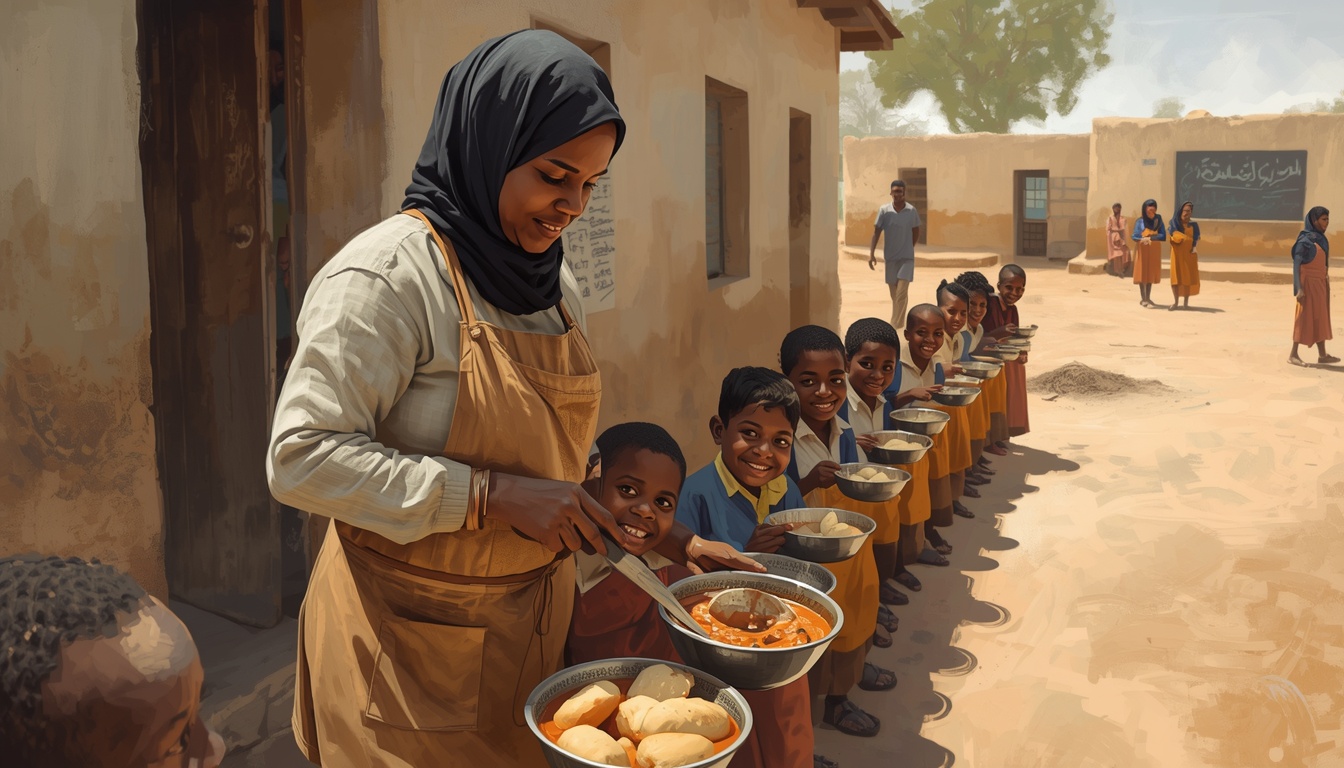
There is a development intervention so well-proven, so cost-effective, and so politically straightforward that it is almost surprising more countries have not made it a universal right. It is not a new technology or a complex financial instrument. It is a meal — a hot lunch, served at school, every day.
School feeding programmes are among the most extensively studied policies in development economics. The evidence is unambiguous: they increase school enrollment, reduce dropout rates, improve learning outcomes, and disproportionately benefit girls. When designed well — with food sourced from local farmers — they also serve as agricultural subsidy programmes, injecting cash into rural economies while feeding children in urban and peri-urban schools. The return on investment, according to multiple World Food Programme analyses, averages nine dollars for every one dollar spent.
Sudan needs this. Urgently. And unlike many development ideas, this one is immediately implementable.
The Scale of the Problem
Before the 2023 war, Sudan already had one of the highest rates of child malnutrition in the world. An estimated 3.5 million children under five suffered from acute malnutrition. School enrollment, particularly in rural areas and for girls, was among the lowest in the region. Millions of school-age children were not in school at all.
The war has made everything worse. An estimated 19 million children have been displaced or had their schooling disrupted. The destruction of livelihoods means that for millions of families, the direct cost of sending a child to school — however minimal — competes with the need to feed that child at home. A school lunch changes this calculation entirely. The meal becomes part of the return on attending.
What the Evidence Shows
Brazil’s National School Feeding Programme (PNAE), established as a constitutional right in 2009, is the largest and most studied in the world. It feeds 40 million children daily. By law, at least 30% of the food must be sourced from family farmers within the region. The results over decades of data are consistent: enrollment up, dropout down, learning outcomes improved, rural agricultural incomes increased. The programme pays for itself in reduced future healthcare costs, higher lifetime earnings, and greater tax revenues.
Ghana’s Home-Grown School Feeding Programme, modelled partly on Brazil, has been running since 2005. It has enrolled millions of children and demonstrably increased female enrollment in participating districts. The food is sourced from smallholder farmers within 30 kilometres of each school.
India’s Mid-Day Meal Scheme is the largest school feeding programme in the world — serving over 120 million children. Independent research has shown that it reduced severe malnutrition by over 50% in participating schools over two decades.
The pattern is consistent across countries, continents, and income levels. A school meal works.
The Sudan Opportunity
Sudan has specific advantages that make a school feeding programme not just beneficial but highly feasible.
Agricultural capacity. Sudan is an agricultural country. Even at its current depressed productivity levels, it produces sorghum, millet, groundnuts, vegetables, and livestock. A national school feeding programme that required local procurement — say, 40% of food from Sudanese smallholder farmers within 100 kilometres of each school — would simultaneously address child nutrition and provide a guaranteed demand signal for farmers to invest in production. This is how Brazil transformed its farming sector while feeding its children.
Cost. A basic school meal in sub-Saharan Africa costs between $0.25 and $0.50 per child per day. At $0.40 per meal, feeding five million Sudanese schoolchildren for a 180-day school year costs approximately $360 million annually — roughly the cost of one major road project. This is not a trivial sum for a country at war, but it is within the range of what international partners, including WFP, the World Bank, and the African Development Bank, have financed in comparable situations.
The reconstruction moment. When schools reopen after the war — and they will reopen — the question is how many children come back. In post-conflict settings, school feeding programmes are one of the most effective tools for bringing children back into the education system. They remove the cost barrier, address the nutritional deficit that impairs learning, and signal to families that the state is investing in their children’s future.
What a Sudanese Programme Would Look Like
A national programme does not need to be built overnight. Start with states where schools are already functioning — River Nile State, Northern State, parts of Kassala and Gedaref where security allows some normalcy. Demonstrate results. Build procurement systems and train cooks and administrators. Expand state by state as the situation permits.
Require local sourcing from the beginning. The procurement rules are not a constraint on the programme — they are part of its purpose. Every kilogram of sorghum bought from a Sudanese farmer for a school kitchen is an investment in two things at once. Ghana’s experience is instructive: when the government committed to buying 70% of school food from local farms within 30 kilometres of each school, it transformed both child nutrition and rural agricultural income in a single policy instrument.
Build physical infrastructure alongside the programme. Many Sudanese schools have no kitchen at all — a single room with a gas burner, a few pots, and a water supply is sufficient for a basic feeding programme. Simple kitchen facilities can be built as part of the school rehabilitation that reconstruction will require in any case, at marginal additional cost.
Establish a legal foundation that survives political cycles. The most important lesson from programmes that have failed is that social spending is always the first target when budgets tighten. Brazil made school feeding a constitutional right in 2009, and that legal protection has kept the programme intact through seven presidential administrations and multiple fiscal crises. A Sudanese programme law — even a short one — would do the same.
The Barriers Are Not Technical
A school kitchen requires no sophisticated technology. Sorghum, lentils, groundnut oil, and seasonal vegetables are available in Sudanese markets. The logistics of moving food from farms to schools are straightforward compared to other supply chains that already function in the country. There is no engineering challenge here.
The barriers are institutional and political, and they deserve to be named.
Bureaucratic coordination. A school feeding programme touches the Ministry of Education (school administration), the Ministry of Agriculture (procurement from farmers), the Ministry of Finance (budget appropriations), the Ministry of Health (nutrition standards), and local government (kitchen management). In a functioning state, inter-ministerial coordination is difficult. In a post-conflict Sudan rebuilding its institutions from the ground up, it is genuinely hard. The solution is a dedicated implementation unit with its own budget authority, clear mandate, and political protection at the level of the Prime Minister’s office — not another departmental committee.
The community trust deficit. After years of conflict, disruption, and broken promises, many Sudanese families are deeply sceptical of government programmes. Telling parents that their children will receive a daily meal at school and then failing to deliver consistently — because supply chains break, budgets are cut, or administrators divert resources — would be worse than never starting the programme at all. The first phase of any Sudanese school feeding programme must be small enough to be reliable. Demonstrate one year of consistent, daily meals in a limited number of schools before expanding. Trust is rebuilt slowly.
The nutrition question. Not all calories are equal, and a programme that feeds children white bread and sugar every day will not produce the cognitive and physical benefits the evidence promises. Nutritional design matters. A Sudanese school meal should reflect what Sudanese children actually need — protein from legumes and groundnuts, iron from leafy vegetables, energy from sorghum and millet — and it should vary seasonally based on what local farms are producing. This requires nutrition expertise, recipe development, and cook training. It also, done well, becomes a form of food culture education: children learn what a balanced meal looks like and take that knowledge home.
Financing at scale. The $360 million annual cost of a five-million-child programme is real, and Sudan cannot finance it alone, especially not in the immediate post-war years. But this is not primarily a money problem — it is a sequencing problem. WFP already operates emergency school feeding in Sudan at reduced scale. The World Food Programme’s Home-Grown School Feeding programme and the Partnership for Child Development have together supported programmes in forty countries at exactly this cost level. The financing architecture exists. What it requires is a Sudanese government counterpart with the institutional capacity to sign agreements, manage funds, and report results — and a credible commitment to build toward domestic financing as the economy recovers.
Political will, and what it actually means. Ultimately, the existence of a national school feeding programme is a statement about what a government believes its job is. Governments that feed schoolchildren have decided, implicitly, that the state owes children an opportunity to learn regardless of their family’s circumstances. This is a political choice, not just a policy one. It requires a government willing to defend social spending when military and security budgets compete for the same money — and willing to tell the international community clearly that education infrastructure, including feeding, is a reconstruction priority deserving the same attention as roads and bridges.
Sudan has had governments that made this choice and governments that have not. The post-war reconstruction moment is the best opportunity in a generation to make it clearly and permanently.
The Deeper Argument
A school lunch is not charity. It is infrastructure — as much as a road or a dam. Human capital is the foundation on which every other development goal rests. You cannot have a diversified economy without an educated workforce. You cannot have an educated workforce if children are too hungry to learn or too poor to attend. The meal is the entry point to everything else.
There is a second argument, less often made but equally important. Government procurement of food from local farmers is industrial policy. Brazil’s law requiring 30% of school food budgets to be spent on family farmers was not sentiment — it was a deliberate use of state purchasing power to create guaranteed demand, which allows farmers to invest, plan, and grow. Guaranteed demand is what markets alone rarely provide to small producers. Hamilton understood this: the state as buyer is as powerful a development tool as the state as builder. Every kilogram of sorghum purchased from a Sudanese farmer for a school kitchen is a demand signal that travels back through the value chain — to the farmer who planted it, the trader who moved it, the miller who processed it, the driver who delivered it. That is not aid. That is economic activation through deliberate policy.
The local procurement requirement also creates the conditions for the next step: food processing as an industry. A country that buys sorghum in bulk for school kitchens and then grinds it locally has created the beginnings of a milling sector. A programme that sources groundnut paste locally has created demand for small-scale processing. Done at scale, a national school feeding programme with local procurement mandates is one of the most efficient ways to kick-start a domestic food processing industry — exactly the kind of value-addition that development economics has shown, consistently, is how countries move up the production ladder.
Sudan has lost years — perhaps a generation — of education to conflict and dysfunction. A national school feeding programme, built for the long term, sourced from Sudan’s own farms, protected by law, and run with genuine community ownership, is one of the highest-leverage investments a reconstructed Sudan could make. The evidence has been in for decades. The logistics are manageable. The financing is accessible. The only thing missing is the political will to treat children’s education — and the agricultural economy that feeds them — as the infrastructure it is.
Further Reading — Kandaka Library
- Food-Poverty-Vulnerability Index Analysis for the Nile Basin Region: Sudan — Quantitative mapping of food insecurity across Sudan’s regions, essential for targeting a school feeding programme.
- Sorghum Value Chain Analysis — How local procurement of sorghum — Sudan’s primary staple — could anchor a home-grown school feeding model.
- The Gezira Scheme: Sudan’s Struggle for Food Self-Sufficiency — The history of Sudan’s flagship agricultural project and its lessons for local food production at scale.
- The Agricultural Potential of Sudan — Abdalla Ahmed Abdalla — Comprehensive case for Sudan’s farming capacity as a foundation for food security programmes.