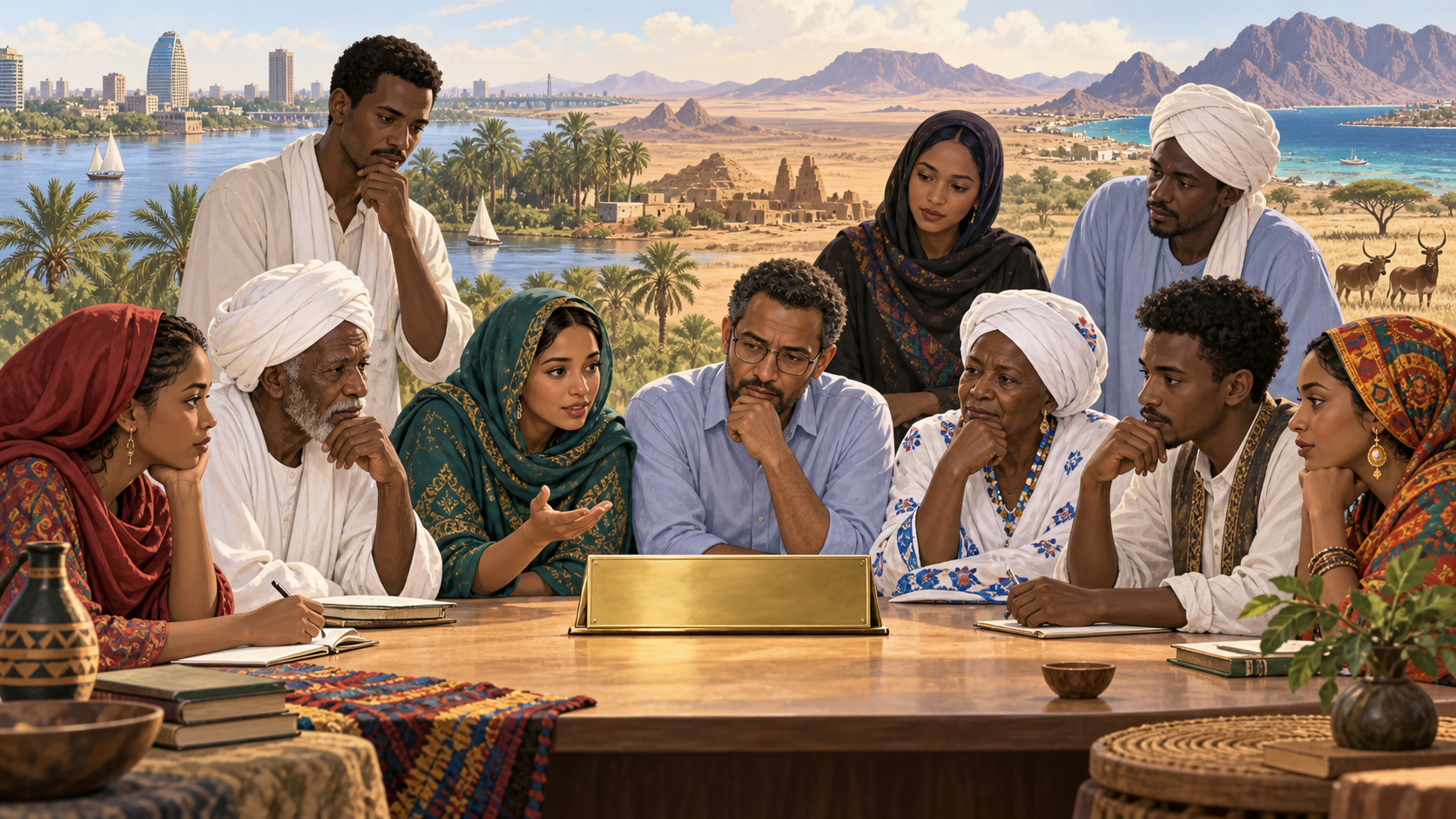
Cover: Original editorial illustration commissioned by Kandaka, 2026. It is symbolic, not a proposed flag, emblem, map or official design.
Sudan, Kush, Nubia and the Problem of Naming a Diverse Republic
After South Sudan became independent in 2011, the world was left with two countries whose names differ by one direction.
Search for Sudan and results often include South Sudan. News reports, maps and conversations confuse the two. Some Sudanese also question whether a name derived from a broad medieval term—Bilad al-Sudan, usually translated as “the lands of the Black people”—is sufficiently distinctive for a country with its own ancient civilizations and complex modern identity.
That has produced attractive alternatives. Kush recalls one of Africa’s great ancient kingdoms. Nubia evokes the civilizations of the Nile Valley. Sennar recalls a major precolonial sultanate. Other proposals reach for Meroë, the Nile, “New Sudan” or a new invented name.
But a national name must do more than sound ancient or dignified. It has to include people in Darfur, Kordofan, the east, the north, the Blue Nile region and the central Nile; pastoralists and farmers; Arabic speakers and speakers of Sudan’s other languages; Muslims, Christians and people of other beliefs; residents, displaced citizens and the diaspora. It must work in Arabic and English, survive daily speech, distinguish the country internationally and avoid turning one region’s history into everyone else’s compulsory identity.
On that test, the best answer is presently the least dramatic one.
Sudan should probably keep the name Sudan.
The name’s origin should be taught honestly, and the official English form could eventually be harmonized. But no alternative now in circulation is clearly more inclusive, more historically accurate or more legitimate. A future constitutional process may reconsider the question. It should not begin by assuming that “Kush” or any other candidate has already won.
Where Did the Name Sudan Come From?
“Sudan” is a shortened form of the Arabic Bilad al-Sudan. Medieval Arabic geographers used the expression for a vast belt south of the Sahara, extending far beyond the borders of today’s Sudan. Cambridge’s A History of South Sudan summarizes it as the “Land of the Blacks,” a term once applied broadly across sub-Saharan Africa. Cambridge excerpt.
The expression was geographic and racial in the descriptive language of its time. It was not originally the unique indigenous name of the territory within Sudan’s present borders. This is why “Sudan” also appeared in colonial geographical labels much farther west: French Sudan, for example, became independent Mali.
Over time, however, the shortened name became attached specifically to the middle Nile political territory governed through Turco-Egyptian and then Anglo-Egyptian administration. At independence in 1956, the sovereign state adopted Sudan rather than the name of one ancient kingdom, ethnic group or region.
This history creates two opposing interpretations.
One says the name is generic and externally applied: a broad Arabic label for Black lands that colonial administration narrowed onto a particular country. Why should a republic with the histories of Kerma, Kush, Meroë, Makuria, Alodia, Darfur and Sennar retain that inheritance?
The other says that names change through use. “Sudanese” is now a national identity, a citizenship, a literature, a cuisine, a diaspora and a political claim. Millions of people have made the name their own. Its historical reference to Blackness can be read not as an insult but as an acknowledgement of the country’s African location and people.
Both interpretations deserve space. Etymology does not dictate present meaning.
Did South Sudan’s Independence Make the Name Incomplete?
When South Sudan became independent, the original Republic of the Sudan continued as the same international legal state, while the new state entered the United Nations as the Republic of South Sudan. ISO retained Sudan’s SD and SDN codes and assigned South Sudan SS and SSD. ISO notice following the division.
That continuity helps explain why Sudan did not become “North Sudan.” It was not a newly admitted state seeking a new identity; it was the continuing state after part of its territory became independent.
The decision still creates practical confusion. “Sudan” and “South Sudan” are sometimes collapsed in databases, search results and casual speech. But this is primarily an information-design problem, not sufficient reason to rename a country.
Kandaka can address it through accurate metadata, filters and editorial language:
- use Sudan and South Sudan consistently rather than “the two Sudans” when precision matters;
- add “Republic of the Sudan” or “Sudan (country)” in search metadata where helpful;
- tag historical material according to the borders and period it describes;
- explain when a pre-2011 source covers the territory of both present states; and
- never label South Sudanese history as merely a subsection of another country’s story.
A website’s search problem should not be mistaken for a constitutional crisis.
What Should a National Name Be Tested Against?
Any serious proposal should pass at least eight tests.
1. Inclusion
Can citizens from every region plausibly hear themselves in it? A name should not make one river valley, ancient state, language, religion or ancestry the official owner of the republic.
2. Historical defensibility
Was the name actually used for the territory or polity claimed? Ancient prestige is not enough. Borders and identities changed, and a historical kingdom may have covered only part of the modern state.
3. Living identity
Does the name respect people who currently use it as an ethnic, linguistic or regional identity? Converting “Nubia,” for example, from the name of a real region and living peoples into a label for every Sudanese could appropriate rather than honor it.
4. Arabic and English usability
The short name, formal name, adjective and demonym must work in both languages and ideally in Sudan’s other major languages. Citizens need a natural answer to “What country?” and “What are its people called?”
5. International distinctiveness
The name should be easy to distinguish in diplomacy, trade, search, sport, travel and emergency reporting. It should not invite confusion with a neighboring region, ancient civilization spread across borders or existing institution.
6. Constitutional legitimacy
A country is not a brand owned by its ruler. A name change requires a legitimate representative or popular decision, especially in a society divided by war and displacement.
7. Practical cost
Every treaty heading, passport system, currency design, government form, schoolbook, embassy sign, commercial registration, map and database may need updating. Existing documents need transition rules. The benefit must justify that administrative burden.
8. Political purpose
What actual problem would the new name solve? If the answer is only pride, novelty or a ruler’s legacy, the case is weak. If it resolves a constitutional conflict or gives formerly excluded citizens a genuinely shared settlement, the case is stronger.
The Candidates, Examined Honestly
Keep Sudan
The case for it: Sudan is already the country’s established Arabic and international name. “Sudanese” is widely used across regional and ethnic differences. The name does not belong to one ancient kingdom or present ethnic group. It connects modern cultural, legal and political history from independence to the present.
It also contains a useful truth. Sudan is an African country whose politics repeatedly distorted Blackness through hierarchies of race, colour and claimed Arab descent. Retaining a name historically linked to Black lands can support an inclusive identity—if the state makes equal citizenship real.
The case against it: The original term was broad, external and imprecise. It does not distinguish the republic from South Sudan cleanly. Some citizens may hear its etymology as a racial label imposed by outsiders rather than a chosen national name.
Assessment: The strongest current option. Its accumulated national meaning outweighs its imprecise origin, and its inclusiveness is greater than that of the leading alternatives.
North Sudan
The case for it: It would create an obvious pair with South Sudan and reduce some international confusion.
The case against it: Sudan is not simply the northern half of a two-part object. Darfur extends far west, the Red Sea states east, and much of the country is not culturally or politically described by “north.” The name would define the state permanently through partition and in relation to another sovereign country. It could also imply that Sudanese identity belongs only to the north.
Assessment: Reject. Geographic convenience is not worth narrowing the country’s identity.
Kush
The case for it: Kush was a powerful ancient African state centred in parts of today’s northern and central Sudan. Its capitals and political centres included Napata and Meroë. Kushite rulers governed Egypt as the Twenty-Fifth Dynasty, and Kush offers a source of Sudanese pride too often subordinated in histories centred on Egypt or the Arab world. The name is short, recognizable and usable in Arabic and English.
The case against it: Ancient Kush was not identical to modern Sudan. Its political geography changed over centuries and was concentrated along the Nile. Modern Sudan includes regions with their own deep histories that were not simply Kushite provinces. “Kush” can therefore turn a valuable national inheritance into a riverine claim over the whole country.
The name is not exclusively available to present Sudan either. During discussion of South Sudan’s future name, “Kush” also appeared as a proposed identity there. Archaeology further warns against flattening Kush, Nubia and later communities into one timeless ethnic nation. Annual Review of Anthropology; research on South Sudanese naming debates.
Assessment: Celebrate Kush as a central civilization in Sudanese history, but do not presume it is an inclusive modern country name.
Nubia
The case for it: Nubia is internationally associated with the middle Nile, ancient states, distinctive architecture and living cultures in Sudan and Egypt. It could help correct the erasure of Sudan’s pre-Islamic and African history.
The case against it: Nubia is both a historical region extending across the modern Egyptian–Sudanese border and a living identity of particular peoples. It does not naturally encompass Darfur, Kordofan, the Red Sea hills, much of eastern Sudan or the Blue Nile region. Calling the entire republic Nubia might erase the very specificity of Nubian languages and communities it claims to honor. Scholarship also debates how “Nubia” relates to Kush and to different historical populations; the terms are not interchangeable. Nubia Still Exists.
Assessment: Reject as a national replacement. Protect and teach Nubian history, languages and heritage on their own terms.
Meroë or Napata
The case for them: Both names connect Sudan to important centres of Kushite civilization. Meroë is visually powerful and internationally associated with Sudan’s pyramids.
The case against them: They are specific places and historical phases, not names that plausibly embrace every modern region. “Meroë” may also produce inconsistent English and Arabic spellings and confusion among the city, archaeological site, kingdom and modern state.
Assessment: Excellent names for museums, universities, cultural programmes and institutions; weak names for the entire republic.
Sennar or the Funj Republic
The case for it: The Funj Sultanate of Sennar was a major precolonial political formation with influence across a substantial part of the Nile Valley and adjoining regions. Sennar connects ancient and modern history more closely than a name drawn exclusively from antiquity.
The case against it: Darfur had its own sultanate and political history; other regions maintained different institutions and identities. Making Sennar national could replace northern antiquity with central-riverine history while leaving the inclusion problem intact. “Funj” may also be heard as an ethnic attribution rather than a civic name.
Assessment: Historically important but not sufficiently national.
Nile Republic
The case for it: The Blue and White Niles meet in Khartoum, and the river system links communities, agriculture, trade and regional diplomacy. The name is simple and geographically intelligible.
The case against it: The Nile crosses many countries and is not distinctively Sudanese. Large parts of Sudan lie far from the main river and have repeatedly resisted a state organized around the central Nile. Naming the republic after the river could reproduce the political geography that marginalized its peripheries.
Assessment: Reject. The Nile is a national resource, not the whole national identity.
New Sudan
The case for it: “New Sudan” has represented a powerful vision of a secular, plural, democratic and restructured country rather than separation between a supposedly Arab north and African south.
The case against it: It is associated with a particular political tradition and liberation movement. Citizens may support pluralism without accepting that movement’s terminology. “New” also ages badly and defines the country against an old order without stating what enduring name follows.
Assessment: Preserve it as an important political idea, not a neutral constitutional name.
A Smaller Reform: Harmonize the Formal English Name
There is a narrower question worth considering even if Sudan keeps its name.
The UN and ISO convention still uses the Republic of the Sudan as the formal English name and Sudan (the) as the short form. Yet the English translation of Sudan’s 2019 Constitutional Charter calls itself the Constitutional Charter for the Transitional Period of the Republic of Sudan, without the second definite article. In everyday contemporary English, most people simply say “Sudan.” 2019 Constitutional Charter; UN country-name guidance.
An elected post-war government could therefore review whether to notify international bodies that the preferred forms are:
- Short English name: Sudan
- Formal English name: Republic of Sudan
- Arabic name: جمهورية السودان
- English demonym/adjective: Sudanese
This would not be a national renaming in the meaningful sense. It would harmonize an uneven translation and remove an increasingly awkward English article while preserving the identity, international continuity and familiar name. It still requires legal and diplomatic review: treaties, databases and international organizations cannot be changed by an editorial preference.
What Other Renamings Teach
Country-name changes occur for different reasons.
Eswatini replaced Swaziland in 2018, adopting an indigenous name used by the state itself. Türkiye asked the United Nations in 2022 to use its Turkish form internationally. North Macedonia changed its constitutional name through the Prespa Agreement to settle a long dispute with Greece. These cases involved very different purposes: decolonization and language, international presentation, and resolution of a diplomatic conflict. UN record for Eswatini; UN notice for Türkiye; Prespa Agreement notification.
They also show that a rename is not merely a domestic announcement. International organizations, treaties, databases, brands and official documents must adapt. North Macedonia’s agreement expressly addressed constitutional amendment, international notification, commercial names, trademarks and terminology.
Sudan should ask what comparable problem its change would solve. “We prefer an older-sounding name” is not equivalent to ending an international dispute or replacing an exonym with a living endonym.
Who Could Legitimately Decide?
No wartime authority, military leader, armed movement or unelected cabinet should rename Sudan unilaterally.
A name change would alter the identity under which citizens hold nationality and the state maintains international relations. It should be considered only within a broadly legitimate post-war constitutional process.
That process would need:
- an independent historical and linguistic report on each serious candidate;
- consultations across every region, displaced communities and the diaspora;
- publication of Arabic, English and major Sudanese-language forms, demonyms and likely legal consequences;
- a costed transition plan for documents, laws, currencies, treaties, databases and institutions;
- protection for the continued historical and cultural use of “Sudan” and “Sudanese”; and
- approval through an elected constitutional assembly, parliament or inclusive referendum under an agreed threshold.
The vote should compare retaining Sudan with a very small number of candidates that have first demonstrated broad regional support. A referendum crowded with romantic historical names would divide the status quo vote and manufacture a winner without a majority mandate.
Kandaka’s Position
Kandaka does not currently recommend changing the country’s name.
Sudan has an externally derived and once very broad etymology, but that is not unusual among country names. More importantly, Sudanese people have transformed it into a living civic identity. It is less regionally possessive than Kush, Nubia, Meroë, Napata or Sennar, and less geographically misleading than North Sudan or Nile Republic.
Keeping Sudan does not require ignoring ancient history. The republic can give Kerma, Kush, Meroë, the Nubian kingdoms, the sultanates of Darfur and Sennar, the Beja world, Kordofan, the Blue Nile region and every other part of its history far more space in museums, curricula, public art and institutions. A country does not honor a civilization only by taking its name.
Nor should retention prevent a future democratic debate. If an inclusive constitutional process eventually produces a candidate supported across Sudan’s regions and communities, the question can be reopened. That candidate should win because people recognize themselves in it—not because it offers the greatest ancient prestige.
For now, the more important task is to change what the name promises.
A Republic of Sudan based on equal citizenship, plural history, civilian government and fair regional power would transform the meaning of “Sudanese” more profoundly than replacing the word on a passport.
The country’s problem is not that its name contains too little glory.
It is that the state has too rarely treated everyone who carries the name as equal.
Principal Sources
- Douglas H. Johnson, excerpt from A History of South Sudan, on Bilad al-Sudan and the naming of South Sudan.
- International Organization for Standardization, 2011 country-code notice following the division of Sudan.
- United Nations, country names and currencies guidance.
- Sudan’s 2019 Constitutional Charter, English translation hosted by the Comparative Constitutions Project.
- Derek Welsby, The Archaeology of Sudan and Nubia, Annual Review of Anthropology.
- Magdalena D. Bechhaus-Gerst, Nubia Still Exists: On the Utility of the Nostalgic Space.
- Ole Frahm, Defining the Nation: National Identity in South Sudanese Media Discourse, including alternative naming debates.
- United Nations records for Eswatini, Türkiye and the Prespa Agreement notification.
Research Note
Research was refreshed on 13 September 2026. Kandaka found no formal national proposal to rename Sudan in the authoritative sources reviewed. ISO’s 2011 record still gives Sudan the codes SD, SDN and 729 and lists “the Republic of the Sudan”; the 2019 Constitutional Charter translation uses “Republic of Sudan.” Sudan’s wartime constitutional dispute makes any claim of present unilateral authority especially contested.
This review is an editorial assessment, not evidence of public consent. It does not substitute for Sudanese-language scholarship, regional consultations, polling, constitutional advice or a costed transition inventory. Those would be prerequisites before Kandaka could endorse any future rename.