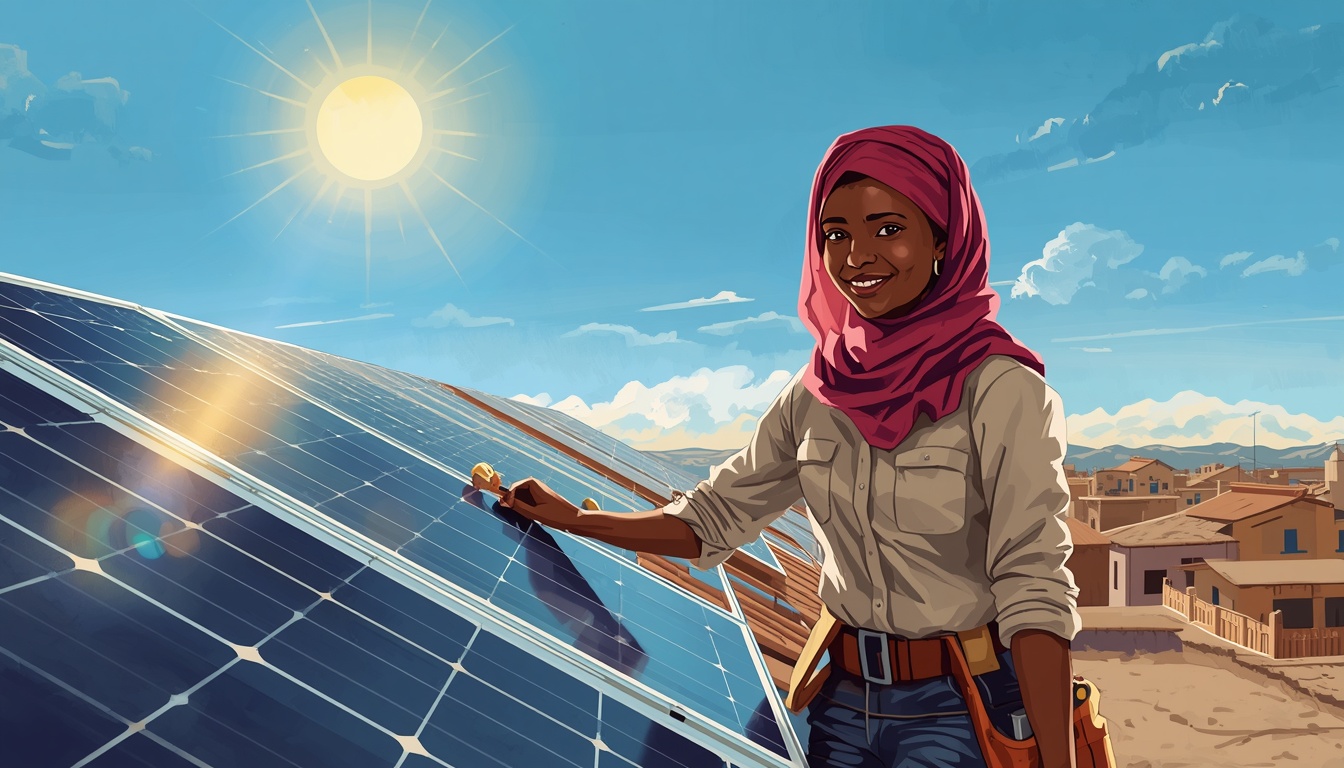
Sudan receives between 6 and 8 kilowatt-hours of solar energy per square metre per day – among the highest figures anywhere on the planet. The Nubian Desert, the Butana Plain, the Bayuda steppe: vast, flat, cloudless, and bathed in sunlight for 300 or more days a year. This is not a marginal resource. It is one of the largest untapped solar endowments in the world, sitting in a country that has, for most of its modern history, been unable to keep the lights on.
Before the 2023 war, fewer than 45% of Sudanese households had reliable electricity access. Rural areas were far lower – many communities had no grid connection at all. The conflict has since destroyed much of what infrastructure existed: substations bombed, transmission lines severed, generating capacity offline. Rebuilding the old system wire by wire would take a decade and billions of dollars Sudan does not have.
But there is another path.
The Case for Distributed Solar
The economics of solar have changed everything. Since 2010, the cost of solar panels has fallen by over 90%. What was once the technology of wealthy countries is now cheaper per kilowatt-hour than diesel generation in most of Africa. For Sudan – a country where diesel is expensive, supply chains are broken, and the grid reaches nowhere – distributed solar is not an idealistic option. It is the practical one.
The model is straightforward: rather than building massive central power plants and running expensive transmission lines to every village, you put solar panels and battery storage directly where people live. A system sized for a school, a health clinic, a water pump, or a neighbourhood of fifty households can be installed in days, owned by the community, and maintained locally. No grid required.
Countries across the Sahel and East Africa are already doing this at scale. Ethiopia’s off-grid solar programme has connected millions of rural households. Rwanda reached near-universal electricity access partly through distributed systems. The technology is proven. The question for Sudan is financing, coordination, and – critically – who does the work.
Large-Scale Solar: The Long Game
Distributed solar solves the rural problem. For Sudan’s cities and industries, larger-scale solutions will eventually be needed – and Sudan’s geography is suited for them.
Egypt’s Benban Solar Park, built in the Western Desert less than 200 kilometres from Sudan’s northern border, is one of the largest solar farms on Earth. It generates nearly 1,500 megawatts and powers more than a million homes. The conditions on the Sudanese side of the border are identical. A comparable facility on Sudanese soil would be technically and economically feasible.
The regional dimension matters too. Sudan sits between energy-hungry East Africa and the potential for solar export to Europe via undersea cable or to Gulf states via Red Sea routes. Long-term, Sudan could be a net energy exporter. Morocco already exports solar power to Europe, and the infrastructure logic for Sudan is similar.
Can Sudanese Build This Industry Themselves?
This is the question most development proposals fail to ask – or answer badly. The standard model for infrastructure in post-conflict countries follows a predictable script: international contractors arrive, build something, hand it over, and leave. The host country gains an asset but not a capability. A decade later, the asset is degraded and the dependency has deepened.
Solar is different. And that difference matters enormously for Sudan.
The technology is genuinely accessible. Solar panels are manufactured globally and sold as commodities. Installation is a skilled trade, not an engineering doctorate. A Sudanese technician can be trained to design, install, and commission a household or commercial solar system in weeks. The wiring, mounting, charge controllers, and inverters involved are the same skills base as electrical contracting – work that Sudanese already do. The gap is not capability; it is the formal training pathway and the initial access to tools and components.
A Sudanese solar industry already exists in embryo. Before and during the war, small solar businesses proliferated in Khartoum, Omdurman, and secondary cities. They imported panels – mostly Chinese, some European – and sold installation services to households and businesses that could not rely on the grid. These businesses are informal, fragile, and operating without any government support framework. But they represent exactly the kind of local capability that a serious national programme should build on, not bypass.
What Sudanese can realistically manufacture. Full panel manufacturing requires semiconductor fabrication that is well beyond Sudan’s current industrial base. But the assembly, mounting structures, and balance-of-system components are a different story. Metal fabrication for panel frames and roof mounts is something Sudanese workshops already do. Wiring harnesses, conduit, junction boxes, and basic electrical components can be produced locally given the right investment. The goal should not be to replicate a Chinese panel factory – it should be to capture as much of the value chain as possible at each stage of development, starting with what is achievable now.
The vocational training pipeline. Sudan has universities, polytechnics, and vocational institutes that trained engineers before the war. Several Sudanese universities ran electrical engineering programmes. The reconstruction of a national solar workforce requires three things: a curriculum update to include solar and storage systems, industry partnerships that provide practical placements, and a certification standard that employers – including international NGOs running off-grid programmes – will recognise. None of this is technically complex. It requires institutional decision-making and modest funding.
The diaspora as a resource. There are Sudanese engineers working in solar across East Africa, the Gulf, Europe, and North America. Some have built careers in the sector specifically. A structured diaspora engagement programme – with financial incentives, protected investment rights, and a clear regulatory environment – could bring both capital and knowledge back. Rwanda’s technology sector recovery drew heavily on diaspora return. Sudan’s solar sector could do the same.
The cooperative ownership model. In rural Sudan, the most durable infrastructure has historically been community-managed. Solar is well-suited to cooperative ownership: a village installs a shared system, appoints a locally-trained technician as caretaker, and pays a small monthly tariff that covers maintenance and eventual replacement. This model has worked in Bangladesh, Kenya, and Tanzania. The key design requirement is that the management structure is Sudanese from the start – not an international NGO managing on behalf of communities, but communities managing for themselves with technical backstop support.
The honest answer to the question is: yes, Sudanese can build this industry. Not the semiconductor end of it, not this decade. But the installation sector, the maintenance sector, the training infrastructure, the local fabrication of balance-of-system components, the financing intermediaries, and the community ownership structures – all of this is achievable, and all of it would keep value inside Sudan rather than sending it abroad.
The Barriers Are Not Technical
The sun rises over the Nubian Desert every morning regardless of who governs in Khartoum. The physics of photovoltaics does not require political stability. The barriers to Sudan’s solar future are entirely human – institutional, financial, regulatory, and political – and that means they are, in principle, solvable.
Financing and the climate capital paradox. The global climate finance architecture was built partly to channel money from wealthy nations to poorer ones for clean energy development. In theory, Sudan should be a prime recipient. The African Development Bank’s Desert to Power initiative has modelled 10,000 megawatts of solar potential in Sudan. The Green Climate Fund, the IFC’s Scaling Solar programme, and bilateral funds from Germany, Japan, and the UAE all have mandates that fit Sudan’s situation precisely.
In practice, most climate finance instruments require a functioning counterpart ministry, a central bank that can manage disbursements, and a track record of project implementation. During and after a civil war, none of these may exist. This is the central paradox of post-conflict climate finance: the countries that most need investment are often the least able to process it. Solving this requires interim mechanisms – UN-managed trust funds, NGO implementers with fiduciary capacity, and phased agreements that build institutional capability alongside physical infrastructure.
Gulf states present a different opportunity. Saudi Arabia, the UAE, and Qatar have invested heavily in renewables at home and have strategic interests in Sudan. Structured correctly, Gulf sovereign wealth investment in Sudanese solar could provide patient, long-term capital without the same institutional prerequisites.
The political economy of diesel incumbents. Every energy transition has losers. Sudan’s diesel generator economy – the importers, distributors, and politically connected fuel traders who profit from unreliable grid power – has a direct financial interest in preventing solar from scaling. These are not abstract interests; they translate into regulatory obstruction, import licensing barriers on solar equipment, and political pressure on ministers considering feed-in tariffs or off-grid subsidies. A serious solar programme requires confronting this directly: transparent procurement, open import licensing for solar components, and political cover for ministers willing to take on the diesel lobby.
The local technical capacity and maintenance trap. Solar systems that are installed by international contractors and maintained by international technicians fail when those contractors leave. The correct sequencing is: train local technicians first, then install systems that those technicians can maintain. This requires a deliberate local content policy – not as an afterthought, but as the organising principle of every solar project from day one.
The regulatory vacuum. Sudan has no feed-in tariff, no net metering policy, no grid interconnection standards for distributed generation, and no licensing framework for solar businesses. In the absence of rules, everything defaults to informal arrangement – which advantages established players with political connections and disadvantages new entrants trying to build legitimate businesses. A solar regulatory framework does not need to be complex; Kenya’s was drafted in months and has been refined over time. But it needs to exist.
The Reconstruction Opportunity
Sudan will rebuild. The question is not whether – it is what kind of energy system gets built when reconstruction begins. Path dependency in infrastructure is real: the choices made in the first years of reconstruction shape the system for decades. If Sudan rebuilds its old centralised, fuel-dependent grid because that is the familiar model, the opportunity will have passed.
The alternative is a distributed, Sudanese-owned solar sector that provides electricity to communities, creates employment in installation and maintenance, builds a training and certification pipeline, and positions Sudan – eventually – as an energy exporter in its region. This is not a utopian vision. It is the direction the economics of energy are already moving. Sudan’s geographic endowment is extraordinary. The question is only whether the institutional and political decisions that would unlock it can be made.
Further Reading – Kandaka Library
- Solar Energy Potential in the Sudan – Academic study measuring solar irradiance across Sudan’s regions and assessing the technical potential for solar energy deployment.
- Sudan Infrastructure Sector Overview – Sector-by-sector assessment of Sudan’s infrastructure deficits, including energy, with investment priority analysis.
- Sudan’s Infrastructure: A Continental Perspective – Cross-sector overview situating Sudan’s infrastructure gaps within the broader African development context.