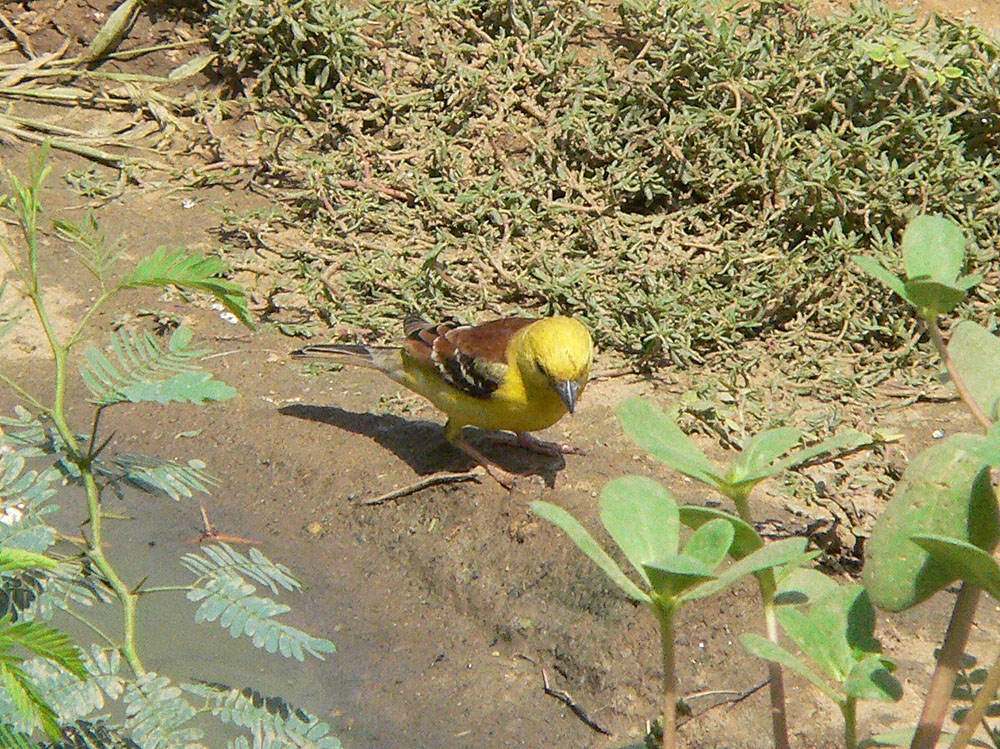
Photo: Christiaan Kooyman, near Aiterba, Red Sea State, 10 March 2007. Original photograph, CC BY-SA 3.0. Unmodified. A dated wildlife photograph, not evidence of present abundance.

Start with the bird in the photograph. Its yellow head and breast are bright enough to interrupt the idea of a uniformly brown landscape. It was photographed in Sudan’s Red Sea State, not borrowed from a safari brochure elsewhere. It is a Sudan golden sparrow, Passer luteus: a small, particular neighbour with a name worth learning.
The Sudan golden sparrow ranges west across the Sahel to Burkina Faso and Senegal. Its common name tells us one place to look for it. The bird in the photograph gives us something more precise, a dated record from Sudan’s Red Sea State. Avibase, Passer luteus
This is a better starting point for a nature story than a competition over which country has the rarest animal. What makes Sudan rewarding to explore on the page is the relationship between particular creatures and very different kinds of place.
A coast with more than coral
UNESCO’s account of Sanganeb and Dungonab Bay–Mukkawar Island describes coral reefs, mangroves, seagrass beds, beaches and islands. Its wildlife includes turtles, rays, dolphins and seabirds, with an internationally important dugong population at Dungonab. These are documented features of the World Heritage property, not a fresh census taken this month. UNESCO site record
The dugong—often called a sea cow—helps shift attention away from the dramatic reef photograph. Its conservation is closely tied to seagrass habitat, as the Convention on Migratory Species’ dugong programme explains. Looking after an animal therefore involves understanding a place that may appear less spectacular than coral. CMS dugong activities
That is part of the appeal. Nature does not arrange itself according to what makes the most striking cover image. A seemingly quiet patch of coastal habitat can belong to the same story as a much more conspicuous animal. A good wildlife feature should help us notice both.
The animal itself is worth a pause. Dugongs are mammals, not fish, and feed mainly on seagrass. CMS notes that they can reach about three metres in length. Their evolutionary relatives include elephants and hyraxes—a surprising connection between the animal grazing offshore and creatures we associate with land. These are species-level facts, not measurements of animals in Dungonab. CMS: dugong facts
When temporary water matters
Far inland, seasonal floodwater collects between the dunes of Khor Abu Habil’s inner delta in Kordofan and White Nile. These temporary pools, known as mayas, provide stopping places for birds. The Ramsar site sheet draws on observations from 2010–2020 and records the sociable lapwing. It gives us a place and period for that record. Present numbers would require a fresh survey. Ramsar site sheet
“Temporary” can sound unimportant. Here it is the point. A photograph taken in one season may miss the character of a place in another. To understand a wetland, we need time as well as a map: when water arrives, how long it stays and which creatures use it.
Dinder supplies another example. Its Ramsar description links pools and mayas to the Dinder and Rahad river systems and explains their role as water and grazing resources during the dry season. The landscape is more than a backdrop behind large animals; the pattern of water is part of the subject. Ramsar’s Sudan site summaries
Birds make borders look different
The Sudanese submission for Dinder on UNESCO’s Tentative List describes the park’s importance for migratory birds. Tentative-list status is not the same as inscription on the World Heritage List, and older bird totals should not be repeated as a current count. The useful point here is that a place in Sudan can form part of a much larger journey. Dinder Tentative List record
Look once more at the sparrow. A patch of low plants beside bare sand was enough for one photographer to stop near Aiterba in March 2007. Another observer returning to the same patch could add the next line of that small local history, even by recording a morning when all was quiet.