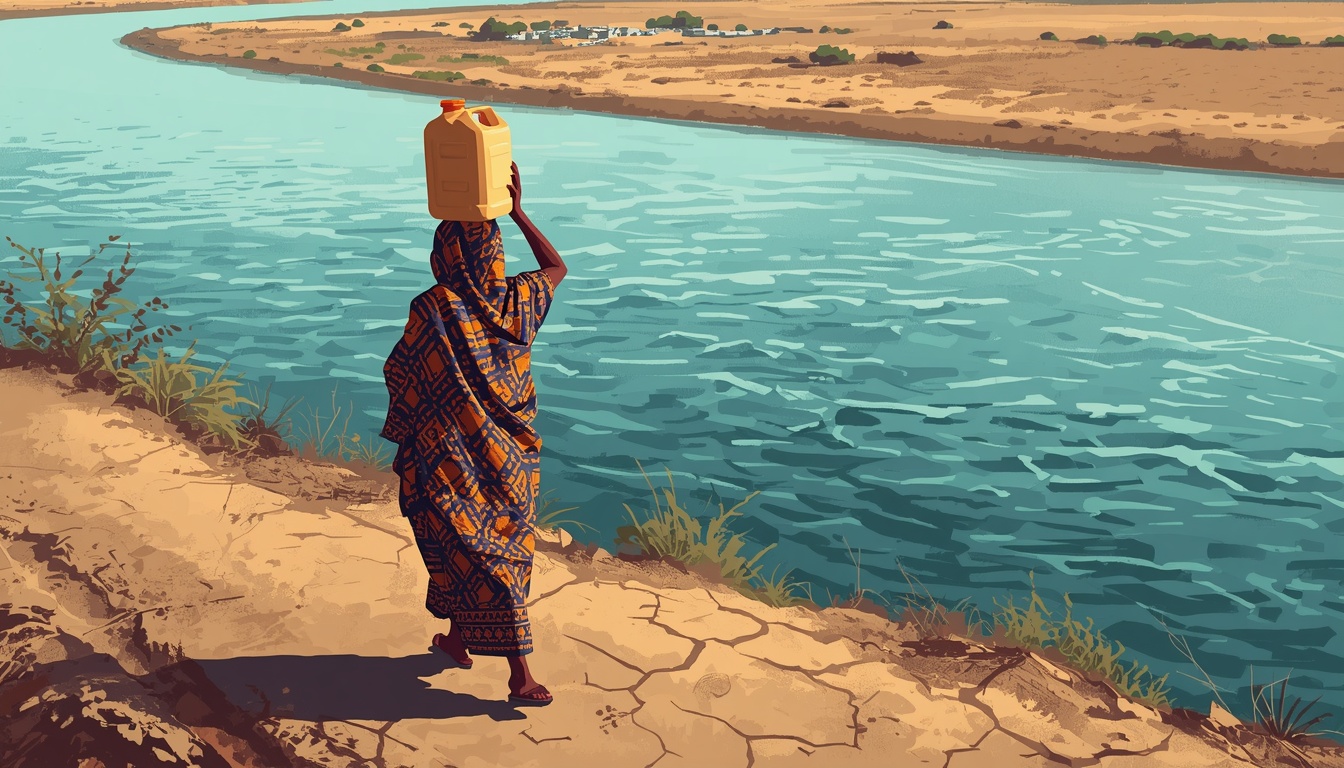
The Nile flows through Sudan for approximately 1,900 kilometres. The Blue Nile descends from the Ethiopian highlands through Sennar and Kosti. The White Nile flows from Uganda through South Sudan and Malakal. They join at Khartoum. The combined river then flows north through Sudan’s dry core, past the ancient cataracts, through the Nubian Desert, and into Egypt. By volume, more than 80 percent of the Nile’s water originates in Sudan’s catchment — the Ethiopian highlands via the Blue Nile and Atbara — before flowing through or past Sudan entirely.
Sudan’s 1959 Nile Waters Agreement with Egypt grants Sudan the right to draw 18.5 billion cubic metres of Nile water annually. Sudan uses, depending on the year, roughly half of that entitlement. The country has more Nile water allocation than it currently uses.
Yet millions of Sudanese lack access to clean drinking water. Rural communities in Kordofan, Darfur, and the Red Sea Hills walk hours to the nearest water point. Annual floods in Blue Nile State, White Nile State, and along the main Nile destroy homes, crops, and lives every rainy season. Rivers run brown with topsoil eroded from degraded agricultural land. Groundwater in many areas is declining as extraction exceeds recharge.
Sudan does not have a water shortage. Sudan has a water management crisis — and the distinction matters enormously for how to address it.
What the Water Is Doing Wrong
Sudan’s water paradox has several interacting dimensions that any serious response must understand.
The seasonal distribution problem. Almost all of Sudan’s rainfall arrives in a three-to-four month window between June and September, concentrated in the central and southern belt. The country receives no rain for eight months of the year. The consequence is a cycle of flood and drought that agricultural and water systems never adapted to manage: too much water at once, damaging crops and settlements, followed by too little for the rest of the year. Traditional water harvesting systems — hafirs (catchment ponds), small earthen dams, flood retention bunds — partially addressed this for centuries. Modern water infrastructure has never been built at the scale required to fully solve it.
The geographic mismatch. The Nile flows through the most arid parts of Sudan — the northern desert corridor and the Khartoum region — while the majority of Sudan’s rainfed agricultural land and its groundwater recharge zones are in the wetter central and southern belt, away from the main river. Connecting Sudan’s most water-abundant areas to its farming zones is a logistics and infrastructure challenge, not primarily a water availability challenge.
The irrigation inefficiency trap. Sudan’s large irrigation schemes — the Gezira, Rahad, New Haifa, Suki, and others — were designed and built decades ago and have not been modernised. The Gezira Scheme, the largest gravity-fed irrigation project in the world when built, loses an estimated 30 to 50 percent of its water to seepage, evaporation, and distribution inefficiency. The canals are unlined earthen channels; water seeps away long before reaching the field. Studies comparing water use efficiency in the Gezira, Rahad, and New Haifa schemes find efficiencies far below what modern irrigation achieves. More water is allocated than reaches the crop.
The drinking water gap. Despite sitting on or near one of the world’s great rivers, Sudan’s rural drinking water coverage was among the lowest in Africa even before the war. UNICEF data before 2023 showed that roughly half of rural Sudanese lacked access to safely managed drinking water. The infrastructure — treatment plants, distribution pipes, household connections — was simply never built outside major cities. The 2023 war has further destroyed what existed.
Flood management as a missing institution. Sudan experiences severe Nile flooding and flash flooding from wadis (seasonal rivers) in the Red Sea Hills and other zones nearly every year. The response has historically been emergency relief — evacuation, aid distribution — rather than structural management: dams, retention basins, channelling works, early warning systems, protected settlements. The result is annual loss of life and property from events that are predictable and, in principle, preventable.
What Better Water Management Looks Like
The solutions to Sudan’s water paradox are known. They are not technically exotic. What has been lacking is investment, institutional capacity, and — in some cases — political will.
Rehabilitating the irrigation schemes. Lining the canals of the Gezira Scheme — replacing unlined earthen channels with concrete or other impermeable material — would reduce water losses substantially and increase the effective water supply to farmers without increasing the water drawn from the Nile. The World Bank and other development institutions have assessed this multiple times. The investment required is large but the economic returns, in terms of agricultural productivity on the world’s largest irrigated agricultural zone, are very high. A modernised Gezira could produce dramatically more food with the same or less water.
Small-scale water harvesting at scale. The traditional hafir and earthen dam systems that stored seasonal rainfall for dry-season use worked for communities across the Sahel for generations. They were undermined partly by conflict and displacement, partly by neglect, and partly by the false promise of large-scale infrastructure that never arrived. A national programme to rehabilitate and expand small water harvesting structures — working with communities, using local labour and materials, establishing maintenance responsibilities — would address the seasonal distribution problem at the level closest to the people experiencing it. Ethiopia, Burkina Faso, and Niger have all run successful programmes of this kind. Sudan has the technical knowledge and the community experience to do the same.
Groundwater development in the non-Nile regions. Sudan has significant groundwater resources — the Nubian Sandstone Aquifer System in the north (shared with Libya, Egypt, and Chad), and shallower aquifer systems across the central belt. For communities in Kordofan and Darfur that are far from surface water sources, properly drilled boreholes with hand pumps or solar-powered pumping are often the most practical and cost-effective drinking water solution. The challenge is the maintenance infrastructure: spare parts, trained pump technicians, community management systems. Programmes that drill boreholes without establishing maintenance capacity produce infrastructure that fails within years. Getting the institutional model right matters as much as the hardware.
Flood early warning and structural flood control. The annual flooding of the main Nile and its tributaries is predictable with reasonable accuracy. A network of upstream gauges, connected to a national flood warning system, would give communities and authorities advance notice — enough time to protect property, move livestock, and prepare. Structural flood control works — levees, retention basins, controlled diversion channels — for the most severely affected zones along the Blue Nile and White Nile would reduce the annual destruction. The World Bank has assessed flood control options for Sudan; the knowledge exists. The missing element is the sustained institutional commitment to implement.
Water and energy together. Sudan’s water problem and electricity problem are related. Pumping groundwater to communities requires power. Treating surface water requires power. Operating irrigation infrastructure at scale — particularly if it is to be modernised with drip or sprinkler systems rather than flood irrigation — requires power. The solar energy opportunity and the water management challenge are complementary investments: solar power to run water systems, water systems extended using reliable solar power. A national water strategy and a national energy strategy need to be developed together.
The Nile Diplomacy Dimension
Sudan does not manage its water in isolation. The 1959 Nile Agreement — which divided the Nile between Sudan and Egypt and gave upstream states nothing — has been challenged by Ethiopia’s Grand Ethiopian Renaissance Dam (GERD) and by the wider Nile Basin Initiative, which has involved all ten Nile basin countries in negotiating a more equitable framework.
Sudan’s position on the GERD has been more nuanced than Egypt’s. Sudan benefits from the dam: it reduces the Aswan High Dam’s sediment load, provides flood control on the Blue Nile that protects Sudanese settlements, and would be a source of electricity that Sudan urgently needs. The concerns are about reservoir filling schedules and drought-year operations — when GERD holds back water during a low-flow year, Sudan’s Gezira scheme draws on reserves that may be insufficient.
The long-term resolution requires a Nile Basin Framework that replaces the 1959 Agreement with an arrangement all ten countries can support. Sudan’s leverage in this negotiation comes from its role as a transit country, its historical relationship with Egypt, and its shared interest with Ethiopia in regional development. A Sudan that has managed its own water resources effectively, reduced its dependence on the Nile by improving rain-fed agriculture and water harvesting, and developed its own hydropower capacity will be a stronger negotiating partner than one that is entirely dependent on uncontested Nile access.
The Priority
Sudan’s water paradox is resolvable. Not easily, and not quickly, but through a series of investments and institutional decisions that are individually tractable and collectively transformative.
The priority order is: drinking water for people first; irrigation rehabilitation second; flood management third; regional integration fourth. All of them require the same underlying institutional foundation — competent, accountable water management agencies at national and state level, with the technical capacity and resources to plan, build, and maintain water infrastructure. Building that institutional foundation is the hardest and most important task. The water is already there.
Further Reading — Kandaka Library
- The Water Resources of the Sudan — UN Water Conference comprehensive assessment of Sudan’s water resources and their development potential.
- Towards Sustainable Management of Water Resources in Sudan — Academic study of water resource management challenges and options across Sudan.
- Sudan and the Exploitation of the Waters of the Nile — Historical and technical analysis of Sudan’s Nile water allocation and use.
- Water Scarcity and Food Security along the Nile — Assessment of the relationship between Nile water access, agriculture, and food security in Sudan.
- Water Resources in Sudan — Overview of surface and groundwater resources across Sudan’s diverse geographic zones.
- Water Use Efficiencies of Gezira, Rahad and New Haifa Irrigated Schemes — Technical study comparing irrigation efficiency across Sudan’s major schemes, documenting losses and improvement potential.