Art & Visual Heritage

Art and visual heritage from Sudan and beyond

Review/rotation: /

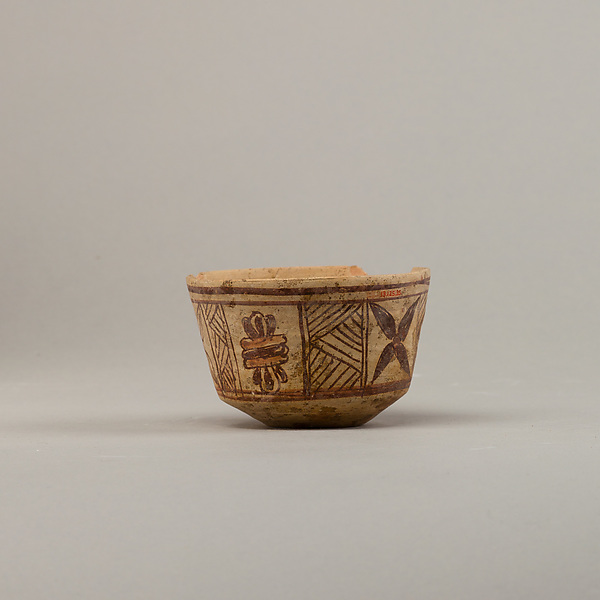
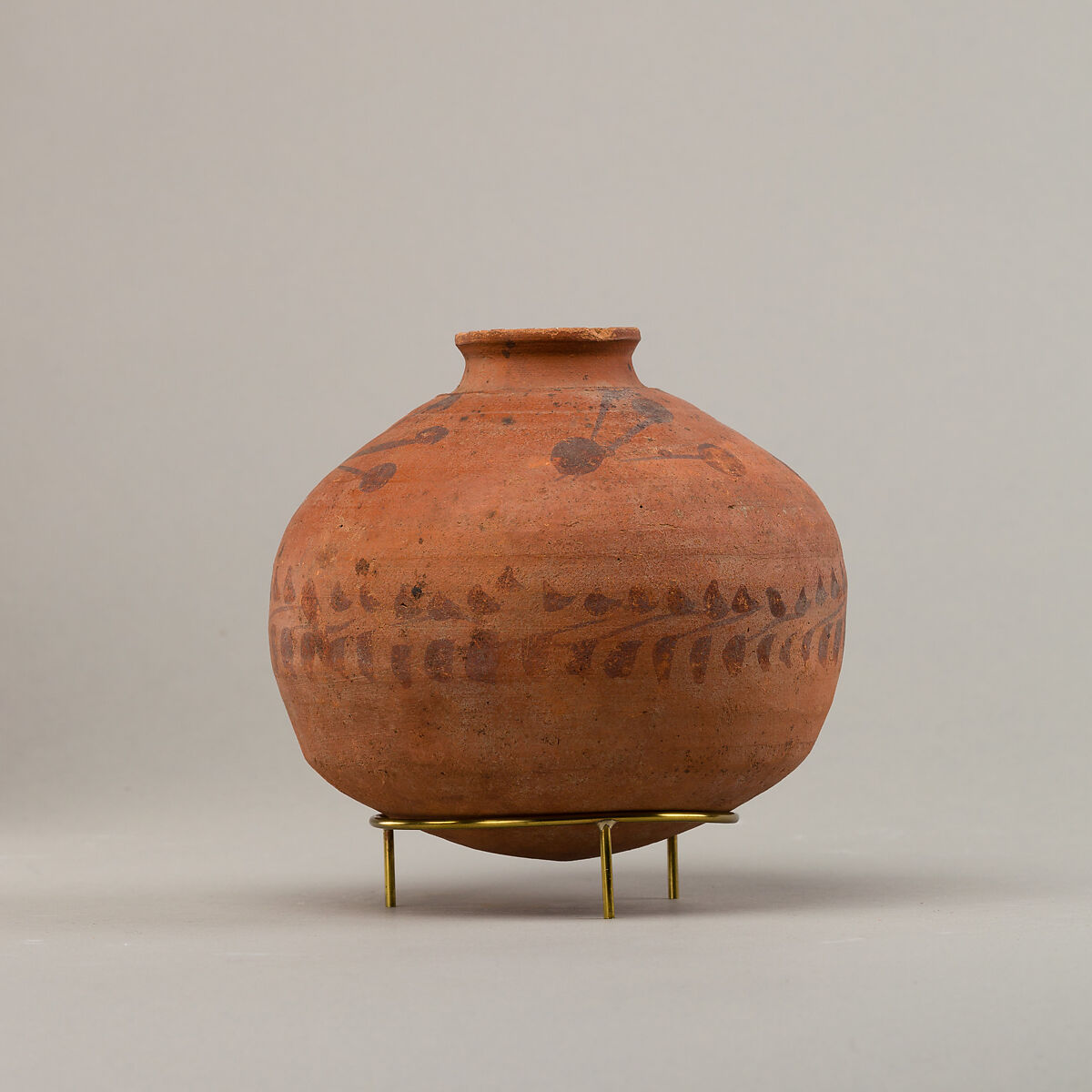
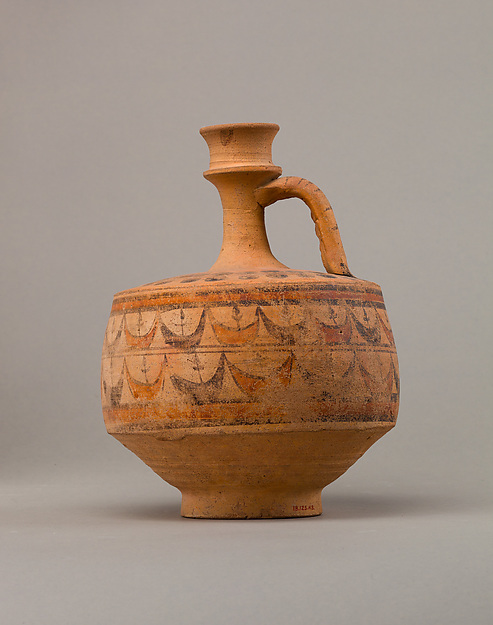
Rounded reddish pottery jar with a short neck, dark painted vines on the shoulder and a leafy band around the body

Painted ceramics · Sudan / Nubia

Jar with painted vines

Maker unrecorded · 270 BCE–320 CE

Dark vines and a leafy band decorate this rounded pottery jar from Faras in Nubia, in present-day Sudan. The Met dates it to the Meroitic period, 270 BCE–320 CE. Its maker is unrecorded. The museum identifies the photograph as public domain and makes it available through Open Access.

View artwork & source ↗ The Metropolitan Museum of Art · Gift of Oxford University Expedition to Nubia, 1926 · Object 26.4.68 · Public domain · CC0 · Met Open Access
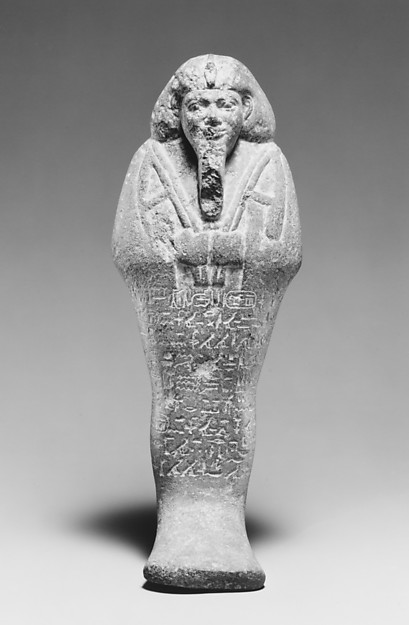
Grey stone funerary figure of Taharqo with crossed arms, a long beard and rows of hieroglyphs down the body

Funerary sculpture · Kush / Nubia

Shabti of Taharqo

Sculptor unrecorded · 690–664 BCE

This granite funerary figure represents the Kushite king Taharqo, who ruled in 690–664 BCE. The Met considers it probably from his pyramid at Nuri in Sudan; that findspot is not certain. Its sculptor is unrecorded. The museum makes this public-domain photograph available through Open Access.

View artwork & source ↗ The Metropolitan Museum of Art · Rogers Fund, 1918 · Object 18.2.10 · Public domain · CC0 · Met Open Access
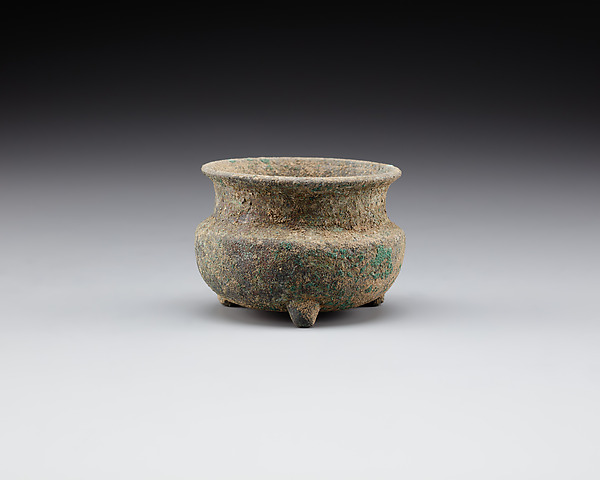
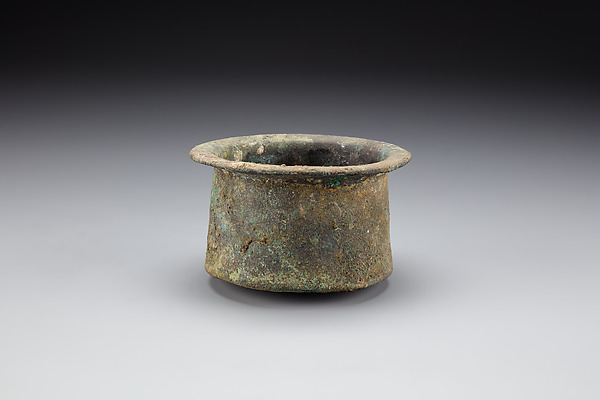
Small copper-alloy vessel with a flared rim, nearly straight sides and a mottled green-brown surface

Metalwork · Sudan / Nubia

Bowl (Faras, 26.4.108)

Maker unrecorded · 270 BCE–320 CE

This Meroitic copper-alloy bowl was excavated at Faras in Sudan, Cemetery 1, Grave 975. The museum records a diameter of 10.1 cm and height of 6.2 cm; its maker is unrecorded. The object number distinguishes it from the other Faras bowl in this collection.

View artwork & source ↗ The Metropolitan Museum of Art · Gift of Oxford University Expedition to Nubia, 1926 · Object 26.4.108 · Public domain · Met Open Access · Unmodified
Gold ram’s head with curved ribbed horns and a cobra above its forehead

Jewellery · Kush / Nubia

Ram’s-head amulet

Maker unrecorded · About 721–664 BCE

A small gold object from the Kushite period, when Nubian rulers governed Egypt. The Met suggests it probably belonged to a royal necklace and connects the ram with Amun. Its precise origin is uncertain: the museum lists Egypt and Sudan, possibly Nubia, rather than a confirmed Sudanese findspot.

View artwork & source ↗ The Metropolitan Museum of Art · Photograph by Oi-Cheong Lee · Gift of Norbert Schimmel Trust, 1989 · Public domain · Met Open Access · Unmodified
Nubian wall painting of the Virgin and Child beside Bishop Marianos in decorated ecclesiastical robes

Historical wall painting · Sudan / Nubia

Madonna and Child with Bishop Marianos

Painter unrecorded (Faras) · 1005–1036

Tempera on plaster from Faras, now in the National Museum in Warsaw. The source dates the painting to 1005–1036; this is the artwork date, not the photograph date. The individual painter is unrecorded.

View artwork & source ↗ National Museum in Warsaw · Photograph uploaded by Vert, Wikimedia Commons · Public domain · Unmodified reproduction
Nubian Christian wall painting depicting the three youths in the fiery furnace

Historical painting · Sudan / Nubia

Three youths in the fiery furnace — Nubian church painting

Painter unrecorded · Historical painting; photograph published 2005

A Nubian church painting photographed at the museum in Khartoum. The descriptive title identifies the scene from Daniel 3; the record does not name the original painter or date the artwork.

View artwork & source ↗ Wikimedia Commons · Photograph by Ibrahim Omer / ancientsudan.org · CC BY-SA 3.0 · Unmodified

Photo stream

Explore Sudan through the years.

Review/rotation:

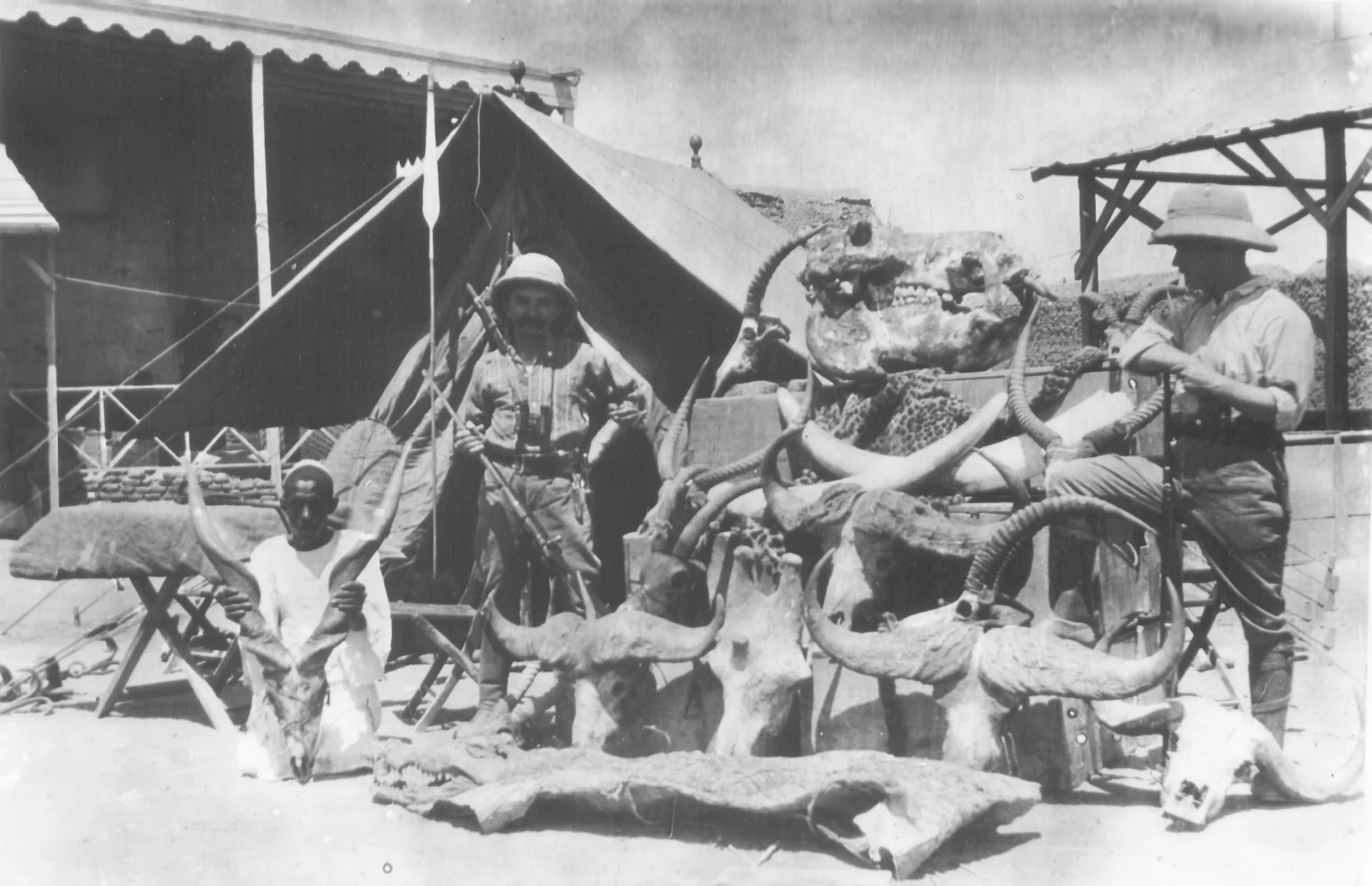
Historical group photograph beside a display of animal skulls, horns and skins in a courtyard.

Hunting trophies in a Khartoum courtyard, early twentieth century

A historical display of hunting trophies in a Khartoum courtyard, dated by the Náprstek Museum to the early twentieth century. The catalogue names Machulka and tentatively identifies Štorch, retaining a question mark; other people and the photographer are unnamed. The image documents historical hunting and collecting, not an endorsement of those practices. No precise capture year or species identification is asserted.

Photographer unknown; National Museum – Náprstek Museum, Bedřich Machulka photographic collection, Af I 808 · CC BY 4.0

Original source ↗
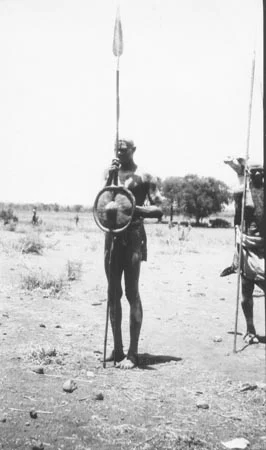
Historical black-and-white photograph of a standing man holding a round shield and spear, with another person partly visible.

Man holding a round shield and spear, 1927

The Náprstek Museum catalogue dates this photograph to 1927 and attributes its location to Kordofan, Sudan. The photographer and the subjects’ names are unrecorded. Its historical labels “Nubové” and “Bagirmi” have not been independently resolved and are not treated here as verified community identities or a precise location. Holding these objects does not establish the man's occupation or participation in combat.

Photographer unknown; National Museum – Náprstek Museum, E. St. Vráz photographic collection, Af I 2046 {K-07263} · CC BY 4.0

Original source ↗
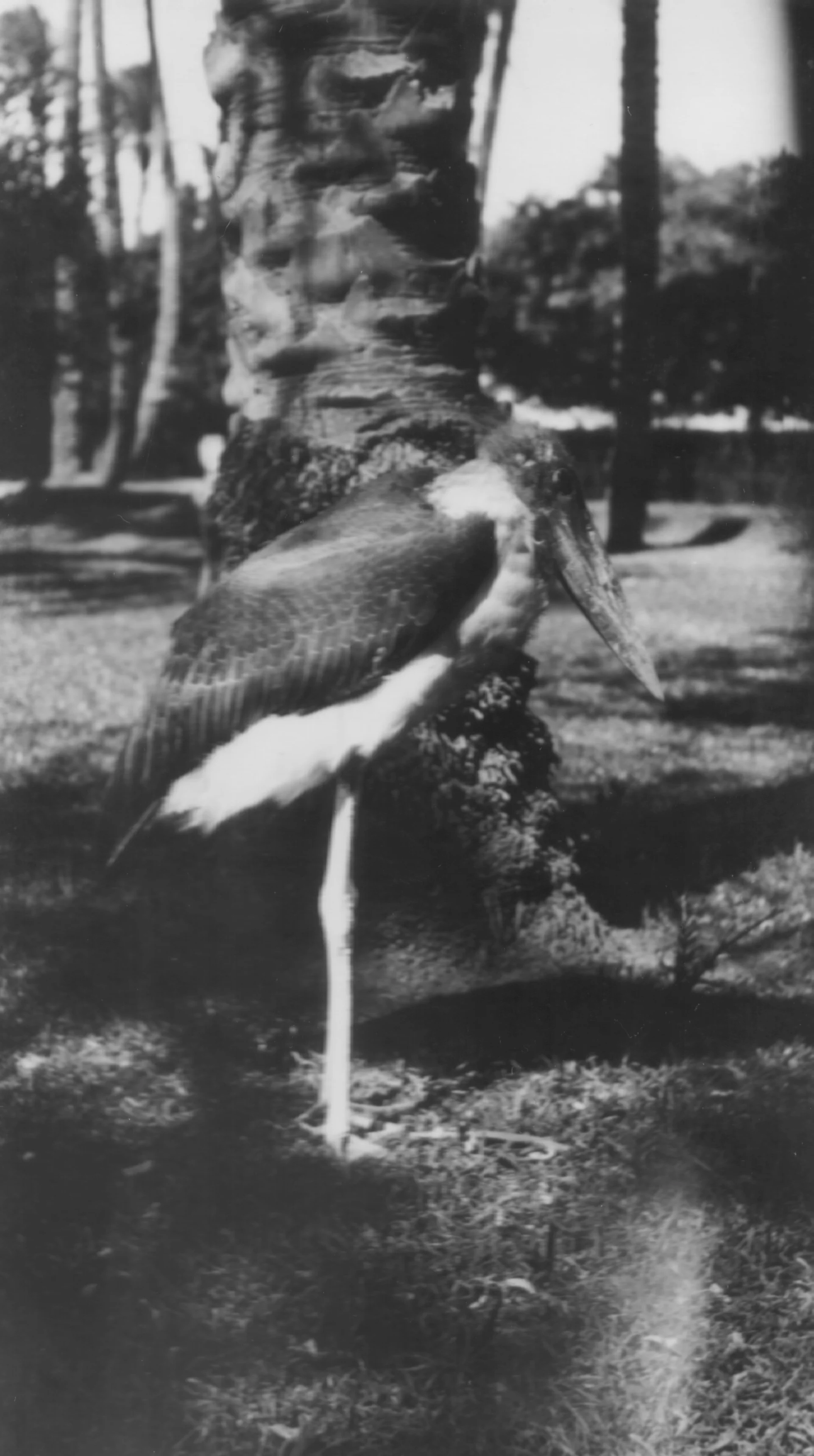
Black-and-white photograph of a large long-billed bird standing beside a palm trunk.

Marabou stork at Khartoum Zoo, 1920s

The Náprstek Museum identifies the bird as a marabou stork at Khartoum Zoo and dates the photograph to the 1920s. The photographer is unrecorded. This historical zoo image does not establish the bird's wild origin, present-day species distribution or the zoo's current condition.

Photographer unknown; National Museum – Náprstek Museum, Bedřich Machulka photographic collection, Af I 99 · CC BY 4.0

Original source ↗
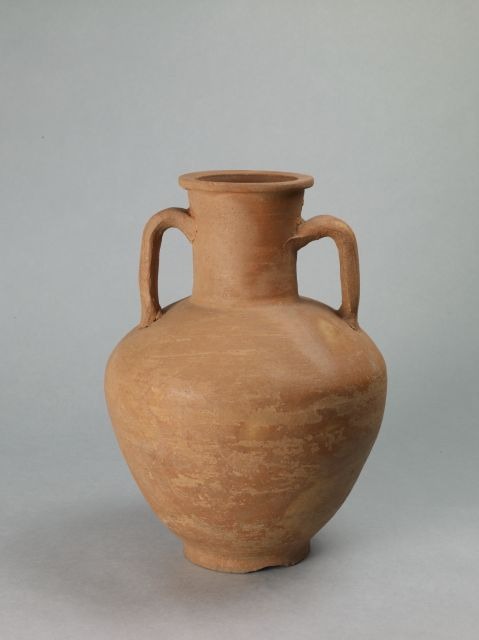
Red-brown ceramic amphora with two handles against a grey background.

Meroitic amphora from Nubia

A two-handled Meroitic amphora in the Finnish Heritage Agency collection (KM17000:39:116:2), catalogued broadly to 300 BCE–400 CE. The record associates it with Nubia but lists both Egypt and Sudan, so no precise modern-country findspot is asserted here. The maker and photographic date are unrecorded. This is a museum object photograph, not a view of present-day Sudan.

Finnish Heritage Agency, Archaeological Object Collection; photographer not named · CC BY 4.0

Original source ↗
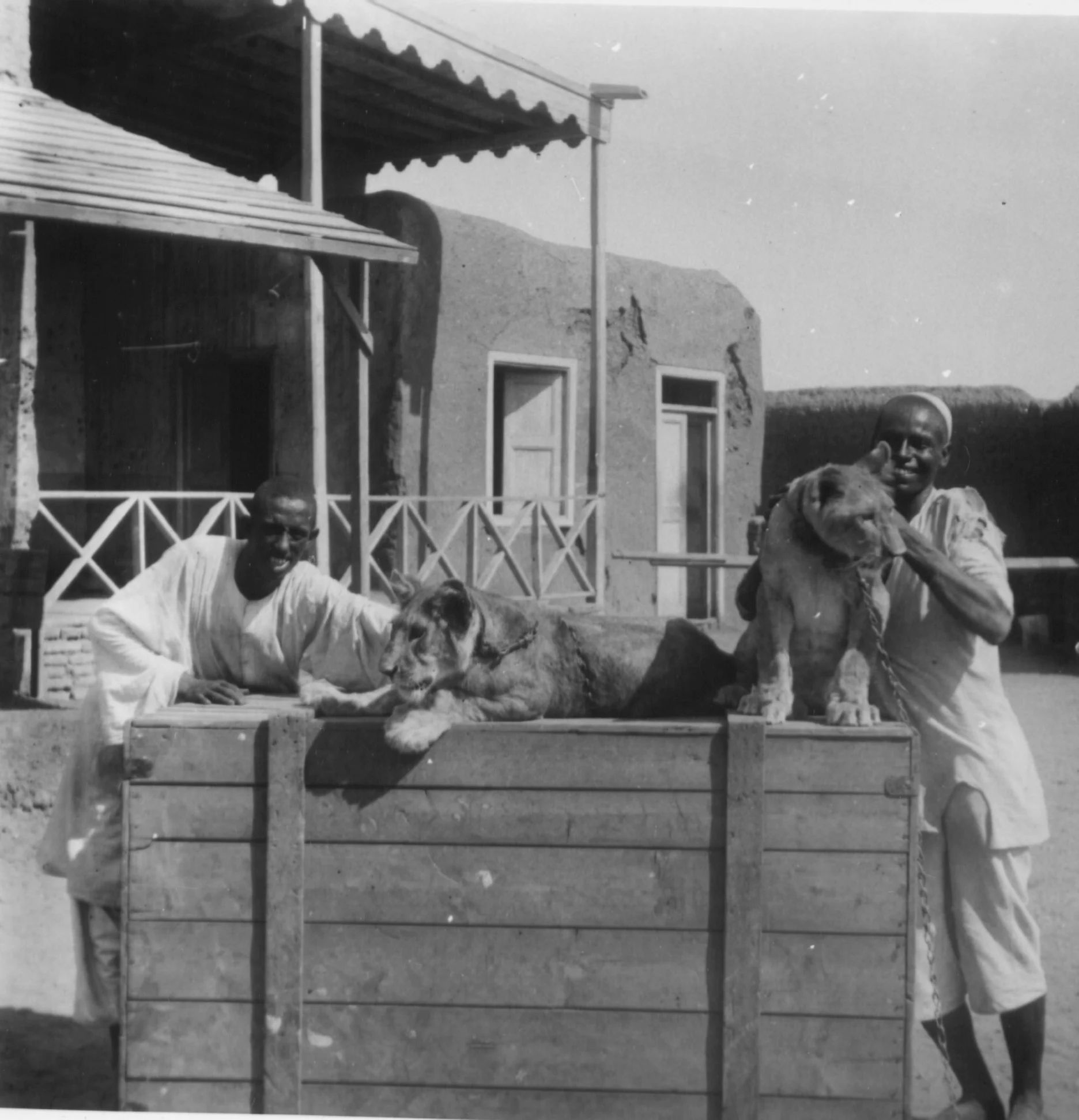
Two men beside lion cubs on a wooden crate in a courtyard.

Two men with lion cubs in Khartoum, 1911

The Náprstek Museum identifies this 1911 scene as Bedřich Machulka's assistants with lion cubs in the courtyard of his Khartoum home. The men and photographer are not named in the record. The photograph documents a historical captive-animal setting; it is not evidence of present-day wildlife conditions or an endorsement of keeping wild animals.

Photographer unknown; National Museum – Náprstek Museum, Bedřich Machulka photographic collection, Af I 629 · CC BY 4.0

Original source ↗
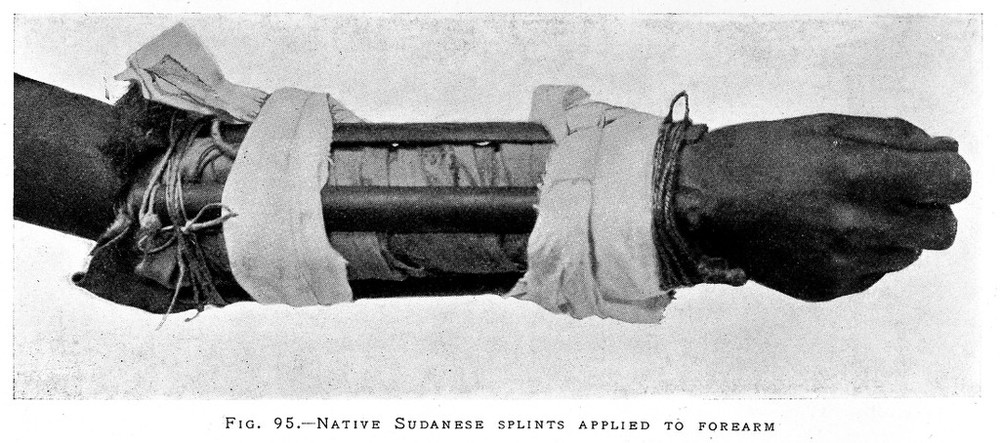
A forearm supported by wooden strips secured with bands.

A historical forearm splint, published in 1908

Wellcome identifies this as a reproduction of a photograph published in Robert Grenville Anderson’s 1908 book on medical practices in Kordofan. The individual photographer and exact capture date are not recorded. The image shows a forearm supported by a splint; it is historical documentation, not medical advice or evidence of treatment effectiveness. The image-level record M0005276 is licensed CC BY 4.0.

Photographer unrecorded / Wellcome Collection; reproduced in R. G. Anderson, 1908 · CC BY 4.0

Original source ↗
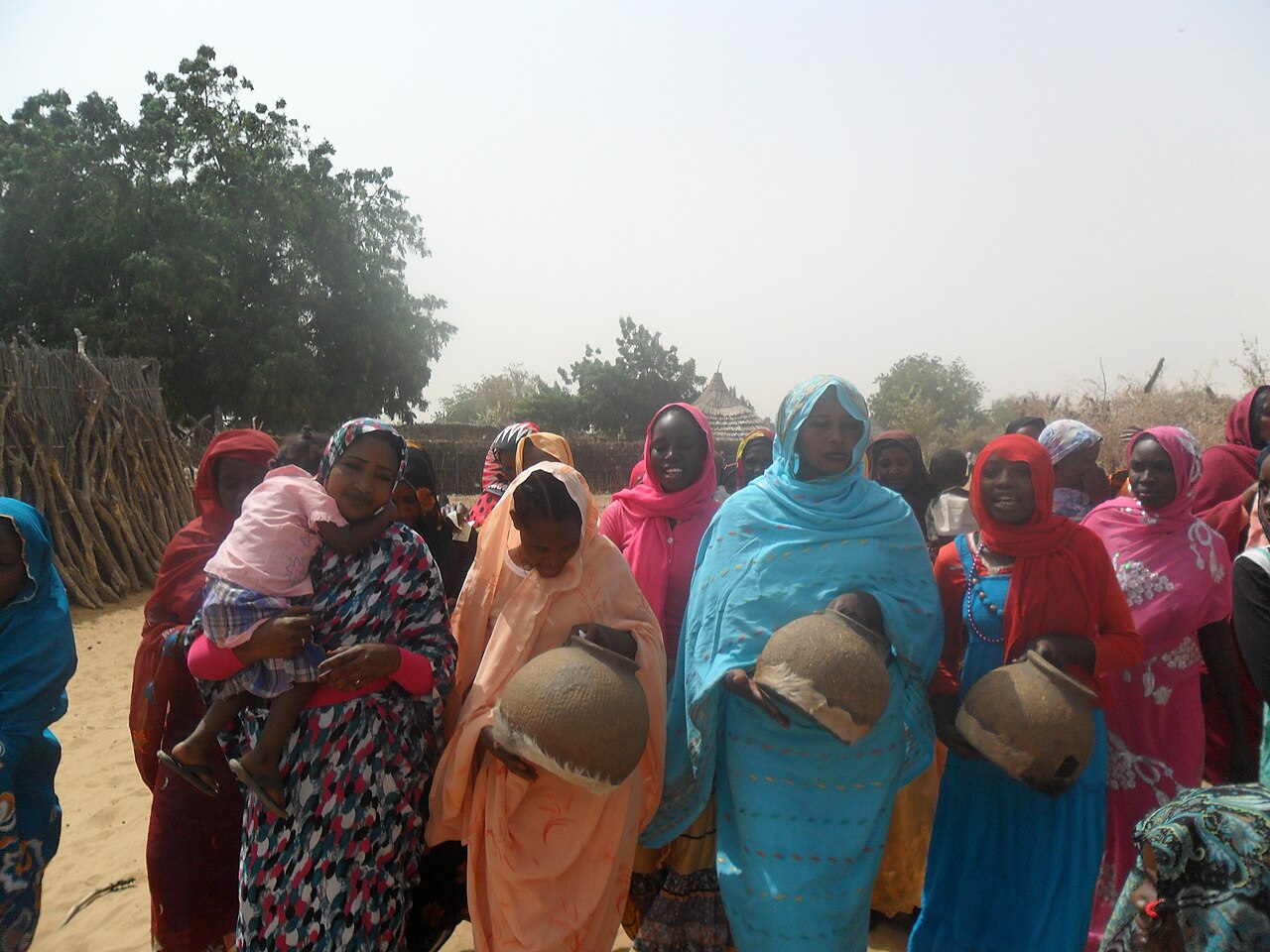
Women in colourful wraps at a gathering, several holding large rounded vessels.

A Sudanese wedding gathering, 2012

Rahma Abdalla identifies this photograph as a traditional Sudanese wedding and dates it to 20 March 2012. The photograph shows women gathered outdoors, several holding large rounded vessels. The source does not identify the village, participants or particular ritual. It illustrates one gathering, not a custom shared by every Sudanese community.

Rahma Abdalla · CC BY-SA 4.0

Original source ↗
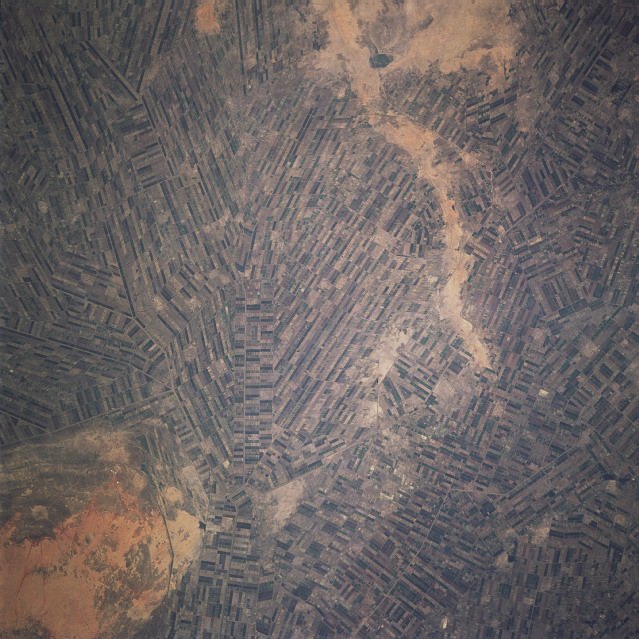
A geometric pattern of fields across the Gezira Plain.

Gezira’s fields from space, 1997

NASA’s photograph shows the field patterns of the Gezira Plain in November 1997. Its mission identifier is STS087-717-088. This is the original version, not the contrast-enhanced derivative made in 2013. It records a historical landscape, not current cultivation or irrigation performance.

NASA · Public domain

Original source ↗
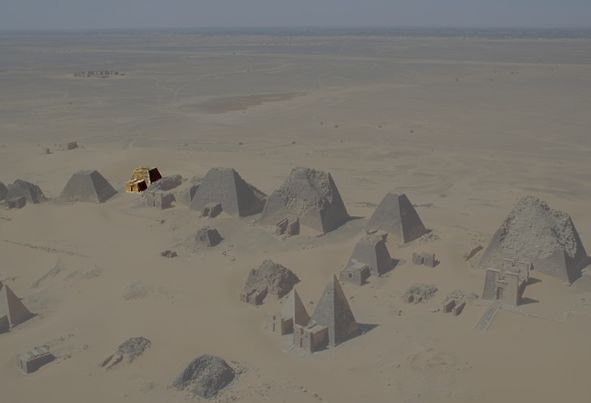
An aerial view of pyramids, darkened except for one highlighted structure.

Meroe from the air, with N5 highlighted, 2001

The full source page identifies B. N. Chagny as photographer and dates the aerial view to 2001. This is an annotated derivative: most of the scene has been darkened to highlight the structure labelled N5 by the source. It is not an unaltered documentary image. The source’s owner credit is retained as written; no new historical identification is inferred.

B. N. Chagny; source owner credit: Francis Geius / SFDAS mission; annotated derivative uploaded by Sven-steffen arndt · CC BY-SA 1.0

Original source ↗
A row of pyramids and chapel entrances across a sandy landscape.

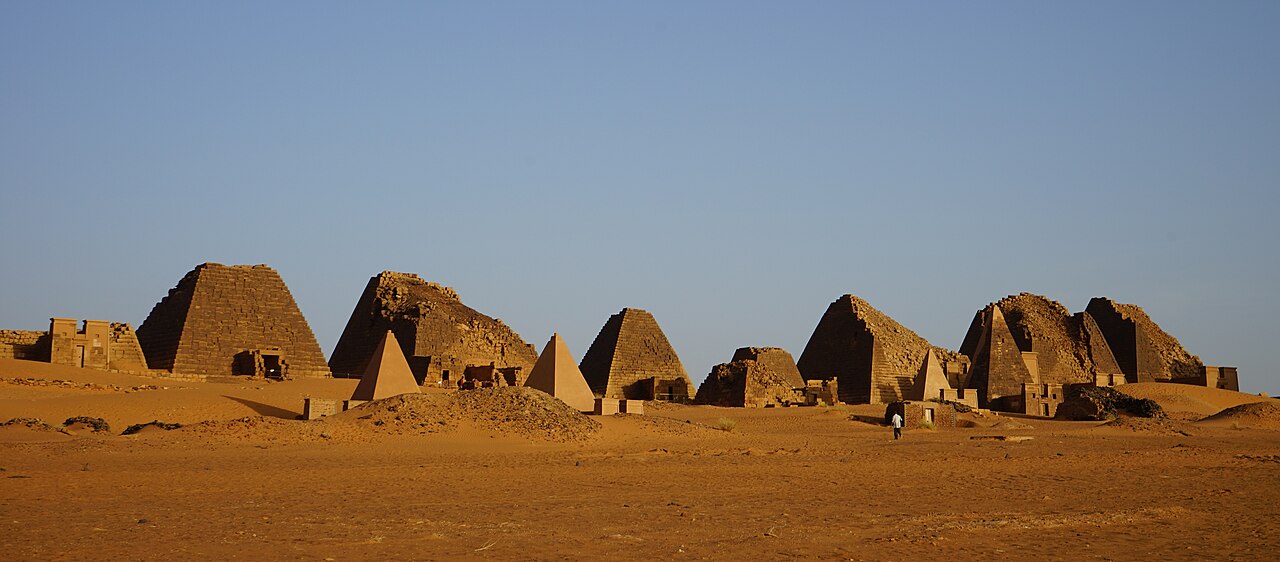
Meroe’s pyramids, 2016

Nina R photographed this view of the Meroe pyramids in Sudan on 27 March 2016. Pyramids of different surviving heights and their chapel entrances stretch across the sandy foreground. This is a dated view of the site, not evidence of its present condition or visitor access. Reproduced at a smaller display size without further alteration.

Nina R · CC BY 2.0

Original source ↗